Breakthroughs in Robot AI Are Cool — But Why Won't They Change Your Life Anytime Soon?

Humanoid robot demos are stunning, but the engineering and economic gap to mass deployment is far deeper than the videos suggest.
A collaborative analysis by MIT Technology Review and the Aventine foundation argues that while breakthroughs in humanoid robotics are genuine, public expectations for near-term deployment are far too high. Viral demo videos show peak performance under controlled conditions, not the messy reality of real-world environments. Scaling from "can do it" to "does it reliably" requires orders of magnitude more engineering effort, and unlike software AI, robots face long hardware iteration cycles, energy constraints, and safety validation timelines measured in years. Until manufacturing and operating costs fall below the human labor they replace, large-scale commercial deployment remains economically premature.
When Humanoid Robots Dance, What Are We Actually Watching?
Recently, a humanoid robot has been popping up across video feeds — white body, black head and torso. You've probably seen it dancing, doing backflips, or smoothly moving objects from one place to another. The footage is stunning, like science fiction bleeding into reality. Yet an analysis by MIT Technology Review, produced in collaboration with the nonprofit research foundation Aventine, offers a sobering reminder: breakthroughs in robot AI are genuinely exciting, but they won't meaningfully change the average person's daily life anytime soon.
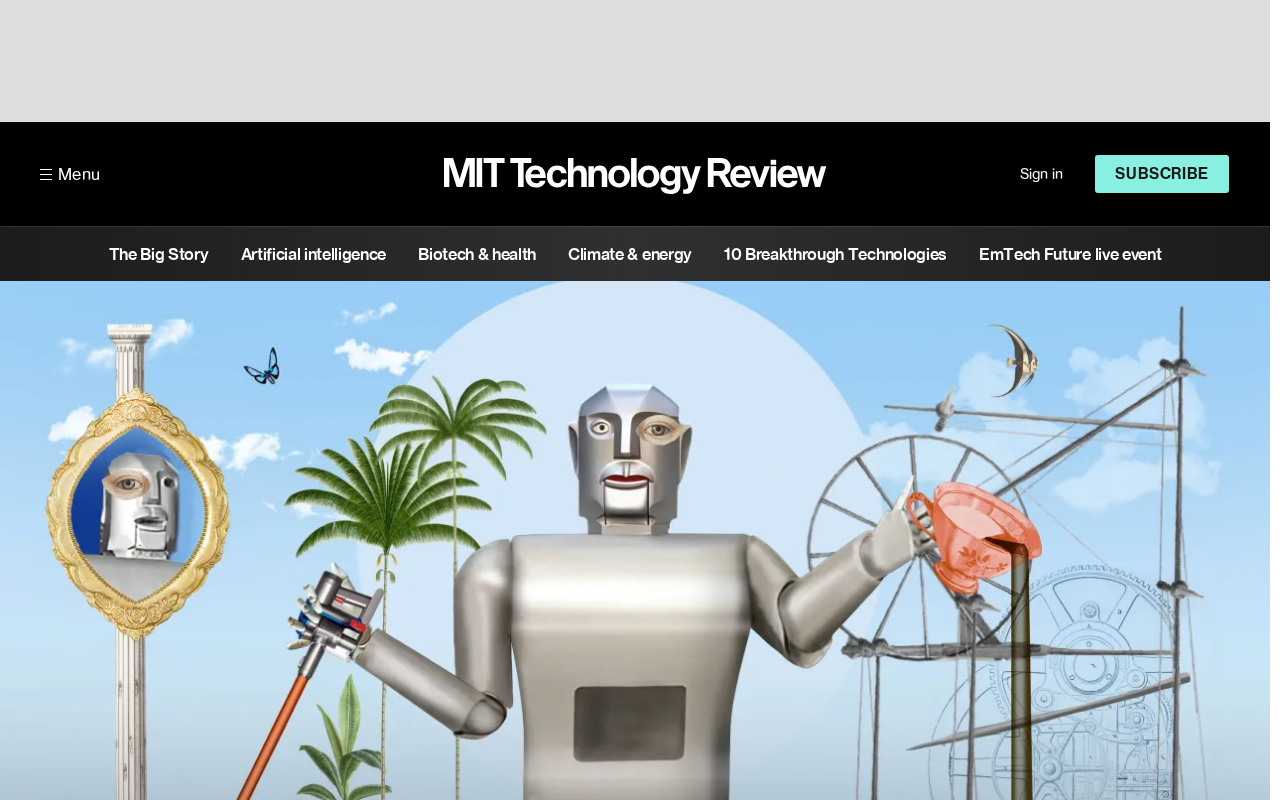
That gap — between what we see in demos and what it takes for robots to enter homes, factories, and streets at scale — is far wider than it appears.
A Dazzling Demo Is Not the Same as Real-World Deployment
Humanoid robots go viral because they're visually irresistible. A machine that moves and balances like a human taps into everything we've ever imagined about future technology. But carefully choreographed demo videos almost always showcase peak performance under optimal conditions.
The real world is full of uncertainty — shifting light, uneven surfaces, randomly placed objects, unpredictable human behavior. Variables that are meticulously controlled in a lab hit robot perception and decision-making systems all at once, continuously, in actual environments. The technical maturity required to nail a dance performance is nowhere near what's needed to reliably wash dishes in an unfamiliar kitchen.
The Distance Between "Can Do It" and "Does It Consistently"
Engineering has a brutal rule: getting a system to work 90% of the time might take relatively modest effort, but getting it to work reliably 99.9% of the time can require tens of times that investment. For robots, this means that the journey from a polished demo to a mass-produced product that runs safely, consistently, and cost-effectively over the long term requires clearing multiple hurdles: reliability, cost, energy consumption, and safety.
This principle is sometimes called the "last mile problem," or measured in nines of availability (like "five nines" — 99.999% uptime). Take the automotive industry as a reference: getting a prototype to complete a lap around a track isn't hard. But engineering a production vehicle to run for a decade without failure in conditions ranging from -40°C to high-altitude low-oxygen environments requires millions of miles of road testing, redundant design, and tight supply chain control. Most humanoid robots today are still in the "prototype stage." The demos from Boston Dynamics, Figure, Unitree, and others are impressive — but on key metrics like continuous operating hours, failure rates, and joint lifespan, these robots still fall well short of industrial production standards. This is precisely why timelines for products like Tesla's Optimus and Xiaomi's CyberOne keep slipping — not because breakthroughs aren't happening, but because reliability validation simply takes time.
Why the Near-Term Promise Is Hard to Deliver
The biggest difference between robots and pure software AI is that robots must continuously interact with the physical world. Software models can be iterated rapidly in the cloud, but robots require real hardware, real testing, real wear, and real maintenance. Every physical interaction carries a time cost and a risk of degradation.
Then there's the economics. Does the cost of manufacturing, maintaining, and deploying a humanoid robot capable of complex tasks actually come out lower than the human labor it replaces? In many scenarios, the answer is still no. There's a gap between technical feasibility and commercial viability that takes time to close.
Why Managing Expectations Matters
The core value of this kind of reporting isn't to dismiss progress in robotics — it's to encourage the public to hold realistic expectations about the pace of development. When inflated short-term expectations go unmet, the fallout can erode public confidence in an entire field and, ultimately, dampen long-term funding and research patience.
Real technological transformation tends to be gradual and unglamorous. It's more likely to begin at specific workstations in factories or logistics operations in warehouses — not by walking straight into every living room.
The challenge robots face when interacting with the physical world is known in academia as the "Reality Gap" — control strategies trained in simulation often degrade significantly when transferred to real hardware, because simulators can't perfectly replicate physical details like friction, material deformation, and sensor noise. To bridge this gap, researchers have developed techniques like Domain Randomization, which improves generalization by randomly perturbing simulation parameters during training — but it remains an open problem. Battery life is another underappreciated constraint: most humanoid robots today run for only one to two hours on a charge, with long recharge times, which poses a genuine barrier for industrial settings requiring continuous multi-shift operation. Every hardware iteration means new procurement and new testing cycles, with development timelines measured in years — a stark contrast to software AI, which can ship updates every few weeks.
A Rational View of Robotics' Future
Breakthroughs in robot AI are real, and the long-term outlook is worth being excited about. But technological maturity takes time, commercial deployment requires economic logic, and social acceptance is its own process. Those jaw-dropping demo videos are genuine snapshots of research progress — they're just not trailers for the daily life that's right around the corner.
For readers following this space, the more grounded posture is this: be excited about the breakthroughs, and also understand the long engineering road between a breakthrough and widespread adoption. Robots will eventually change our lives — but that "eventually" is probably further away than the videos make it look.
Related articles

Workbuddy for Absolute Beginners: How a Desktop AI Agent Fits Into Real Workflows
A beginner's guide to the Workbuddy desktop AI agent: installation, claiming credits, file management, and building automated workflows—compared with CodeX for fit and cost, helping professionals shift from AI question-askers to AI managers.

OpenAI's New Agent Stack: Computer Use, Decisions API, and Ultra-Fast Workflows
OpenAI Dev Day unveiled a new agent stack: Computer Use outperforms humans, Decisions API delivers ultra-low-latency classification via Luna, Agents API opens the same Computer Use capabilities, and GPT-6.1 Sol costs only one-seventh of Astra. Core updates, benchmark data, and developer insights.

Liang Wenfeng Open-Sources DeepInfo Inference Framework, Takes On U.S. Ban
DeepSeek open-sources its DeepInfo inference framework after its models, featuring GPU/CPU cross-pipelining, small-model prediction with large-model verification, and full Huawei Ascend and NVIDIA chip support—facing the U.S. federal ban head-on. This article analyzes its significance for AI deployment and open-source strategy.