Brian Chesky: AI Agents Need Their Own Operating System

Airbnb CEO Chesky calls for an AI-native OS to support the shift from human to machine users.
Airbnb CEO Brian Chesky argues that as AI agents take over tasks like booking and price comparison, the existing software ecosystem needs a fundamental rebuild — not just agent-friendly platform interfaces, but an AI-native operating system designed for machine agents to handle authentication, permissions, and task orchestration. He contends the real bottleneck in consumer AI isn't model capability, but lagging ecosystem infrastructure. For two-sided platforms like Airbnb, getting ahead on agent-ready interfaces is both a defensive move and a strategic bet on the next wave of growth.
Why the CEO of Airbnb Is Talking About AI Operating Systems
Airbnb co-founder and CEO Brian Chesky recently shared a forward-looking take in an interview: AI agents need their own dedicated operating system. This isn't just speculation — as large language models grow more capable, a growing number of tasks are shifting from direct human operation to autonomous AI execution. Yet nearly all existing software infrastructure was designed for human users, with little thought given to how machine agents interact with the world.
Chesky, a seasoned operator of consumer products, offers a perspective worth paying attention to. Airbnb is fundamentally a two-sided platform connecting hosts and guests, with its core competency rooted in understanding and matching complex human needs. As AI agents begin taking over tasks like booking, price comparison, and itinerary planning, how platforms adapt to this new type of "user" has become an unavoidable practical question.
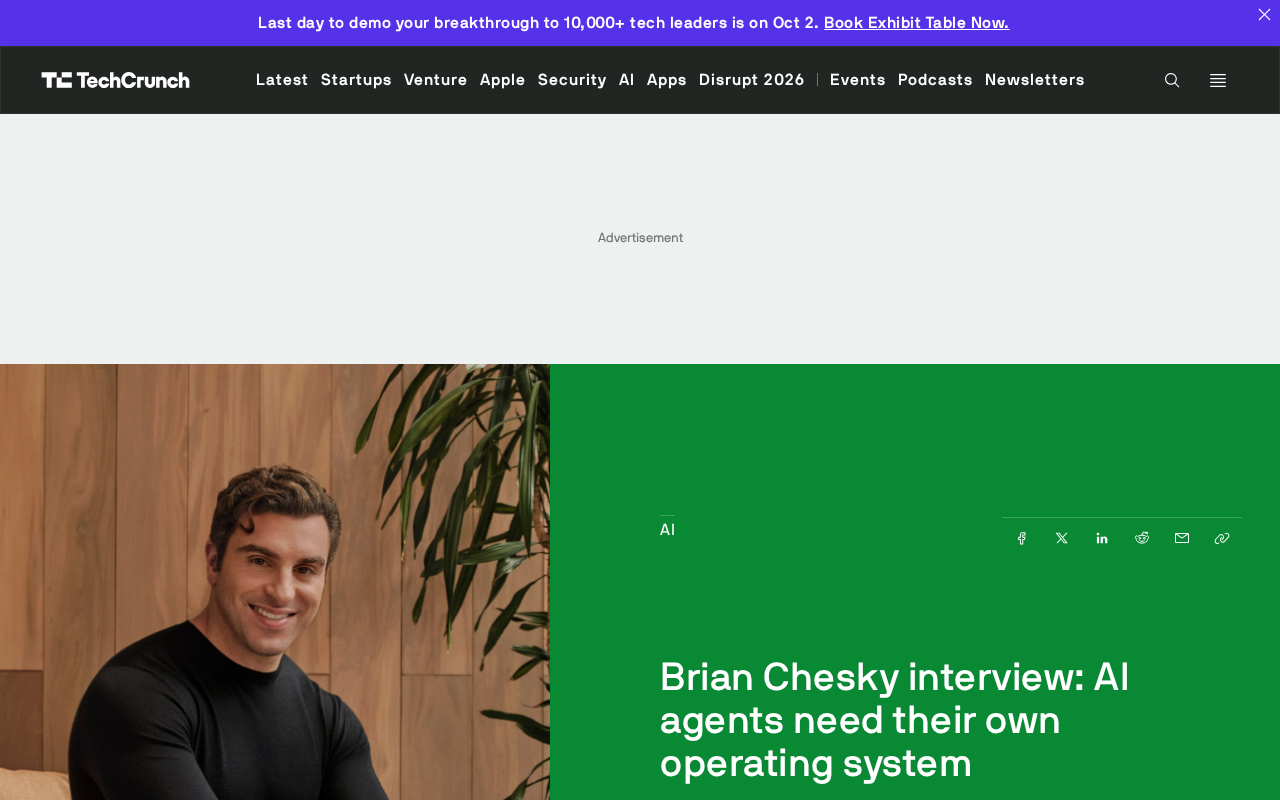
What It Means to Make Airbnb "Agent-Friendly"
In the interview, Chesky discussed what it would take to make Airbnb truly "agent-friendly." This points to a fundamental shift: platform interfaces have always been designed for human eyes and hands — buttons, images, dropdown menus, payment flows — all built on the assumption that the operator can see, click, and think.
AI agents interact with the world in an entirely different way. They're far better suited to completing tasks through structured data, API calls, and well-defined semantic interfaces than by simulating human click behavior on visual UIs. If a booking platform wants to be efficiently invoked by AI agents, it needs to rethink what capabilities it exposes to machines and how.
This means platforms may need to offer dedicated agent channels — letting AI query listings, understand pricing strategies, confirm availability, and complete transactions without awkwardly "pretending" to be a human navigating a webpage. For the broader consumer internet, this represents a fundamental infrastructure rebuild aimed at machine users.
The industry has already seen several interaction protocols designed specifically for AI agents. Anthropic's MCP (Model Context Protocol), launched in late 2024, is a leading example — it defines a standardized interface spec that lets AI models invoke external tools, read data sources, and execute operations in a unified way, without building a custom adapter for every platform. Similarly, Google DeepMind's Agent-to-Agent (A2A) protocol goes further, focusing on communication and collaboration between multiple agents. The emergence of these protocols confirms that the need Chesky describes has moved from concept to engineering reality. For platform businesses, adopting standard protocols like these offers more ecosystem value than building proprietary agent interfaces from scratch — much like how websites once chose to support OAuth for unified login rather than maintaining siloed account systems.
Why the World Needs an AI-Native Operating System
Chesky's central argument is that the world needs an "AI-native" operating system. The operating systems we use today — whether desktop platforms like Windows and macOS, or mobile ones like iOS and Android — were all built around the paradigm of human-computer interaction. Their core job is to surface computing power to humans through graphical interfaces.
An AI-native operating system, by contrast, would be designed from the ground up around how agents schedule resources, collaborate with one another, and safely execute actions on behalf of users. Such a system would need to address a whole new set of problems: identity and authentication, permission management, task orchestration, and inter-agent communication. As large numbers of AI agents simultaneously navigate across services to execute tasks, the absence of a unified coordination layer will lead to chaos and inefficiency.
From this angle, Chesky is putting his finger on a real bottleneck in consumer AI development: model capabilities are advancing rapidly, but the infrastructure to support those capabilities is lagging behind. Without a standardized agent interaction layer, every platform has to adapt to AI independently, making it nearly impossible for the ecosystem to develop any real coherence.
It's worth clarifying what "operating system" means in an AI context, since it diverges from the traditional definition. Conventional operating systems (like Linux or Windows) manage hardware resources — CPU, memory, storage — and provide standardized interfaces for applications above them. The "AI-native operating system" Chesky envisions manages something different: the action capabilities and permission boundaries of agents — which agent can act on behalf of which user, on which service, to perform what operations, and how those actions can be audited or rolled back. This is fundamentally an identity and authorization orchestration layer, layered with task scheduling and cross-service state management. The closest existing products to this vision include OpenAI's Operator, Microsoft's Copilot Studio, and agent orchestration frameworks from startups like Dust and LangChain. But no single player has yet established a true operating-system-level standard on the consumer side — which is exactly why Chesky believes the window of opportunity remains open.
The State and Challenges of Consumer AI
Chesky also addressed the broader state of consumer AI. Despite the enormous hype surrounding generative AI over the past year or so, truly killer consumer applications that change everyday users' lives remain limited. Most breakthroughs have centered on conversational assistants and content generation. Getting AI to actually "do things for users" — like autonomously completing an entire travel booking — still runs into multiple barriers: trust, reliability, and interface compatibility.
This is precisely where Chesky's perspective adds value. For consumer AI to mature, stronger models alone won't be enough. It also requires ecosystem-level support: platforms willing to open their capabilities to agents, users willing to trust agents to make decisions on their behalf, and operating-system-level infrastructure to coordinate all of it.
For platform businesses, getting ahead of the curve by building agent-friendly interfaces could become a critical competitive differentiator. As users increasingly prefer to "have AI book it for me" rather than "open the app and book it myself," services that aren't ready for machine users risk being quietly bypassed by the agent decision chain.
The "trust problem" facing AI agents in consumer scenarios has concrete technical roots. Current mainstream large language models suffer from hallucination — generating plausible-sounding but incorrect outputs when uncertain. This is tolerable in content generation, but the stakes are completely different when an agent is booking flights, transferring funds, or signing contracts. There's also the significant challenge of error compounding across multi-step tasks: a 90% accuracy rate per step means that after 10 consecutive steps, the overall success rate can fall below 35%. This explains why most consumer AI assistants today remain in "suggest" mode rather than "execute" mode. Breaking through this ceiling requires not just more reliable models, but platform-side technical guarantees — reversible actions, auditable execution — which is precisely the responsibility Chesky argues the infrastructure layer must take on.
Closing: A Paradigm Shift Toward Machine Users
Chesky's remarks reflect a broader shift in how industry leaders are thinking about the next phase of the AI wave — moving from "model competition" to "ecosystem reconstruction." The history of operating systems consistently shows that whoever defines the interaction paradigm and underlying standards ends up holding platform power. If AI agents truly become one of the internet's primary "users," building a native operating system for them could well be the next fiercely contested territory.
For platforms like Airbnb, proactively embracing agent-friendly design is both a defensive survival strategy and a forward-looking growth opportunity. The impact of this transformation will reach far beyond any single industry.
Related articles

ChatGPT Space Launches: Team Collaboration and New Pages Features Explained
ChatGPT Space is OpenAI's new team collaboration feature with Pages, real-time collaboration, and Slack/Google Drive sync. We break down its privacy design, multi-platform integration, and the full workflow from conversation to document.

Migrating Apache Spark UDFs to GPU Acceleration with AI Agents
NVIDIA developer blog explains how AI Agents rewrite Apache Spark UDFs for GPU acceleration, covering migration criteria, agent rewriting and verification workflows, plus pitfalls like result consistency and CPU-GPU transfer overhead.

Zed Editor v0.40.4-rc2 Released: Usage Credits Now Available Without Upgrading
Zed editor releases v0.40.4-rc2, allowing users to use usage credits for AI features without upgrading to a paid plan, lowering the trial barrier.