BridgeTwist: Training-Free Conditional Sampling Revolutionizes Schrödinger Bridge Models

BridgeTwist proposes the first training-free conditional sampler for pretrained Schrödinger Bridge models, with strong multi-task performance.
BridgeTwist is the first training-free conditional sampler for pretrained Schrödinger Bridge (SB) models, filling a gap in this area. Its core method is tempered twisted sequential Monte Carlo: it constructs a closed-form twisted proxy using the velocity and score fields exposed by SB pretraining, avoiding extra training; employs time-varying exponential tempering that is conservative early and aggressive later; and designs a bridge-shaped inference diffusion schedule with telescoping importance weights, making the sampler asymptotically exact for the posterior. Experiments show BridgeTwist surpasses existing training-free baselines on class-conditional generation and text-prompted image generation, and is competitive with specialized solvers on inverse problems such as inpainting, deblurring, and super-resolution. This work brings SB models on par with diffusion and flow models in training-free conditional sampling, lowering the barrier to conditional generation.
BridgeTwist: Training-Free Conditional Sampling Revolutionizes Schrödinger Bridge Models
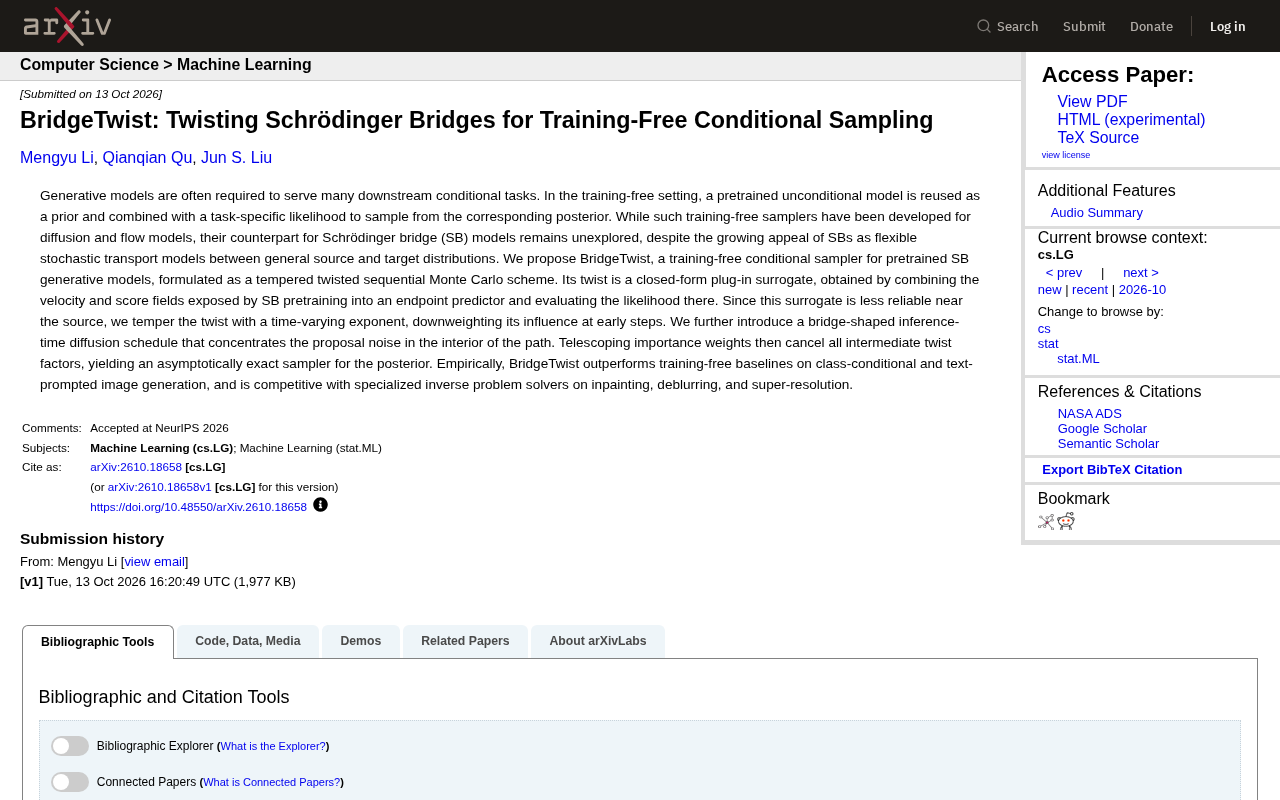
Generative models are increasingly taking on various downstream conditional generation tasks. In training-free settings, researchers typically reuse a pretrained unconditional model as a prior, combine it with task-specific likelihood functions, and sample from the posterior distribution. Diffusion models and flow models already have corresponding training-free samplers, but Schrödinger Bridge (SB) models—a flexible stochastic transport model capable of building bridges between general source and target distributions—have long lacked a training-free conditional sampling scheme. The latest research, BridgeTwist, fills this gap by providing a training-free conditional sampler for pretrained SB models.
Why Schrödinger Bridges Need Training-Free Sampling
A Schrödinger Bridge describes the most likely stochastic evolution path given a source distribution and a target distribution. Unlike diffusion models that generate unidirectionally from noise to data, SB can establish transport between any two distributions, making it attractive for tasks such as image translation and domain adaptation.
However, the practical demands of conditional generation vary endlessly: today it's class-conditional generation, tomorrow it's image inpainting, and the day after it might be super-resolution. If every task required retraining a conditional model, the computational cost and data requirements would be prohibitive. Training-free sampling is precisely the key path to solving this pain point—using a single pretrained model to handle multiple conditional tasks.
Previously, diffusion models had training-free samplers like DPS and ΠGDM, and flow models had corresponding schemes as well. Although SB models have a more general theoretical framework, they lacked a corresponding training-free conditional sampling method. The emergence of BridgeTwist finally gives SB models their own training-free conditional sampling tool.
Training-free conditional sampling in diffusion models and flow models is important background for understanding BridgeTwist's positioning. The term "training-free" refers to not retraining a conditional model, but instead reusing a pretrained unconditional generative model together with task-specific likelihood functions to sample from the posterior distribution $p(x_0|y) \propto p(x_0)p(y|x_0)$. On the diffusion model side, DPS (Diffusion Posterior Sampling) uses the current estimate of $x_0$ at each denoising step to compute likelihood gradients for correcting the sampling trajectory; ΠGDM (Pseudoinverse-Guided Diffusion Model) approaches the problem from an inverse problem perspective, using pseudoinverse guidance for sampling. On the flow model side, researchers achieve similar effects through Bayesian corrections of continuous-time ODEs. These methods share a common idea: leveraging the score field or velocity field already learned by the pretrained model, combined with likelihood gradients for guidance, without retraining. What makes SB models unique is that they model stochastic transport between any two distributions, with their velocity and score fields simultaneously characterizing information from both ends of the path. This provides richer information for training-free sampling while also introducing new technical challenges—how to correctly utilize these fields for posterior sampling without retraining is precisely the problem BridgeTwist aims to solve.
Core Method: Twisted Sequential Monte Carlo
At the heart of BridgeTwist is a tempered twisted sequential Monte Carlo scheme. The name sounds complex, but breaking it down reveals a clear line of thinking.
Closed-Form Twisted Proxy
In traditional sequential Monte Carlo, the twist function is used to guide particles toward high-likelihood regions, but the exact twist function is usually difficult to compute. BridgeTwist's cleverness lies in constructing a closed-form plugin proxy: using the velocity field and score field exposed during SB pretraining, it combines them into an endpoint predictor, then evaluates the likelihood at that endpoint.
This proxy requires no additional training—it is obtained "for free" directly from the pretrained model. It essentially tells the sampler: following the current velocity and score fields, where will the particle approximately land, and what is the likelihood value there?
Velocity field and score field are key concepts for understanding how BridgeTwist constructs the twisted proxy. In a Schrödinger Bridge model, the velocity field $v(x,t)$ describes the deterministic drift direction of a particle at time $t$, while the score field $\nabla_x \log p_t(x)$ describes the gradient direction of the probability density. The two are related through the continuity equation or the Fokker-Planck equation. For SB models, these two fields simultaneously encode transport information from the source distribution to the target distribution. BridgeTwist's core insight is that given the current state and these two fields, an endpoint predictor can be constructed to estimate where the particle will ultimately arrive. Specifically, the velocity field can be used to extrapolate along the deterministic trajectory, while the score field can correct for uncertainty introduced by stochastic diffusion; combining the two yields an estimate of the endpoint $x_T$. Then, evaluating the likelihood function $p(y|x_T)$ at the estimated endpoint gives the value of the twisted proxy. The closed-form nature of this proxy means low computational cost, and it comes entirely from the pretrained model without any additional training. The reliability of endpoint prediction varies with time—predictions are most accurate in the middle of the path where information is richest, and deviate more near the source distribution due to lack of target-end information, which is precisely why tempering is needed.
Time-Varying Exponential Tempering
Using this proxy directly has a problem: in regions close to the source distribution, the reliability of endpoint prediction is low. BridgeTwist's strategy is to introduce a time-varying exponent to temper the twist term—reducing the influence of the twist early in sampling and gradually strengthening it as the process advances.
This "conservative first, aggressive later" strategy is intuitive: in the initial stage, information is insufficient, and excessive intervention may introduce bias; in the later stage, predictions become increasingly accurate, and only then can strengthened guidance effectively push toward the target posterior.
Bridge-Shaped Inference Diffusion Schedule
The research team also designed a bridge-shaped inference-time diffusion schedule, concentrating proposal noise in the interior region of the path. Combined with telescoping importance weights, all intermediate twist factors cancel out layer by layer, ultimately yielding a sampler that is asymptotically exact for the posterior distribution.
This means BridgeTwist is not only practical but also has theoretical guarantees—as the number of particles increases, the sampling results converge to the true posterior.
Sequential Monte Carlo and twist functions are the foundational tools of the BridgeTwist method and warrant further elaboration. Sequential Monte Carlo (SMC) is a class of sampling methods that approximates complex distributions through a set of weighted particles. Its basic procedure is: sample several particles from an initial distribution, gradually evolve them through a series of intermediate distributions, resample particles at each step based on importance weights, and ultimately approximate the target distribution. The twist function plays a key role in SMC—it is essentially a value function over the current state and remaining steps, used to foresee future likelihood contributions, thereby guiding particles toward high-likelihood regions and reducing weight degeneracy. Ideally, an exact twist function enables the sampler to converge efficiently, but in practice computing the exact twist function is often infeasible and typically requires approximation. BridgeTwist's innovation lies precisely here: it leverages the velocity and score fields naturally exposed by the SB pretrained model to construct a closed-form twisted proxy, avoiding additional training or complex numerical approximations. Furthermore, "tempering" is a commonly used technique in SMC, where a temperature parameter is introduced to gradually "heat" or "cool" intermediate distributions, alleviating sampling difficulties caused by large distribution discrepancies. BridgeTwist combines this with a time variable to form a time-varying exponential tempering strategy.
Telescoping importance weights are the key technical means by which BridgeTwist achieves asymptotic exactness. In standard SMC, each particle maintains an importance weight to correct the discrepancy between the proposal distribution and the target distribution. As the number of steps increases, weights may degenerate (a few particles dominating the vast majority of weight), leading to increased estimation variance. BridgeTwist exploits the special structure of the SB path—where source-end and target-end information converge in the path interior—to design telescoping weight updates: the twist factor introduced at each step is progressively canceled in subsequent steps. This "telescoping" structure is analogous to cancellation of terms in mathematics, ensuring that approximation errors introduced at intermediate steps do not accumulate, and the final weight depends only on quantities at the two endpoints. Combined with the bridge-shaped inference-time diffusion schedule—which concentrates proposal noise in the path interior rather than at the endpoints—the sampler is theoretically asymptotically exact for the posterior distribution: as the number of particles tends to infinity, the sampling distribution converges to the true posterior. This provides BridgeTwist with theoretical guarantees beyond purely heuristic methods, and is an important feature distinguishing it from many training-free samplers that rely on approximate guidance.
Experimental Results: Strong Performance Across Multiple Tasks
BridgeTwist was validated on multiple conditional generation tasks.
In class-conditional image generation and text-prompted image generation tasks, BridgeTwist surpasses existing training-free baseline methods. These two tasks represent two major typical scenarios of conditional generation: discrete label control and natural language control.
In inverse problem solving, including image inpainting, deblurring, and super-resolution, BridgeTwist is competitive with solvers specifically designed for inverse problems. These tasks typically have stronger physical constraints, and performing on par in such tasks demonstrates BridgeTwist's excellent generality.
Significance for the Generative Model Ecosystem
BridgeTwist's value lies not only in the proposal of a single method, but more importantly in filling the gap in SB models' training-free conditional sampling.
From a research landscape perspective, diffusion models, flow models, and SB models are the three mainstream frameworks in current generative modeling. The first two have rich research on training-free conditional sampling, while SB models had been absent. BridgeTwist brings all three to the same starting line in this dimension.
From an application perspective, training-free means a lower barrier to use. Researchers and developers can use a single pretrained SB model and adapt it to multiple conditional tasks through BridgeTwist, without having to train a separate model for each task. This is especially practical in scenarios with limited computational resources or rapid task iteration.
Of course, BridgeTwist is still in the research stage, and its performance in actual large-scale deployment, robustness to different SB pretraining qualities, and other issues remain to be further validated. But as the first systematic scheme for training-free conditional sampling of SB models, it lays an important foundation for subsequent research in this direction.
Paper title: BridgeTwist: Twisting Schrödinger Bridges for Training-Free Conditional Sampling
Related articles

OpenAI Cracks Math Problems, Why Are Mathematicians Losing Sleep?
OpenAI claims to solve math problems — why are mathematicians anxious? Vergecast reveals the Eye of Sauron dilemma and the tension between AI answers and human understanding.

CSS Conditional Border-Radius Trick: Auto-Square Corners When Elements Touch the Edge
Pure CSS conditional border-radius: auto-square corners when elements touch the edge, rounded while floating. Use calc(100vw-100%) with clamp() to kill the transition band, and container query units cqi for non-fullscreen containers, plus a scrollbar offset workaround.

Google TimesFM 3.0 Hands-On: Is Zero-Shot Forecasting Good Enough?
Hands-on test of Google TimesFM 3.0: zero-shot error cut by ~25% with second-level results, but the two versions give opposite answers in business what-if planning. A deep dive into model internals, version differences, and four key production limitations.