Bright Data Review: Free Credits, AI Agent MCP Server, and Pricing

Bright Data provides scraping APIs and an open-source MCP server to connect AI assistants to the live web, with 5,000 free credits per month and compliance risk borne by the user.
Bright Data provides infrastructure for public web data collection, including proxies, scraping APIs, ready-made datasets, and an MCP server that lets AI assistants read the live web. New accounts get 5,000 free credits per month with no credit card required; the Scraping API and MCP server share the same credit pool, and unused credits do not roll over. Under pay-as-you-go pricing, Web Unlocker, SERP, and Web Scraper API cost $1.50 per 1,000 successful requests or records; residential proxies are $8 per GB; scale plans start at $499 per month. The MCP server is open source and supports local NPM or remote connections; once integrated into clients such as Cloud and Cursor, tools like search and scrape-to-Markdown become available. Bright Data states it only collects public data, but the legality of scraping depends on the target website's terms, the data type, and the jurisdiction—the risk is borne by the user. This solution is suitable for teams that need to quickly validate a concept for providing AI agents with real-time web access.
Bright Data provides infrastructure for public web data collection, including proxies, scraping APIs, ready-made datasets, and an MCP server that lets AI assistants read the live web. For developers looking to connect real-time web data capabilities to AI agents, this offers a ready-made path.
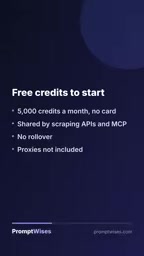
Free Credits and Pricing Model
New accounts get 5,000 free credits per month with no credit card required. These credits are shared between the Scraping API and the MCP server in a single pool, and unused credits do not roll over to the next month.
Under pay-as-you-go pricing, Web Unlocker, SERP, and Web Scraper API cost $1.50 per 1,000 successful requests or records. Residential proxies are listed at $8 per GB, with scale plans starting at $499 per month.
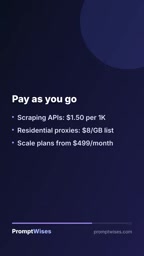
This pricing structure suits everything from experimentation to medium-scale collection needs. The free credits are enough to test basic functionality, but production environments require evaluating costs based on request volume.
Web Unlocker is a core Bright Data service specifically designed to bypass anti-scraping mechanisms on target websites (such as CAPTCHAs, IP bans, and JavaScript rendering), ensuring that scraping requests successfully return content. It automatically handles proxy rotation, header spoofing, and browser fingerprint simulation, so developers only need to send the target URL to get the page HTML. SERP API is used to scrape search engine results pages (such as Google and Bing) and returns structured search result data, suitable for SEO monitoring, competitive analysis, and similar scenarios. Web Scraper API provides pre-configured scraping templates for specific websites, outputting structured data (such as JSON) without the need to parse pages yourself. All three are billed per successful request or record at $1.50 per 1,000.
MCP Server: Connecting AI Assistants to the Live Web
Bright Data's MCP server is open source. You can add it to Cloud, Cursor, or other clients, and it supports running locally via NPM or connecting remotely. Once configured, tools such as search and scrape-to-Markdown become available.
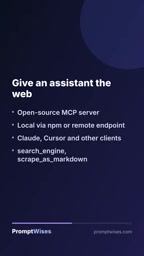
This means AI assistants can directly call these tools to retrieve web content, which is returned in Markdown format for easier downstream processing. The open-source nature lowers the integration barrier, allowing developers to review and modify the code themselves.
MCP (Model Context Protocol) is an open protocol proposed by Anthropic, aimed at standardizing how AI assistants connect to external tools and data sources. It defines a client-server architecture: the AI assistant acts as the client and performs specific operations through tools exposed by the MCP server (such as search and scraping). The core value of MCP lies in decoupling—developers don't need to write separate integration code for each AI platform; they only need to implement one MCP server, which can then be called by any client that supports the protocol (such as Cursor or Claude Desktop). Bright Data's MCP server is built on this protocol, packaging web scraping capabilities as standard tools so AI assistants can access real-time web data in a unified way.
Compliance Risk: Responsibility Lies with the User
Bright Data states that it only collects public data, but whether scraping is legal depends on the target website, its terms of service, the type of data, and the applicable jurisdiction. This risk is borne by the user.
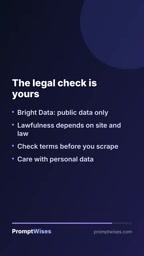
Before collecting personal data, always conduct a compliance check. Laws and website policies vary widely across regions, and you cannot assume that public data is free to scrape.
Residential proxies are proxy services that assign IP addresses through real user devices (such as home networks). Compared with data center proxies, their IPs are less likely to be identified and blocked by target websites, making them commonly used in scraping scenarios that require high anonymity. Bright Data's residential proxy network covers the globe and is billed by traffic (GB) at $8 per GB. When using residential proxies, pay special attention to compliance: some websites explicitly prohibit access through proxies in their terms of service, and different jurisdictions have varying legal requirements for proxy use. In addition, the IP sources of residential proxies involve user consent, and users should ensure their usage complies with Bright Data's terms of service and local laws.
Use Cases and Recommendations
For teams that need to provide AI agents with real-time web access, the combination of Bright Data's MCP server and scraping APIs offers a solution that is quick to get started with. The free credits are suitable for validating a concept, but long-term use requires attention to credit consumption and scale costs.
On compliance, it's advisable to clarify data usage and target website policies early in the project, and to consult legal advice when necessary. The open-source MCP server allows for custom extensions, making it suitable for teams with some development capability.
Related articles
9Router Tutorial: A Free AI Token Solution for Claude Access
Complete 9Router tutorial: deploy an open-source AI routing proxy in two commands, aggregate free providers like KiRo AI, Gemini, and OpenCode, and use AI tokens free in the Claude client via Combo multi-model scheduling.

Cursor Agent SDK Released: Build Your Own AI Agents with Code
Cursor opens its Agent SDK: Agent-as-Code with Markdown instructions and TypeScript tools, one-command deploy, or self-host as a Node process. Pricing and independent testing still missing.

Cloudflare Open-Sources Security Audit Skill: Turning AI Agents into Code Auditors
Cloudflare open-sources Security Audit Skill, letting AI Agents run six-stage security audits with adversarial validation to cut false positives and output structured findings.json.