Cloudflare Open-Sources Security Audit Skill: Turning AI Agents into Code Auditors
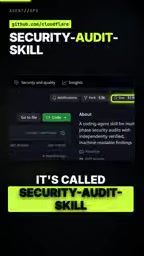
Cloudflare open-sources Security Audit Skill for six-stage AI Agent audits with adversarial validation.
Cloudflare's Security Audit Skill gained 16,000 GitHub stars in a week. Installable with one command into Cloud Code or Cursor, it runs a six-stage audit pipeline. Its core is adversarial validation—each finding is handed to a fresh Agent tasked with disproving it to cut false positives—outputting structured findings.json with confirmed, needs validation, or rejected labels and incremental reruns. It's an early pre-launch defense, not a replacement for penetration testing.
Cloudflare recently open-sourced a project called Security Audit Skill, which enables AI Agents to perform security audits automatically. According to a YouTube video, the project quickly gained traction on GitHub, adding 16,000 stars in a week for a total of nearly 52,000. One frontend developer strongly recommends running it before a project goes live.
What It Is: A Six-Stage Automated Audit Pipeline
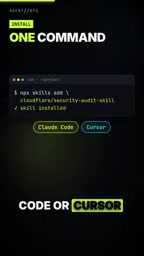
Security Audit Skill is a skill package that can be installed into Cloud Code or Cursor with a single command. It breaks security auditing into six stages, from mapping the architecture to generating the final report, forming a complete pipeline.
This staged design makes the audit process structured and avoids the randomness of traditional chat-style interaction. Each stage has a clear objective, making progress easy to track and results easy to reproduce.
What Are Cloud Code and Cursor?
Cloud Code and Cursor are both programming tools for AI-assisted development. Cursor is an AI-first code editor built on a VS Code fork, with built-in support for LLM chat, code completion, and agent-style task execution—developers can have the AI read the codebase and perform multi-step operations directly within the editor. Cloud Code (here referring to a Cloudflare-related AI coding/Agent runtime, or a command-line coding Agent similar to Claude Code) provides a runtime into which "skill packages" can be installed, allowing structured task workflows to be encapsulated as reusable skills. Security Audit Skill emphasizes installability into these two types of tools because such environments give Agents file read/write, command execution, and codebase traversal capabilities—so the six-stage audit pipeline can be truly automated rather than remaining at the level of conversational suggestions.
Core Mechanism: Adversarial Validation and Structured Output
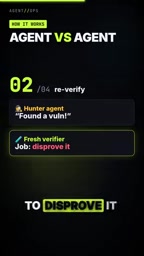
The project's most striking design is "adversarial validation": each discovered vulnerability is handed to a fresh Agent whose sole task is to try to disprove it. This mechanism simulates red-team/blue-team confrontation and effectively reduces false positives.
Audit results are no longer a pile of chat logs but a structured findings.json file. Each issue is marked as confirmed, needs validation, or rejected, making it easy for teams to import directly into issue-tracking systems.
In addition, repeated runs continue from the previous audit results rather than starting from scratch. This means audits can be performed incrementally as code evolves, saving time and compute resources.

Why Are False Positives a Core Pain Point in Security Auditing?
Static analysis and automated scanning tools have long faced high false-positive rates: rule matching or pattern recognition flags seemingly dangerous code as vulnerabilities, even though contextual protections may exist or the code may be unreachable. If security teams manually review each one, the cost is extremely high; if they ignore them outright, real issues may slip through. The adversarial validation approach assigns "disproof" as an independent task to a fresh Agent, insulating it from the original finder's conclusions, and tasks it specifically with finding evidence that the vulnerability does not hold. This is similar to how a blue team in red-team/blue-team exercises tries to refute the red team's findings—essentially introducing a second opinion to filter out noise. For AI auditing, this can significantly increase the credibility of confirmed results, but it also adds compute overhead, which makes the incremental audit mechanism especially important.
Why It's Worth Watching: Lowering the Barrier to Security Audits
For small and mid-sized teams or individual developers, professional security audits are expensive. Security Audit Skill encapsulates audit capabilities as skills executable by AI Agents, letting developers quickly self-check within their everyday coding environment.
That said, its positioning should be viewed rationally: it cannot replace professional penetration testing or manual code review, but serves as an early line of defense to help uncover common vulnerability patterns. The frontend developer in the video recommends running it before a project release, precisely based on this "find early, fix early" approach.
The Boundary Between AI Agent Security Audits and Professional Penetration Testing
Professional penetration testing is conducted by security engineers simulating real attackers, performing authorized active attack testing against a system. It covers complex scenarios such as business logic flaws, privilege bypass, and supply chain attacks, and typically involves human judgment and custom exploit chain construction. AI Agent-driven auditing is closer to an enhanced version of automated code review and pattern matching: it excels at finding common vulnerability patterns (such as injection, hardcoded secrets, and insecure deserialization) but struggles to understand deep business semantics or execute multi-step attack chains. Therefore, the reasonable positioning of Security Audit Skill is "pre-launch self-check" and "an early line of defense in continuous integration," not a replacement for compliance penetration testing. Teams should treat its output as leads to be verified—fix confirmed items first, and hand needs validation items to humans for judgment in combination with business context.
Quick Start and Caveats
Installation requires just one command and supports Cloud Code and Cursor. After running, proceed through the six stages and finally review the categorized results in findings.json. Confirmed issues should be fixed first, needs validation issues can be judged with human input, and rejected issues need no action.
Given the project's high popularity, it's worth following updates to its GitHub repository and community feedback to understand real-world false-positive rates and coverage.
One-line Summary
Cloudflare open-sources Security Audit Skill, enabling AI Agents to run six-stage automated audits with adversarial validation of vulnerabilities.
Paragraph Summary
Cloudflare has open-sourced the Security Audit Skill project, which gained 16,000 GitHub stars in a week for a total of nearly 52,000. The skill package installs into Cloud Code or Cursor with a single command and breaks security auditing into six stages, forming a pipeline from architecture mapping to report generation. Its core mechanism is adversarial validation: each discovered vulnerability is handed to a fresh Agent dedicated to disproving it, reducing false positives. Results are output as a structured findings.json, with issues marked as confirmed, needs validation, or rejected, and incremental auditing based on previous results is supported. The project lowers the barrier to security auditing for small and mid-sized teams and works well as an early pre-launch line of defense, but it cannot replace professional penetration testing or manual code review.
Related articles

T3 Code: The Open-Source AI Coding Assistant's Comeback Story
T3 Code is an open-source AI coding assistant that unifies subscriptions like Codex and Claude, with powerful remote control and parallel task management.

Never Elected, Yet Ruled New York for 30 Years: The Ultimate Case Study in the Mechanics of Power
Robert Caro's biographies reveal how unelected Robert Moses ruled New York for 30 years through legal drafting and public authorities, and how Lyndon Johnson built leverage as a "powerless" Senate Majority Leader. Unpacking the underlying logic of accumulating and sustaining power.

The CPython 3.10 Recursion Trap and Synthetic Recovery in TokenGuard, an LLM Circuit Breaker
TokenGuard's author recounts a recursion crash caused by OrderedDict.pop in CPython 3.10 and introduces v0.3.0's Loop Nudge synthetic recovery, inline DLP scanning, and other new LLM agent circuit-breaker capabilities.