BriLLM-MetaPred: The First Language Model Derived from an AGI Mathematical Theory
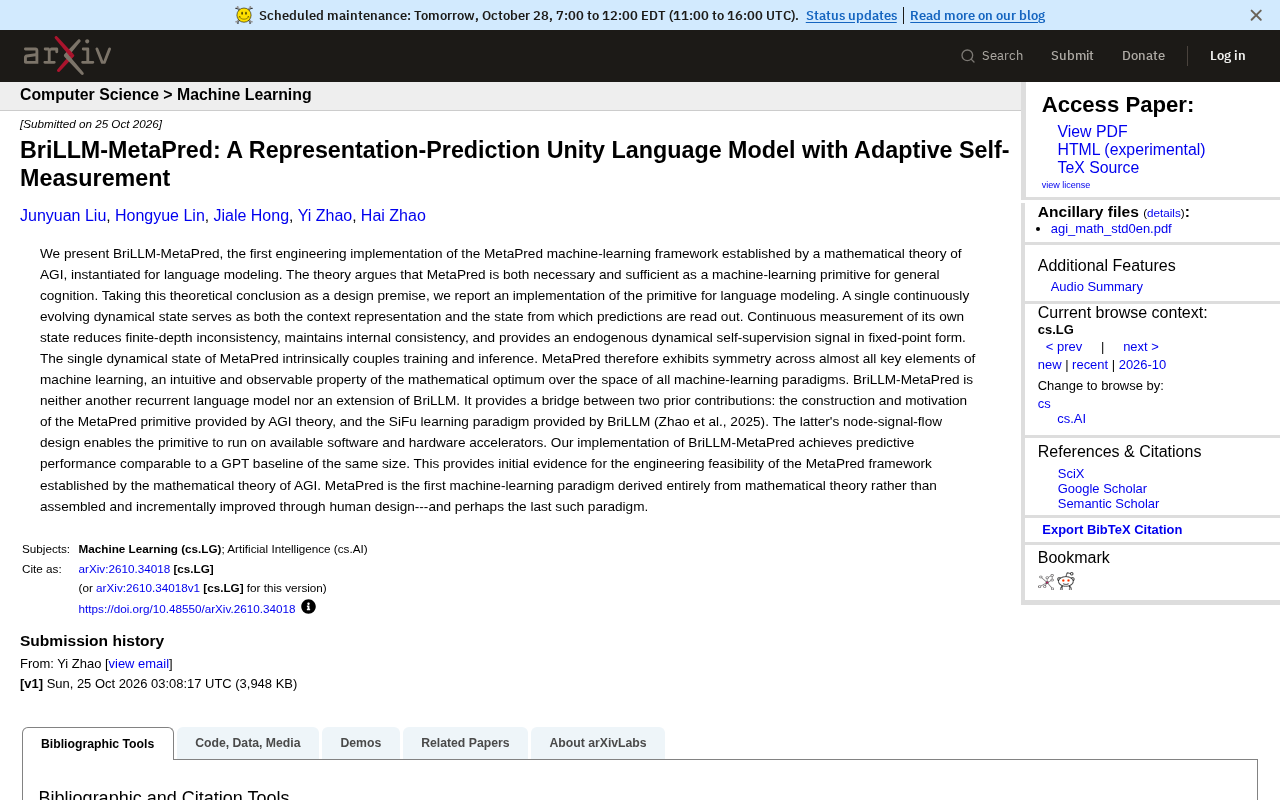
BriLLM-MetaPred is the first machine learning paradigm derived from an AGI mathematical theory, using a single dynamical state to unify representation and prediction.
BriLLM-MetaPred is the first engineering implementation of the MetaPred machine learning framework, claiming to be derived entirely from AGI mathematical theory rather than manually assembled. Its core is a single, continuously evolving dynamical state that simultaneously handles context representation and predictive readout, achieving representation-prediction unification; the model continuously measures its own state to reduce finite-depth inconsistency and provide an endogenous self-supervised signal in fixed-point form; training and inference are intrinsically coupled by sharing the same state, exhibiting symmetry. In engineering terms, it is implemented via BriLLM's SiFu node-signal-flow paradigm and positioned as a bridge connecting theoretical primitives and engineering carriers. Initial results show predictive performance comparable to same-scale GPT baselines, as preliminary evidence of engineering feasibility.
Can the design paradigm of language models only rely on humans constantly "stacking modules and tweaking architectures"? A new paper offers a counterintuitive answer: starting from a mathematical theory of AGI, directly deriving a machine learning primitive, and turning it into a runnable language model. This is BriLLM-MetaPred.
According to the paper, it is the first engineering implementation of the MetaPred machine learning framework, and the first machine learning paradigm derived entirely from mathematical theory rather than assembled through manual design and incremental improvement. The authors even assert that this may be "the last such paradigm."
One State That Serves as Both Representation and Prediction
The core design of BriLLM-MetaPred is remarkably simple: a single, continuously evolving dynamical state simultaneously serves as the source state for both context representation and predictive readout.
Traditional language models typically split "representation" and "prediction" into two separate structures—the former handled by encoders or hidden layers, the latter by an output head. MetaPred unifies both into the same dynamical state. Prediction is no longer an externally attached readout operation, but is read directly from this state itself.
This "representation-prediction unified" design brings the model structurally closer to the optimal form described by the theory. The paper claims that MetaPred exhibits symmetry across almost all key elements of machine learning—an intuitive and observable property of the mathematical optimum in space.
Self-Measurement: An Endogenous Self-Supervised Signal
Another key mechanism in the paper is continuous measurement of its own state.
The model constantly measures its own dynamical state, a process with three effects: reducing inconsistency caused by finite depth, maintaining internal consistency, and providing an endogenous dynamical self-supervised signal in the form of a fixed point.
This is worth noting. Conventional self-supervision relies on externally constructed proxy tasks (such as masked prediction or contrastive learning), whereas MetaPred's self-supervised signal comes from measurements of the state itself—it is "endogenous" rather than "externally added." This brings the source of the training signal closer to the model's own dynamics and also supports stability in fixed-point form.
Fixed point is a core concept in dynamical systems theory: if a system state no longer changes under a certain mapping, i.e., f(x) = x, then x is called a fixed point of that mapping. In deep networks, the information loss and inconsistency caused by a finite number of layers can be understood as the state not yet having converged to a stable point. Constructing the self-supervised signal as a constraint that "the state tends toward a fixed point" is equivalent to requiring internal representations to be self-consistent across iterations rather than relying on external labels or proxy tasks. This idea of using convergence as a training objective has theoretical resonance with implicit deep models such as Deep Equilibrium Models, but MetaPred emphasizes generating signals endogenously from state measurements.
Symmetric Coupling of Training and Inference
Because training and inference share the same dynamical state, MetaPred naturally couples the two. The paper describes this property as "symmetry": the training and inference phases are no longer structurally separated.
For engineering implementation, this means the model does not need a separate path designed for inference; the dynamical behavior learned during training can directly carry over to the inference process. The authors argue that this symmetry is an observable feature of the mathematical optimum, not the result of human design.
Dynamical state refers to a set of variables inside the model that continuously evolve with input and time, whose updates are determined by a fixed evolution rule (dynamical equation). Unlike a traditional Transformer, where each layer has independent parameters and intermediate states are discarded after a single forward pass, the dynamical state is continuously maintained and updated throughout the computation. MetaPred lets this state serve simultaneously as context representation and prediction readout source: context information is encoded into the state's evolution trajectory, while predictions are read directly from the current state. Because training and inference follow the same state evolution rule, the two are naturally coupled structurally, with no need for a separate inference path—this is the concrete source of what the paper calls "symmetry."
Not Another Recurrent Language Model, but a Bridge
The paper explicitly emphasizes that BriLLM-MetaPred is neither yet another recurrent language model nor a simple extension of BriLLM. Its positioning is as a bridge connecting two prior works:
- First, the MetaPred primitive constructed and justified by AGI theory;
- Second, the SiFu learning paradigm proposed by BriLLM (Zhao et al., 2025).
SiFu's node-signal-flow design enables this theoretical primitive to actually run on existing software and hardware accelerators. In other words, the theory provides "what should be done," and SiFu provides the engineering channel for "how to run it."
The SiFu (Signal-Flow) learning paradigm is a node-signal-flow computational framework proposed by BriLLM (Zhao et al., 2025). Its basic idea is to treat the network as a graph structure composed of nodes and signal flows, where computation corresponds to the propagation and aggregation of signals among nodes rather than the stacking of traditional tensor operations. The key engineering value of this design is that it naturally fits the parallelism and memory access patterns of existing GPUs/TPUs, enabling theoretically abstract dynamical primitives to be mapped to executable operator graphs. BriLLM-MetaPred leverages SiFu's node-signal-flow abstraction to transform the MetaPred primitive from a mathematical definition into an implementation runnable on existing accelerators, thereby opening the channel between "theoretical primitive" and "engineering carrier."
Initial Performance Evidence: Comparable to GPT Baselines of the Same Scale
The most closely watched question for an engineering implementation is: how does it perform in practice, given its theoretical elegance?
The paper's answer is that BriLLM-MetaPred's predictive performance is comparable to GPT baselines of the same scale. The authors view this as preliminary evidence of the MetaPred framework's engineering feasibility, not a final conclusion.
The significance of this result lies in validating the path, not in chasing leaderboard rankings. As the first machine learning paradigm fully derived from mathematical theory, reaching the level of same-scale GPT on language modeling tasks already answers the prior question of "whether the theory can be implemented." Whether it can demonstrate advantages at larger scales and on more tasks remains an open question.
What a Theory-First Paradigm Means
The paper's ambition goes beyond a single language model. The authors argue that MetaPred is the first machine learning paradigm derived entirely from mathematical theory rather than manually assembled and incrementally improved, and they suggest it may be the last such paradigm.
Whether this claim holds requires long-term scrutiny by the community. But the question it raises is valuable: as model architectures increasingly rely on empirical trial and error, could deriving primitives from theory and then finding engineering carriers become another viable path? BriLLM-MetaPred at least provides a testable sample.
For readers interested in AI infrastructure, the appeal of this work lies not in parameter scale but in its attempt to connect the three stages of "theory—primitive—engineering" and to use same-scale GPT baselines as a reference point. Whether this路线 can go far will depend on more independent reproductions and scale validation in the future.
Related articles

Medicare Spends $50,000 Treating a Heart Attack but Won't Spend $100 Preventing One: The Mismatch in Healthcare
Medicare pays ~$50,000 to treat a heart attack but won't spend $100 to prevent one. This article unpacks the MedPage Today opinion piece and Hacker News debate on why healthcare payment favors treatment over prevention and the deep causes of incentive misalignment.

Nvidia May Cosign Loan for Nscale's West Virginia AI Data Center
Nvidia is considering cosigning a loan for Nscale's West Virginia AI data center. This article analyzes the signal significance of chip vendors entering data center financing, the risk-sharing logic, and project uncertainties.

Claude Code v2.1.316 Update Analysis: Enterprise Gateway and Multiple Stability Fixes
Claude Code v2.1.316 released: new enterprise gateway pooled group budgets, layered policy mode, subagent effort control, dozens of Shell, network, and session recovery fixes, and Opus 4.8 fast mode deprecated.