Browser Fingerprinting: The Next-Generation Privacy Tracking Technology Replacing Cookies

Browser fingerprinting is quietly replacing cookies as the dominant user tracking method — and it's far harder to block.
As browser vendors and regulators accelerate the phase-out of third-party cookies, the ad and data industry has rapidly shifted to browser fingerprinting. By collecting dozens of signals — User-Agent strings, screen resolution, Canvas rendering output, font lists, and audio processing characteristics — fingerprinting generates a highly unique device identifier on the server side. Unlike cookies, it leaves no files on the user's device and cannot be eliminated by clearing browser data or enabling incognito mode. Defenses such as Tor Browser's feature standardization, Brave's API randomization (Farbling), and reducing API surface area each involve tradeoffs that may affect website functionality or user experience. This technological trend poses not only a technical privacy challenge but also raises broader questions about whether current privacy regulatory frameworks are adequate.
When Cookies Fade Out, Tracking Doesn't Stop
As mainstream browsers phase out third-party cookies and introduce stricter privacy protections, many users believed they had finally escaped the relentless grip of online tracking. The reality, however, is quite the opposite — a more covert and harder-to-block technology is stepping in to replace cookies, becoming the new favorite tool of advertisers and data companies: Browser Fingerprinting.
The phrase "Fingerprints Are the New Cookies" perfectly captures this trend. Unlike cookies, which store identifiers on users' devices and can be easily cleared, fingerprinting reconstructs user identities on the server side by collecting a large number of device and browser characteristics — all without the user noticing, and with virtually no way to actively remove the trace.
What Is Browser Fingerprinting?
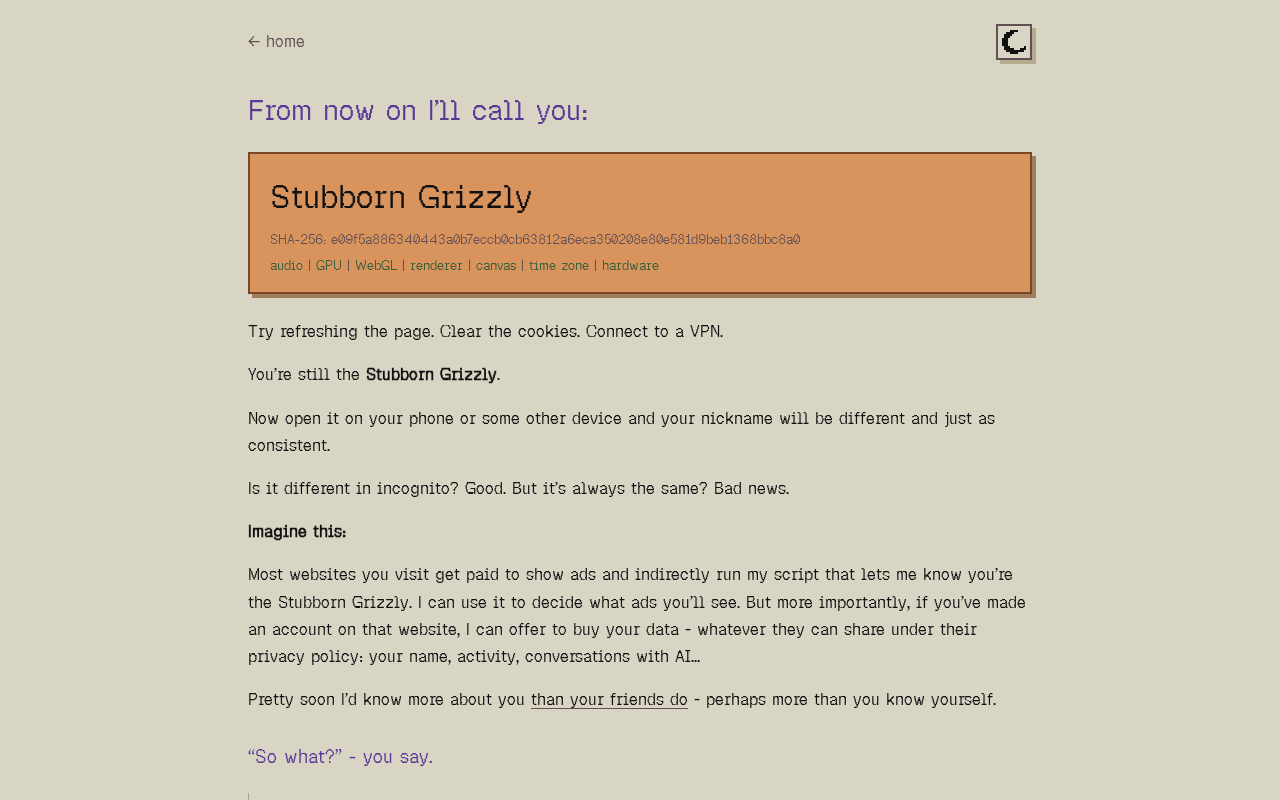
A browser fingerprint is a highly unique identifier generated by collecting various attributes exposed by a browser and device. These attributes include, but are not limited to:
- User-Agent string and browser version
- Screen resolution, color depth, and viewport dimensions
- List of installed fonts
- Timezone and language settings
- Canvas and WebGL rendering output (subtle differences arise from different hardware/drivers)
- Audio processing stack characteristics (AudioContext fingerprint)
- Hardware information such as CPU core count and device memory
No single attribute is sufficient to identify an individual, but when combined, the entropy of these dimensions is high enough to pinpoint a specific user among billions of devices. Research has shown that a significant proportion of browser configurations are globally unique — meaning even if you clear all cookies or use incognito mode, a fingerprint can still re-associate you with your previous identity.
Why Fingerprinting Is Harder to Fight Than Cookies
Cookies are files stored locally; users can delete them at any time, and browsers provide clear management interfaces for doing so. Fingerprinting, on the other hand, is "passively collected" — it leaves nothing on your device that can be deleted. Instead, it is calculated in real time by the server each time you visit. You cannot "turn off" your screen resolution, nor can you "clear" your GPU's rendering characteristics.
This fundamental difference renders traditional privacy measures (clearing cookies, using private browsing mode) nearly ineffective against fingerprinting — which is precisely why it's called the "next-generation cookie."
It's worth noting that a fingerprint's stability stems from the high consistency of hardware and software environments. Even if a user changes their network IP or switches browser accounts, as long as the underlying device remains the same, the fingerprint hash computed server-side will often closely match the previous visit, enabling persistent cross-session and cross-platform tracking. The EFF's Panopticlick project (now renamed Cover Your Tracks) analyzed millions of visits and found that over 80% of browser configurations could be uniquely identified globally after collecting roughly 18 dimensions — an information entropy far exceeding what a traditional cookie identifier carries. Furthermore, fingerprint collection occurs entirely within server-side HTTP request handling logic, without relying on any client-side storage APIs. This means browser-level storage isolation strategies — such as Safari's ITP or Firefox's ETP — are nearly powerless to block it.
A New Battleground in the Privacy Arms Race
The rise of fingerprinting reflects the ongoing cat-and-mouse game between the online advertising ecosystem and privacy advocates. As regulators and browser vendors continuously tighten restrictions on tracking, the data industry keeps finding new technical pathways to circumvent those restrictions. When one door closes, another window tends to open.
From a technical ethics perspective, fingerprint tracking poses even thornier problems than cookies: it operates without users' knowledge and with no effective way to opt out, severely undermining users' control over their own data. This has sparked intense debate in the community about whether existing privacy frameworks are sufficient.
Possible Defensive Approaches
The industry has explored several countermeasures against fingerprint tracking:
- Feature standardization: Some browsers (such as Tor Browser) try to make all users present as similar a set of characteristics as possible, effectively "hiding individuals in the crowd" to reduce identifiability.
- API randomization: Injecting random noise into the outputs of fingerprint-prone APIs like Canvas and AudioContext to undermine fingerprint stability.
- Reducing the attack surface: Limiting the granularity of device information accessible to websites — for example, fuzzing screen dimensions or disabling partial font enumeration.
- Policy-level constraints: Explicitly bringing fingerprint tracking under privacy regulation through legislation and requiring clear user consent.
Each of these approaches involves tradeoffs — excessive standardization can break website functionality, while randomization may degrade user experience. There is no single silver bullet.
Tor Browser's "feature standardization" strategy is widely considered one of the most thorough protective approaches in both academic research and engineering practice. Its core idea is rooted in the concept of the "Anonymity Set": an individual user's identifiability depends not on the absolute value of their characteristics, but on how many other users share identical characteristics. When all Tor users present the same window size, the same font subset, and the same Canvas rendering output, an attacker who collects a complete fingerprint still cannot distinguish one individual from another. Brave Browser takes a different approach — injecting small random perturbations ("Farbling") into the outputs of APIs like Canvas, WebGL, and AudioContext, so that each visit generates a slightly different fingerprint, disrupting cross-site tracking chains while attempting to preserve normal website functionality. These two approaches represent two technical paths — "reducing uniqueness" versus "breaking stability" — each with its own applicable scenarios and limitations.
What This Means for Users and Developers
For everyday users, recognizing that "deleting cookies does not mean being invisible" is an important first step. Using privacy-focused browsers, enabling anti-fingerprinting extensions, and staying informed can help mitigate the risk to some degree — but cannot eliminate it entirely.
For developers and product teams, this is a reminder about technical responsibility: having the capability to collect fingerprints does not mean it should be used indiscriminately. As privacy awareness grows and regulations tighten, business models that rely heavily on covert tracking will face increasing compliance and reputational risks in the long run.
Whether fingerprinting is truly the new cookie is not just a technical judgment — it's a deeper question about the future direction of online privacy.
Related articles

Chain of Thought Isn't Just for AI: How Humans Can Use CoT to Improve Thinking Quality
Chain of Thought isn't just a prompt trick for large models. Starting from a Hacker News discussion, this article analyzes why CoT works for human thinking too, breaks down actionable ways to transfer it, and highlights the key differences between human CoT and machine CoT.
Cloudflare Teams Up with OpenAI: Closi…
Cloudflare Teams Up with OpenAI: Closing the Loop from Vulnerability Discovery to Defense with AI
Cloudflare uses OpenAI Daybreak to investigate security vulnerabilities and generate reviewable remediation plans, while developers use Codex to boost coding efficiency and quality.

Orca Multi-Agent Orchestration in Practice: A Guide to Parallel Collaboration with Claude and Codex
Orca is Stable AI's free open-source agent workbench supporting 34 agents like Claude Code and Codex in parallel. Learn its Git worktree isolation, multi-model orchestration, and mobile management.