Browser Use: The Fastest-Growing Agent Primitive, Now Managed by DeepAgents
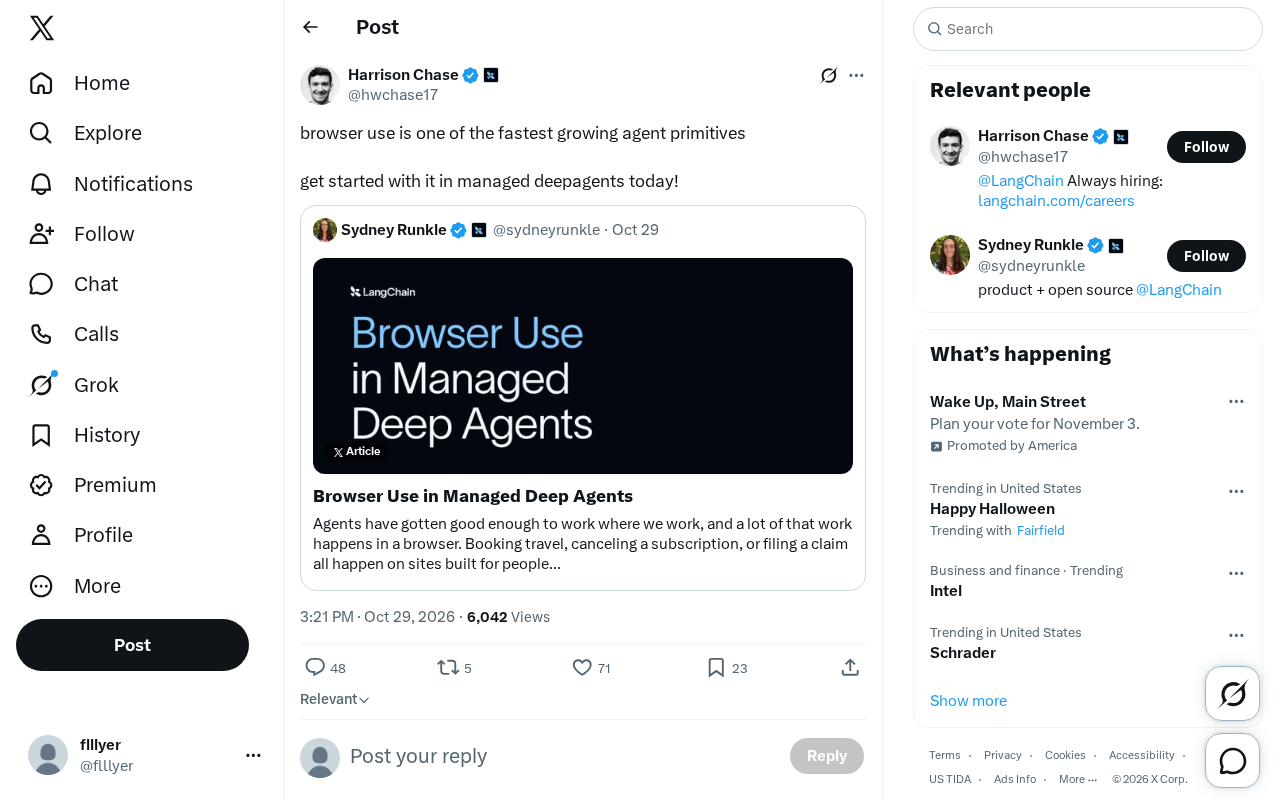
DeepAgents positions Browser Use as the fastest-growing Agent primitive and offers it in a managed environment.
The article notes that Browser Use is becoming one of the fastest-growing primitives for AI Agents, valued for enabling Agents to directly operate web interfaces and cover many real-world tasks such as searching, form filling, clicking, and scraping. DeepAgents emphasizes its "managed" capability, letting developers enable browser operations in a managed environment without building infrastructure like browser instance management and session persistence, so they can focus on Agent logic and task orchestration. It lists typical scenarios including information retrieval, form filling, price monitoring, and end-to-end task execution, argues that capabilities becoming primitives and deployments becoming managed are the direction of Agent infrastructure evolution, and reminds enterprises to evaluate new issues such as data isolation, observability, and debugging.
Browser Use Is Becoming a Core Agent Primitive
Browser Use is rapidly emerging as one of the fastest-growing primitives in the AI Agent space. A "primitive" here refers to a foundational building block for more complex Agent capabilities—much like function calling and code execution, Browser Use enables Agents to directly operate web interfaces to complete tasks such as searching, filling out forms, clicking, and scraping information.
This assessment comes from DeepAgents' latest statement on social media. Although it's just a short tweet, it sends a clear signal: browser operation is no longer an experimental feature but an indispensable layer of Agent infrastructure.
Why is Browser Use growing so fast? The reason is that the vast majority of real-world tasks happen on web pages. From checking flights and submitting forms to comparison shopping, the browser is the primary entry point for human interaction with the internet. If an Agent cannot operate a browser, it will struggle to truly take over end-to-end business processes.
Common Types of Agent Primitives
In Agent architectures, common primitives include: function calling (letting the model trigger external APIs), code execution (running scripts in a sandbox), retrieval (obtaining information from knowledge bases or web pages), memory (persisting state across turns), and multi-step planning (decomposing tasks). Browser Use is regarded as a "primitive" rather than an ordinary tool because it provides general-purpose operational capability over web pages—the largest entry point for information and business—and can be freely combined with other primitives. Compared with simple HTTP requests, Browser Use can handle complex pages involving JavaScript rendering, login states, and dynamic interactions, covering long-tail scenarios that APIs cannot reach.
DeepAgents' Managed Capability Lowers the Barrier to Entry
In the past, enabling an Agent to use a browser required setting up a runtime environment, managing browser instances, and dealing with anti-scraping and login states—considerable engineering complexity. The key word DeepAgents emphasizes this time is "managed"—users can directly enable Browser Use capability in a managed environment without building infrastructure from scratch.
This means developers can focus on Agent logic design and task orchestration rather than low-level details like browser drivers and session persistence. For teams looking to quickly validate browser Agent scenarios, the managed model significantly shortens the path from idea to prototype.
DeepAgents positioning Browser Use as a "primitive" also implies that it works in concert with other capabilities in the framework (such as tool calling, memory, and multi-step planning) rather than being an isolated feature. Developers can combine browser operations with other tools within the same Agent to build more complete automation workflows.
Technical Differences Between Managed Browsers and Self-Built Solutions
Self-built browser Agents typically have to deal with version management of browser drivers (such as Playwright and Puppeteer), concurrency and recycling of headless browser instances, persistence of cookies and login states, and anti-scraping strategies and CAPTCHA handling. The managed model encapsulates these operational details into service interfaces, so developers only need to invoke abstract operations like "open page," "click element," and "extract content." The trade-off is potentially limited flexibility, and you need to pay attention to how well the managed environment supports compatibility with specific websites and network egress policies.
Typical Application Scenarios for Browser Agents
The rise of the Browser Use primitive corresponds to a set of high-value scenarios:
- Information retrieval and aggregation: Let the Agent open multiple web pages, extract structured information, and summarize it, replacing manual tab-switching.
- Form filling and process submission: Automate repetitive web operations in scenarios such as recruiting, government services, and procurement.
- Competitor and price monitoring: Periodically visit target pages, capture changes, and generate reports.
- End-to-end task execution: Chain together multi-step web interactions, from search to checkout and from inquiry to booking.
What these scenarios have in common is that the tasks themselves are not complex but rely heavily on operating web interfaces. The Browser Use primitive gives Agents the ability to "browse the internet like a human," thereby covering a large number of long-tail tasks that were previously difficult to automate.
Managed Services Are the Direction of Agent Infrastructure Evolution
DeepAgents incorporating Browser Use into its managed capabilities reflects a clear trend in Agent infrastructure: capabilities becoming primitives and deployments becoming managed. Developers no longer need to set up a separate runtime environment for each Agent capability; instead, they enable them on demand through a managed platform.
The benefit of this model lies in consistency and maintainability. Managed environments typically handle operational issues such as browser versions, session isolation, and concurrency scheduling, giving developers a stable layer of abstraction. For enterprise users, managed services also make it easier to meet compliance and audit requirements.
Of course, the managed model also brings new considerations: how data is isolated in the managed environment, whether browser operations have sufficient observability, and how to debug when exceptions occur. These issues are worth evaluating in advance when adopting managed browser capabilities.
The Unique Nature of Observability and Debugging in Browser Agents
Exceptions in browser Agents often occur at the page level: element selectors failing, page load timeouts, pop-up blocking, expired login states, and so on. Therefore, whether the managed environment provides operation recordings, step-level logs, screenshot snapshots, and DOM snapshots directly determines the efficiency of problem diagnosis. When evaluating managed browser capabilities, enterprises should focus on confirming whether these observability tools are available and whether they support correlating browser sessions with the Agent's reasoning chain for tracking.
How to Get Started
According to DeepAgents' guidance, developers can now enable Browser Use capability in the managed version of DeepAgents. It is recommended to start with a small, specific task—for example, having the Agent visit a specified page and extract key information—to first validate the basic workflow, then gradually expand to multi-step interactions and complex processes.
As one of the fastest-growing Agent primitives, Browser Use is shifting from an "optional capability" to a "standard configuration." For teams building practical Agents, becoming familiar with this primitive early will help them gain an edge in the ensuing competition in Agent applications.
One-line Summary
DeepAgents positions Browser Use as the fastest-growing Agent primitive and offers this capability in a managed environment.
Paragraph Summary
The article points out that Browser Use is becoming one of the fastest-growing primitives for AI Agents, with its value lying in enabling Agents to directly operate web interfaces and cover a large number of real-world tasks such as searching, form filling, clicking, and scraping. On social media, DeepAgents emphasized its "managed" capability, which allows developers to enable browser operations in a managed environment without building infrastructure like browser instance management and session persistence, so they can focus on Agent logic and task orchestration. The article lists typical scenarios such as information retrieval, form filling, price monitoring, and end-to-end task execution, and argues that capabilities becoming primitives and deployments becoming managed are the direction of Agent infrastructure evolution, while reminding enterprises to evaluate new issues such as data isolation, observability, and debugging.
Related articles

DeepSeek Harness in Detail: DIY Your Own Software Like Building with LEGO
What is DeepSeek Harness? Using the metaphor of a car assembly platform, this article explains this equipment system of freely combinable functional modules, analyzes its spatiotemporal composability technical foundation, and shows how ordinary users can DIY exclusive software that does not exist on the market at extremely low cost.

DeepSeek Harness Step-by-Step Tutorial: Master DSH and Its Plugin Ecosystem in 50 Minutes
DeepSeek Harness step-by-step install tutorial: from Node.js environment setup to client installation, covering three plugin install methods — chat, marketplace, and command line — plus practical uses of local file access and plugin extensions.

DeepSeek Open-Sources Super-agent Architecture: A Turning Point for Proactive AI
DeepSeek's open-source Super-agent architecture proposes a new proactive AI paradigm: a central Agent dispatches tasks, sub-Agents execute autonomously, and humans only decide and accept. This article analyzes the watershed between passive and proactive AI, and the implementation logic of proactive Agents in scenarios like short-video lead generation.