BrowserOS neo: The Open-Source Tool That Lets AI Agents Control Your Browser

BrowserOS neo is an open-source local browser that lets AI agents use your login sessions to complete real web tasks.
BrowserOS neo is an open-source browser designed specifically for AI agents, running locally on your machine and reusing your existing login credentials. It enables AI assistants like Claude Code and Codex to perform real web tasks on your behalf, supports multi-agent parallel execution, and offers session replay for transparency. With 12K+ GitHub stars, it addresses the critical gap between AI capabilities and authenticated web access.
A Browser Not Designed for Humans
When we think of browsers, what comes to mind are tools like Chrome, Safari, or Firefox — built for human interaction. But BrowserOS neo flips this concept on its head — it's a browser built "not for you, but for your AI agents."
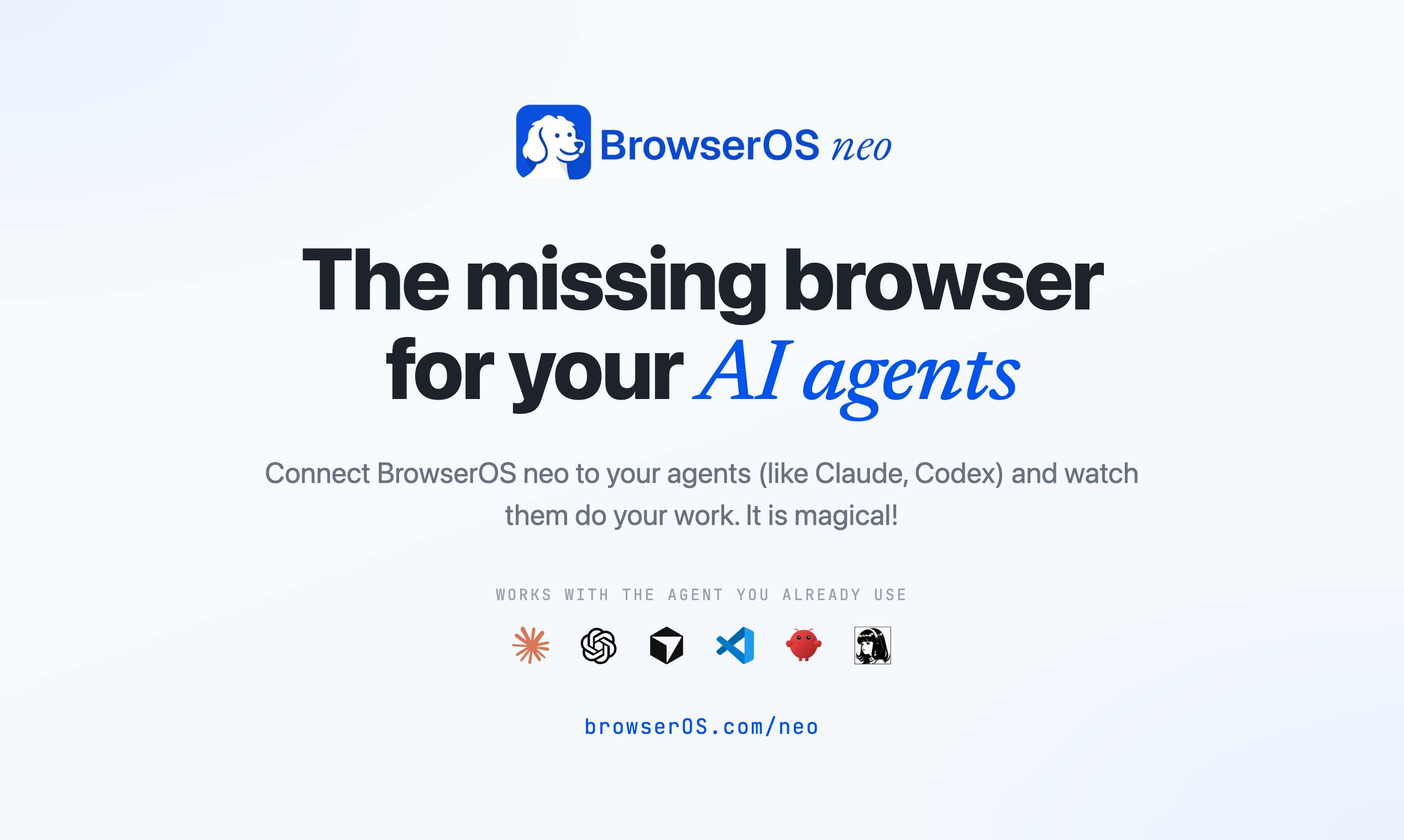
According to its Product Hunt listing, BrowserOS neo has an extremely clear positioning: it runs on your local machine, uses your existing login credentials, and enables AI coding and productivity agents like Claude Code, Cowork, and Codex to truly complete tasks on your behalf. The product ranked #6 on Product Hunt that day with 102 upvotes, and has already earned over 12,000 stars on GitHub.
Why AI Agents Need a Dedicated Browser
Pain Points with Existing Solutions
As AI coding assistants like Claude and Codex grow increasingly capable, a practical problem has emerged: when these agents need to perform web-based tasks, they're often limited by sandbox environments or lack real login states. They can't easily access your accounts on GitHub, enterprise internal systems, or various SaaS platforms, making "last-mile" automation nearly impossible.
To understand the technical background here: current mainstream AI coding assistants (such as Claude Code and OpenAI Codex) typically run in restricted sandbox environments. A sandbox is a security mechanism that confines program execution to an isolated environment, preventing access to system resources or external networks. While this design ensures security, it also means AI agents cannot access web services that require authentication. Traditional solutions include API integrations or OAuth token passing, but these have limited coverage, and many web applications don't offer comprehensive API interfaces — leaving a huge number of browser-dependent tasks unable to be automated.
BrowserOS neo targets precisely this "missing link" (The Missing Browser). By running locally, it directly reuses the user's existing login sessions in the browser, allowing AI agents to operate in a real, authorized environment without repeatedly handling cumbersome authentication flows.
From a technical implementation perspective, this session reuse involves Cookie and Session management mechanisms. Web applications maintain user login states through HTTP Cookies, which typically contain session identifiers (Session IDs) that servers use to recognize authenticated users. BrowserOS neo accesses the user's local browser Cookie storage (such as Chrome's SQLite database) and shares these authentication credentials with the browser instances used by AI agents. This avoids the security risks of traditional RPA tools that require re-login or storing passwords in plaintext.
Acting as Your Proxy for Real Tasks
The keyword here is "real tasks." Unlike automation tools that can only handle demos, BrowserOS neo emphasizes letting agents complete end-to-end actual work under your identity — such as reviewing documents that require login, performing actions in web applications, or collecting information across platforms. This means AI is no longer an isolated advisor but a true executor that can "get things done."
It's worth noting that browser automation technology itself has undergone a long evolution. From Selenium born in 2004, to Google's Puppeteer released in 2017, to Microsoft's Playwright in 2020 — these tools have continuously improved the ability to programmatically control browsers. However, they are fundamentally designed for developers writing scripts, requiring pre-defined operation steps. The fundamental difference with BrowserOS neo is that it provides AI agents with a browser runtime for dynamic decision-making and interaction — agents can adjust their behavior in real-time based on page content rather than executing fixed scripts. This represents a qualitative shift from "automation" to "intelligence."
Core Feature Highlights of BrowserOS neo
Multi-Agent Parallel Execution
BrowserOS neo supports "running many agents at once." This capability is crucial for complex workflows — you can have one agent handle code review, another organize documentation, and a third perform data scraping, all working in parallel within the same browser environment, dramatically improving automation efficiency.
The technical implementation of multi-agent parallel execution involves browser multi-instance management and resource isolation. Each agent requires an independent Browser Context — an isolation mechanism provided by modern browser engines, similar to incognito windows — where contexts don't share Cookies and cache but can share underlying browser processes to conserve system resources. Chromium's multi-process architecture naturally supports this parallel mode, with each tab or context running in an independent rendering process. BrowserOS neo builds on this to implement coordination scheduling between agents, avoiding conflicting operations on the same resource while ensuring each agent's task execution doesn't interfere with others.
Session Replay: Making Agent Behavior Transparent and Auditable
One of the biggest concerns about AI agents executing tasks is the "black box" problem — you don't know exactly what the agent did. BrowserOS neo offers a "Replay any session" feature, allowing users to replay any agent operation session and clearly see what steps the AI took in the browser.
This design is significant for security and auditability. It not only facilitates debugging and troubleshooting but also gives users a sense of control over agent behavior, alleviating the trust anxiety that comes with granting account permissions to AI.
Open Source and Privacy: The Product's Two Trump Cards
Free, Open Source, and Community-Driven
BrowserOS neo is completely free and open source, having already accumulated over 12,000 GitHub Stars. This number reflects the developer community's strong recognition of the "AI-native browser" direction. The open-source model means users can audit the code and verify its security, while also leaving ample room for community extensions and customization.
Privacy Advantages of Local Execution
The product is tagged with "Open Source, Privacy, Artificial Intelligence" on Product Hunt. "Privacy" is a significant selling point that shouldn't be overlooked. Since BrowserOS neo runs on the user's local machine, sensitive login credentials and session data never need to be uploaded to third-party servers. In an era of frequent data breaches, this "data never leaves your machine" architecture is extremely attractive to privacy-conscious users and enterprises.
Industry Significance and Outlook for AI Agent Browsers
The emergence of BrowserOS neo represents a rising trend: redesigning foundational toolchains for AI agents. Over the past few decades, software tools have been built around "human operators"; but as AI agents increasingly take on execution roles, what we need are interfaces and runtime environments optimized for "machine operators."
The scale of this trend is expanding rapidly. In 2024-2025, the AI Agent ecosystem is experiencing explosive growth. Beyond BrowserOS neo, similar projects include Anthropic's Computer Use (letting Claude directly control desktops), Microsoft's UFO (an Agent framework for Windows applications), and various Web Agents based on vision-language models. Together, these projects form the "Agent Infrastructure" layer, with the core philosophy that when AI transitions from "advisor" to "executor," an entirely new middleware stack is needed to connect AI capabilities with real-world software systems. Gartner calls this trend "Agentic AI" and predicts that by 2028, 33% of enterprise software interactions will be completed through AI Agents.
By entering through the browser — the most fundamental gateway to the internet — BrowserOS neo has seized a critical node. It's foreseeable that as agent ecosystems like Claude, Codex, and Cowork mature, these "agent-native" tools will become increasingly common and may even reshape the entire software interaction paradigm.
Of course, products like this also face challenges: how to ensure security boundaries while granting AI powerful permissions, and how to prevent losses from agent errors — these are problems that need ongoing solutions. Through session replay, local execution, and open-source transparency, BrowserOS neo has already provided preliminary answers to these questions. For developers and teams following the AI Agent space, it's undoubtedly a project worth watching and trying.
Key Takeaways
Related articles

How to Interview Engineers in the AI Era: Practical Insights on Restructuring the Interview Process
When AI coding tools render traditional algorithm interviews ineffective, how should teams restructure? Insights from a year of practice on evaluating systems thinking, problem decomposition, and human-AI collaboration.

AI Agent Observability: A New Paradigm for Production Debugging and Hallucination Governance
Deep dive into AI Agent observability tools for production debugging and hallucination governance, covering full-chain tracing, semantic evaluation, and continuous improvement strategies.

How Theoretical Physicists Can Efficiently Get Started with Machine Learning: Optimal Paths and Resource Guide
A systematic guide for theoretical physicists transitioning to ML, covering math advantages, a three-stage learning path, classic textbooks, and physics-ML cross-disciplinary research directions.