Brute-Force Context Stuffing vs. RAG: Is Vector DB a Dead End for Agent Memory?

Developer dumps RAG for raw context stuffing, finds agent reasoning quality jumps — sparking debate on over-engineered memory pipelines.
A developer shared on Reddit that he abandoned vector databases (RAG) for AI agent short-term memory, instead dumping complete raw JSON action logs directly into the prompt. RAG's semantic similarity search fails to preserve execution order and causal chains, causing frequent retrieval errors in long-running agent loops. By leveraging a free trial of a million-token context model, he validated large-scale context filling as a viable approach — more precise and debuggable than complex RAG pipelines for short-term working memory. The article notes both approaches have distinct use cases, and that attention degradation in ultra-long contexts remains the key limiting factor.
A Debate Over Agent Memory
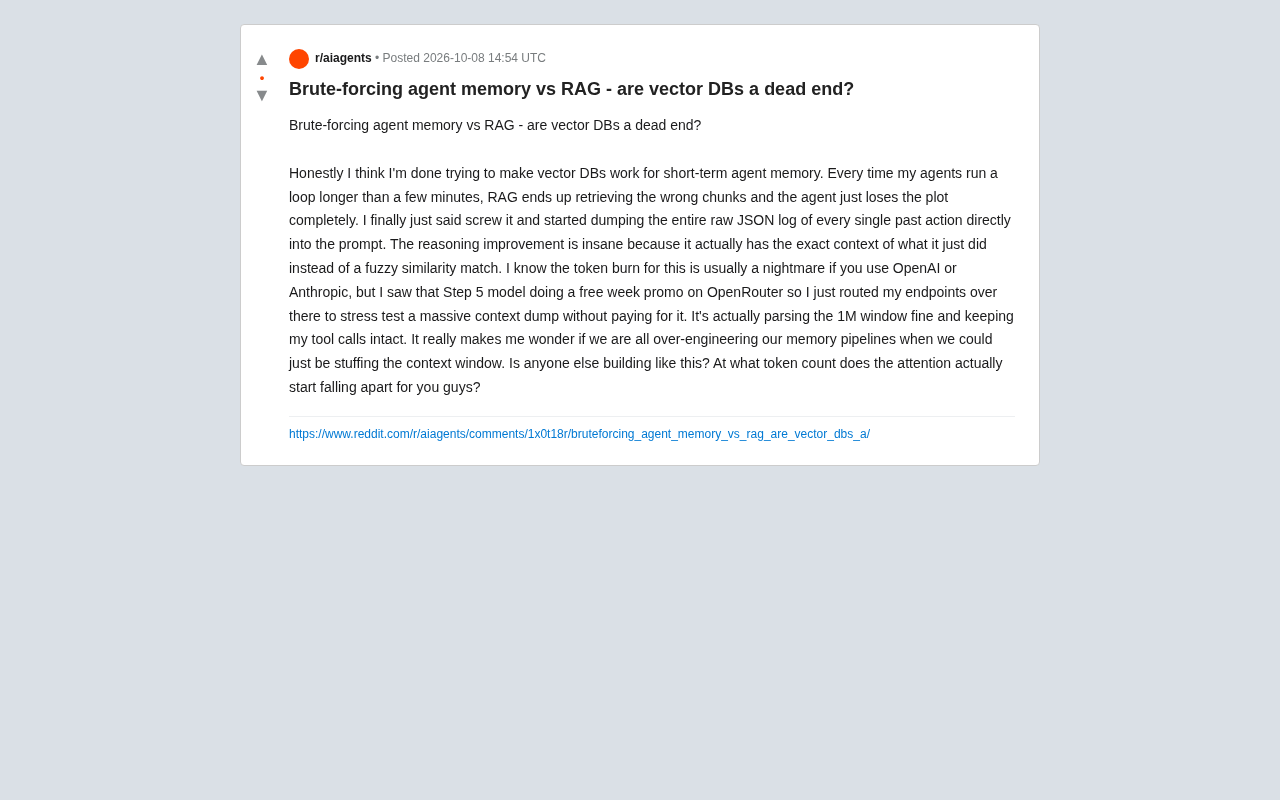
On Reddit, a developer shared a provocative take: he had given up on using a vector database (Vector DB) for AI agent short-term memory. His reason was straightforward — whenever an agent's run loop exceeded a few minutes, the RAG-based (Retrieval-Augmented Generation) approach would start retrieving the wrong chunks, causing the agent to "completely lose the plot."
His solution was blunt: just dump the complete raw JSON log of every past action directly into the prompt. According to him, the improvement in reasoning quality was "absolutely insane," because the agent was given the exact context of what it had just done, rather than a fuzzy similarity-match result.
Why RAG Fails Inside Agent Loops
This issue cuts to a core weakness of RAG architecture in agentic scenarios. RAG fundamentally retrieves "roughly relevant" chunks via vector similarity, which works well for static retrieval tasks like knowledge base Q&A. But an agent's short-term memory has fundamentally different requirements: it needs precise, ordered, and complete action history — not semantically approximate content.
When an agent executes a long chain of tool calls, the output of each step may be the critical input for the next decision. Similarity matching becomes a source of noise here — it might rank some unrelated action from several steps back as "highly similar," misleading the current reasoning. What vector retrieval loses is precisely the execution order and causal chain, both of which are essential to an agent's coherence.
The standard RAG workflow involves splitting documents into fixed-size chunks, converting each chunk into a high-dimensional vector via an embedding model, and storing them in a vector database. At query time, the question is similarly vectorized, and nearest neighbors are retrieved using cosine similarity or dot product, then inserted into the prompt. This pipeline is designed on the premise that "similar questions lead to similar answers" — well-suited for relatively static knowledge bases. In an agent's action history, however, semantic similarity has almost no relationship with "what information is needed next." An agent calling a tool to "read a file" and one to "write a file" are semantically very similar, yet their temporal relationship and causal dependencies are entirely different. Vector retrieval has no natural way to encode "this happened before that" — which causes retrieval results to fail frequently in temporally sensitive reasoning.
Experimenting with Brute-Force Million-Token Context Filling
The original poster admitted that the biggest obstacle to dumping all raw logs into the context window is cost. Using models from OpenAI or Anthropic, this kind of "token burning" is typically a nightmare. His workaround was to take advantage of a free trial period for a Step 5 model on OpenRouter, routing requests there to stress-test large-scale context dumping without spending money.
The results surprised him: the model was able to parse a 1-million-token context window and maintain the integrity of tool calls throughout. This experiment reflects the progress long-context models have made in recent years — when the window is large enough and the attention mechanism is stable enough, "throwing everything in" can genuinely become a viable engineering path.
The core challenge for long-context models is that the computational complexity of the attention mechanism grows quadratically with sequence length, which made early Transformer architectures unable to handle very long inputs. In recent years, improvements in positional encoding (e.g., RoPE, ALiBi), sliding window attention, and dedicated long-context fine-tuning have expanded the effective context windows of major models from the initial 4K and 8K tokens to 128K and even million-token scales. But "supporting million-token input" and "effectively extracting information from a million tokens" are two different things. Researchers use the "Needle-in-a-Haystack" test to measure how well models can locate critical information within very long contexts. Results show that many models have noticeable attention blind spots in the middle of their context — content near the beginning and end of the prompt is much more likely to be recalled than content in the middle, a phenomenon known as the "Lost in the Middle" problem.
Are We Over-Engineering Our Memory Pipelines?
This led the developer to pose a question worth the entire community reflecting on: Are we all over-engineering our memory pipelines? When the context window is long enough, the complex pipeline of retrieval, chunking, embedding, and re-ranking may be solving a problem that could have been sidestepped entirely.
This perspective has merit. A RAG pipeline introduces a tremendous amount of engineering complexity — choosing an embedding model, defining chunking strategies, maintaining the vector store, tuning retrieval quality — and each step is a potential failure point. The direct context-filling approach, while seemingly "brute-force" in token consumption, trades that for determinism and debuggability: you know exactly what the model sees.
Of course, this approach has clear limits. Long context is not a free lunch, and attention degradation in real-world scenarios is an unavoidable issue. The original poster himself asked: At what token scale does attention actually start to break down? This is precisely what "Needle-in-a-Haystack" long-context evaluations aim to answer — though results vary enormously across different models and tasks.
Attention degradation refers to the phenomenon where, as the input sequence grows longer, the model's focus on early or mid-sequence tokens diminishes, causing critical information to be "diluted." The root cause lies in how attention weights are normalized via softmax — when the number of candidate tokens is extremely large, the weight assigned to each position approaches a uniform distribution, making it hard for useful information to stand out among irrelevant tokens. This is analogous to human working memory capacity limits, but with a different mechanism: the model doesn't "forget" early content, but cannot assign it sufficient weight during computation. The Needle-in-a-Haystack benchmark quantifies this degradation threshold by randomly inserting a key fact into a long document and testing whether the model can accurately recall it. Model performance varies significantly — some show a noticeable drop in accuracy beyond 32K tokens, while others remain stable over much longer ranges.
The Two Approaches Are Not Mutually Exclusive
It's worth noting that the discussion above comes from a single developer's hands-on experience and its conclusions have not been systematically validated. Vector databases and long-context filling don't have to be in a zero-sum competition:
- Short-term working memory (action history within the current task loop) is genuinely better suited to direct context filling, which prioritizes precision and order.
- Long-term knowledge memory (massive document stores, historical session archives) still can't be fully replaced by brute-force context filling, given cost and scale constraints — RAG remains valuable here.
- As context pricing drops and window sizes expand, the boundary between the two is shifting, but "how attention is distributed across long contexts" remains the key variable determining the upper limit.
For developers building agentic systems, the takeaway from this discussion may be: don't default to RAG as the only answer. Before diving into a complex memory pipeline, run a baseline with the simplest "stuff the context" approach first — you might get surprisingly good results, and you'll get a much clearer view of where the real bottlenecks actually lie.
Related articles

How Big Can Stars Really Get? The Physical Limits of the Largest Stars
Red supergiants are the largest stars by volume, with radii up to 2,000 times the Sun, engulfing the inner solar system. But there is no precise upper limit on stellar size—models predict up to 15,000 solar radii. The most massive blue stars are far smaller than red supergiants—biggest and heaviest are two different things.

Apple HomeView Smart Display Full Feature Breakdown: Wall-Mount or Desktop, $299
Apple launches HomeView, a $299 smart display with wall-mount and desktop options, 12MP camera for facial recognition, smart home control, music playback, and recipe step-by-step cooking. Full breakdown of watch faces, apps, privacy, and cooking integration.

Where Did the Promised New Studio Go? Craft Computing Answers After Five Years
Craft Computing's host responds to viewer questions: the new studio promised five years ago was shelved as construction costs soared from $30,000 to $75,000, and was replaced by a 168-square-foot garage conversion.