Bublr: Open-Source Writing + Newsletter to Build Your Own Home on the Internet
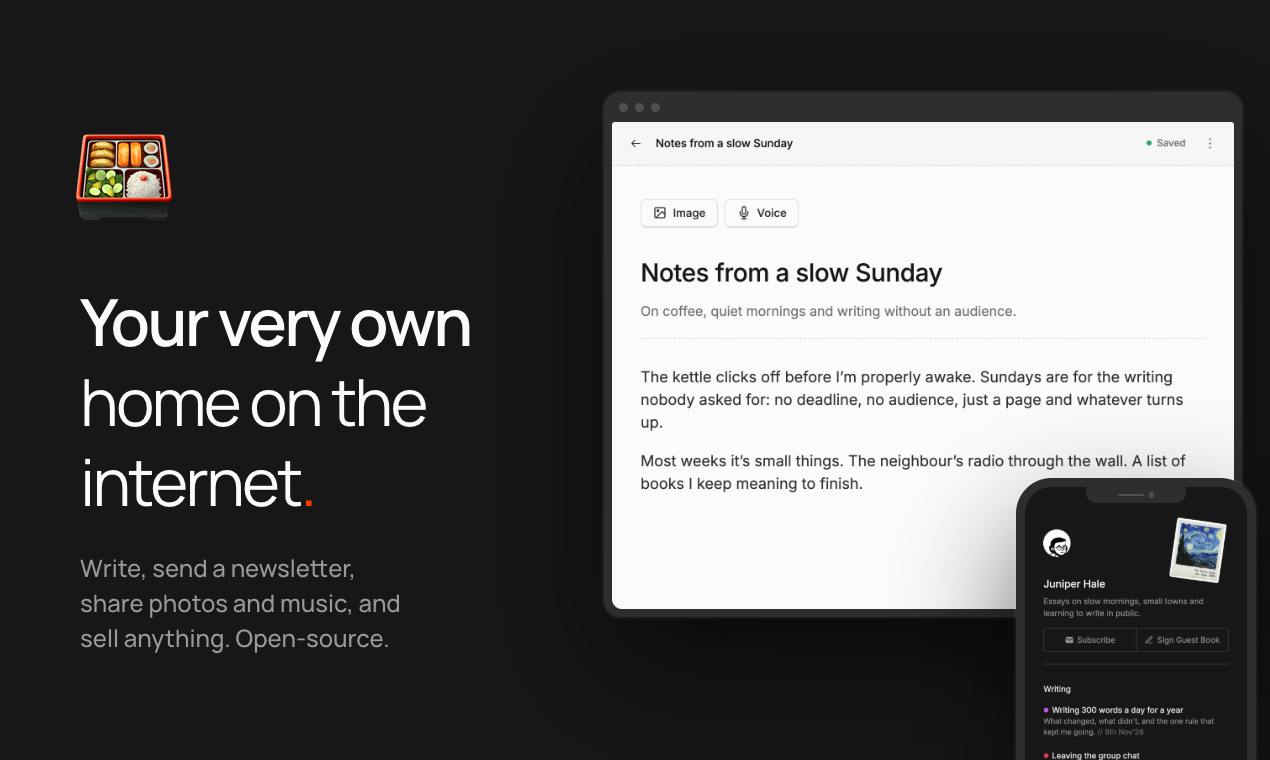
Open-source writing and newsletter tool Bublr gains traction, focusing on data autonomy and ad-free operation.
Bublr is an open-source writing and email newsletter all-in-one tool that has gained attention on Product Hunt, with the tagline "Your very own home on the internet, newsletter included." It bundles a personal homepage, blog, and email subscription — readers can subscribe directly on the page, and new content triggers automatic email notifications. Compared to platforms like Substack, Bublr's differentiators are being open-source, ad-free, and paywall-free, plus support for photo walls, Spotify music decoration, and a built-in store for direct monetization. Recent additions include Markdown export, private draft links, and a no-registration Explore page. It suits independent writers who value data autonomy, but lacks platform traffic distribution, and the long-term sustainability of the open-source project remains to be seen.
At a time when content platform algorithms shift constantly and paywalls are everywhere, an open-source project called Bublr has quietly gained traction on Product Hunt. Its tagline is "Your very own home on the internet, newsletter included" — offering writers a quiet, open, dedicated space with built-in email newsletters.
Core Positioning: A Writer's "Digital Homestead"
Bublr addresses a clear pain point: creators want a publishing channel that belongs entirely to them, rather than living on some big platform that could change the rules at any moment. It bundles a personal homepage, blog, and email newsletter together — readers can subscribe directly on your page or at the end of articles, and the system automatically sends email notifications when you publish new content.
This "homepage + newsletter" combination isn't new; platforms like Substack have already proven the model works. But Bublr's differentiator lies in its open-source nature and its commitment to no ads, no paywalls. The project is open-sourced on GitHub, meaning capable users can self-deploy or audit the code, returning some control over data to creators.
Newsletter (email newsletter) refers to a publishing format where creators regularly push content to subscribers via email. Unlike social platforms that rely on algorithmic distribution, email lists represent an audience relationship that creators directly own: subscriber email addresses are held by themselves or their chosen service provider, and delivery doesn't depend on platform recommendation mechanisms. Platforms like Substack, Ghost, and Beehiiv rose around this model. It's worth noting that running your own newsletter involves technical issues like email deliverability and unsubscribe compliance (such as CAN-SPAM and GDPR) — which is one reason hosted open-source tools like Bublr have value.
Open Source in this context typically refers to a software licensing model where source code is publicly available and users are allowed to view, modify, and self-deploy it. For writers, the practical significance of open source includes: the ability to self-host to avoid platform shutdown risks, auditable data handling practices, and the ability to continue the project themselves if maintenance stops. However, open source doesn't mean free or zero-barrier — self-deployment often requires a server, domain, and basic operations knowledge, which is exactly the trade-off that hosted open-source services need to navigate.
Feature Highlights: More Than Just Writing
Personalized Homepage and Content Monetization
Bublr lets users decorate their personal pages with photo walls and music (you can directly connect Spotify to stream what you love), turning the homepage into a space with genuine personal character. Even more practical is the built-in store feature — you can sell anything directly, with revenue going straight into your account, and the platform takes no cut or merely serves as a channel.
New Features for Readers
Recent updates include: Markdown export, private draft links, and an Explore page that can be browsed without registering an account. Markdown export lowers content migration costs, private links make it easy for authors to share unfinished drafts with a small group, and Explore lets readers discover content without signing up, lowering the reading barrier.
According to its Product Hunt page, Bublr received 81 upvotes, ranked 7th for the day, with only 1 comment. The numbers aren't explosive, but considering that open-source writing tools typically grow slowly through word of mouth, this starting point is worth watching.
Markdown is a lightweight markup language that uses simple symbols (such as # for headings and ** for bold) to format text, with source files being essentially plain text. For writers, its significance lies in: content isn't locked into any proprietary format, can be migrated to other platforms or tools at any time, and is safer for long-term preservation. Bublr offering Markdown export essentially lowers users' migration costs, echoing its positioning that emphasizes "content ownership."
Comparison with Similar Tools
The market isn't short of writing and newsletter tools: Substack excels in ecosystem and recommendation networks, Ghost is open-source and professional but has a higher deployment barrier, and the Notion + email plugin combination is flexible but lacks integration. Bublr's positioning is closer to "lightweight Ghost + personal homepage decoration," suited for independent writers who don't want to fuss with servers but care about data autonomy.
Its risks are also obvious: the sustainability of open-source projects depends on maintainers' energy, and there's no clear answer yet on how the free, ad-free model can operate long-term. Additionally, the store feature involves payment compliance, and creators in different regions may face additional barriers.
Ghost is an open-source content publishing platform that started as a blogging system and later added membership and newsletter features. Built on Node.js, it offers both official hosting and self-hosted server deployment. It has a good reputation among independent writers and media teams — its strengths are professional content management and a membership subscription system, while its weakness is that self-deployment requires some technical skill and server costs. Bublr is compared to "lightweight Ghost" precisely because it also focuses on open source and newsletters, but emphasizes low-barrier personal homepage building.
Who Should Try Bublr
If you're a writer who values content ownership and wants to keep your email list in your own hands, or simply wants a personal homepage free from algorithmic interference, Bublr offers an option worth trying. Its open-source nature also appeals to technically minded creators willing to participate in co-building.
However, if you rely on platform traffic distribution to attract readers, Bublr clearly can't replace large content platforms for now — it's more of a "home base" than a "traffic gateway."
One-line Summary
Open-source writing and newsletter tool Bublr gains traction, focusing on data autonomy and ad-free operation.
Paragraph Summary
Bublr is an open-source writing and email newsletter all-in-one tool that has gained attention on Product Hunt, with the tagline "Your very own home on the internet, newsletter included." It bundles a personal homepage, blog, and email subscription — readers can subscribe directly on the page, and new content triggers automatic email notifications. Compared to platforms like Substack, Bublr's differentiators are being open-source, ad-free, and paywall-free, plus support for photo walls, Spotify music decoration, and a built-in store for direct monetization. Recent additions include Markdown export, private draft links, and a no-registration Explore page. It suits independent writers who value data autonomy, but lacks platform traffic distribution, and the long-term sustainability of the open-source project remains to be seen.
Related articles
GTA VI's Instagram Clone: A Time Waster That's Worth Trying
*GTA VI* includes an Instagram-like social app dubbed "a time waster but worth it." This article explores how it enhances immersion, satirizes social media, and appeals to players tired of real-world socializing.

5.0 Magnitude Earthquake Near Manhattan Beach: USGS Quick Report and HN Buzz
USGS quick report: 5.0 magnitude earthquake ~5 km SW of Manhattan Beach, CA. HN post gets 200 points, 134 comments. Key takeaways and how to read quake reports.

Google Account Banned for Using Gemini?
A Hacker News user reports a Google account banned for using Gemini, raising concerns about AI service account security. We analyze possible causes and offer developer advice.