Budget-Paired Counterfactual Auditing: A New Approach to Evaluating Vision Agents

Budget-paired counterfactual auditing separates planning from heuristics via budget perturbation, shifting vision-agent evaluation from outcomes to process.
The article argues that conventional answer accuracy conflates observation selection, budget adaptation, and final decision in vision agents, obscuring the source of capability. It introduces budget-paired counterfactual auditing: fix evidence and region bindings, perturb only remaining budget, and compute exact continuation values to decompose expected accuracy loss into stepwise acquisition loss and terminal decision loss, corresponding to planning quality and terminal judgment. Experiments on forty paired routing anchors with five open-weight agents show fine-grained attribution is possible, moving evaluation from outcome- to process-oriented, though sample size limits generalizability.
When reading dense documents, vision agents need to allocate a limited observation budget across candidate regions. However, conventional answer-accuracy metrics conflate three key questions: where the agent looks, how it adapts its remaining reading, and how it answers after observation stops. This conflation makes it difficult to determine whether an agent's capability stems from planning or from heuristics. The recently proposed "Budget-Paired Counterfactual Auditing" protocol offers a new way forward for trustworthy evaluation.
Limitations of Accuracy Metrics and the Design of the Auditing Protocol
The mainstream way to evaluate vision agents today is to compute answer accuracy, but this metric is essentially a "black box"—it only tells us how many questions the agent answered correctly under a given budget, without explaining why. An agent may score highly because it is good at selecting key regions, or simply because a heuristic happens to match the test distribution. More troublesome still, when the budget changes, differences in the agent's performance cannot be attributed to specific decision-making stages.
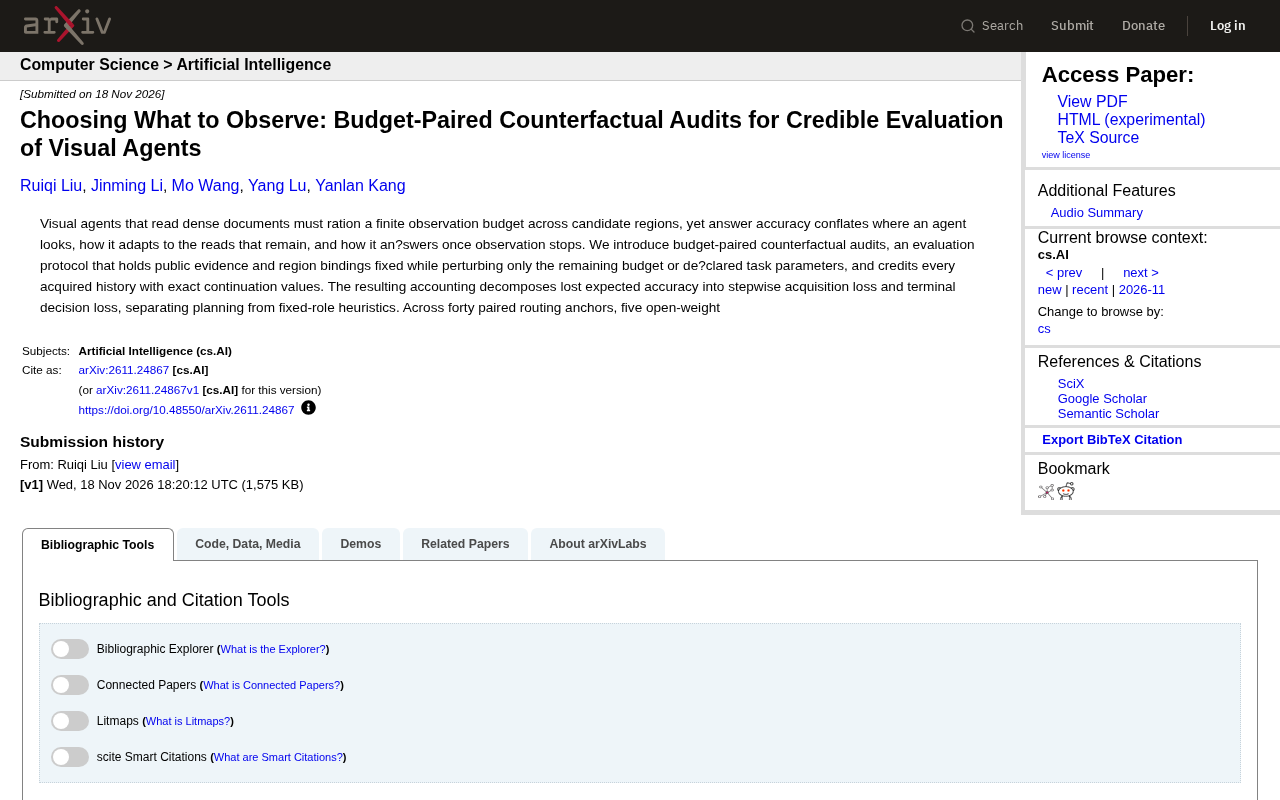
The core design of budget-paired counterfactual auditing is to keep the public evidence and region bindings fixed, perturb only the remaining budget or the declared task parameters, and then compute the exact continuation value for each acquisition history. This controlled perturbation means evaluation no longer relies on a single accuracy number, but instead observes how the agent's behavior changes across different budgets.
Counterfactual Audit is an evaluation method rooted in causal inference. Its core idea is: while holding all other conditions constant, artificially change one key variable and observe how the system's behavior changes accordingly, thereby judging that variable's causal contribution to the final outcome. In vision-agent evaluation, counterfactual auditing fixes the acquired evidence and region bindings, perturbs only the remaining budget or task parameters, and constructs counterfactual scenarios of "what would the agent do if the budget were different." This approach can reveal behavioral differences that conventional accuracy cannot capture, because it directly tests the agent's sensitivity of decision-making to budget changes rather than focusing solely on whether the final answer is correct.
Decomposing Accuracy Loss: Separating Planning from Heuristics
The key breakthrough of this protocol is that it decomposes the expected accuracy loss into two parts: stepwise acquisition loss and terminal decision loss. Stepwise acquisition loss measures the quality of the agent's planning when selecting regions at each step, while terminal decision loss reflects the final judgment capability after observation stops. This decomposition directly distinguishes planning ability from fixed-role heuristics—the former is a dynamic selection strategy based on current information, while the latter is a static, context-independent rule.
For example, if an agent performs poorly on stepwise acquisition loss, it means it is not good at dynamically adjusting observation regions based on existing information; if its terminal decision loss is high, it indicates that it cannot effectively integrate information after observation ends. This fine-grained attribution offers direct guidance for improving agent design.
Fixed-Role Heuristic refers to an agent using preset rules that are independent of the current context to select observation regions or make decisions, such as "always look at the title first" or "always scan for keywords." Such heuristics do not dynamically adjust based on acquired information, so they may perform well in-distribution but lack generalization and adaptability. In contrast, planning ability requires the agent to dynamically assess the value of the remaining budget based on existing observations and choose regions that maximize information gain. Decomposing accuracy loss into stepwise acquisition loss and terminal decision loss is precisely intended to quantify the respective contributions of these two capabilities: the former reflects planning quality, and the latter reflects information integration and judgment ability, thereby avoiding mistaking incidental success driven by heuristics for planning ability.
Experimental Design and Preliminary Findings
The study conducted experiments on forty paired routing anchors, involving five open-weight vision agents. Through the paired design, each anchor corresponds to a set of budget perturbations, making comparisons across different agents fairer. Although the original text does not disclose specific performance numbers, it can be inferred that this auditing method can reveal differences masked by conventional accuracy—for instance, some agents perform well when the budget is ample but degrade rapidly when the budget tightens, exposing deficiencies in their planning ability.
Paired Routing Anchors are a design used in experiments to control variables. Each anchor represents a fixed set of initial conditions and evidence bindings, and on this basis multiple budget-perturbed versions are generated to form paired samples. By comparing agent behavior across different budget versions under the same anchor, researchers can precisely calculate the causal impact of budget changes on decisions without being confounded by differences in task difficulty or initial information. This paired design improves statistical power, enabling meaningful differences to be detected even with limited samples (such as forty anchors), while also providing a fair baseline for cross-agent comparisons.
Implications for Vision-Agent Evaluation
The significance of this work lies in pushing evaluation from "outcome-oriented" to "process-oriented." For researchers, counterfactual auditing provides a diagnostic tool that can pinpoint an agent's weak links; for developers, it means they can optimize planning modules or decision modules in a more targeted way rather than blindly tuning hyperparameters.
However, the method is still in its early stages, with a limited sample size (forty anchors) and reliance on open-weight agents. More diverse tasks and agent architectures will be needed in the future to verify its generalizability. Regardless, budget-paired counterfactual auditing represents an important step toward trustworthy evaluation of vision agents—it is no longer satisfied with "answered correctly," but asks "why it answered correctly."
One-line Summary
Budget-paired counterfactual auditing separates planning from heuristics by perturbing the budget, moving vision-agent evaluation from outcome-oriented to process-oriented.
Paragraph Summary
The article points out that conventional answer-accuracy metrics conflate three stages of vision agents—observation selection, budget adaptation, and final decision—making it difficult to determine the source of capability. To address this, it introduces the "budget-paired counterfactual auditing" protocol: fix evidence and region bindings, perturb only the remaining budget, and compute exact continuation values, thereby decomposing expected accuracy loss into stepwise acquisition loss and terminal decision loss, corresponding respectively to planning quality and terminal judgment ability. Experiments evaluate five open-weight vision agents on forty paired routing anchors, demonstrating the possibility of fine-grained attribution. The method moves evaluation from outcome-oriented to process-oriented, helping to locate weak links and guide targeted optimization, but the sample size is limited and generalizability remains to be verified.
Related articles

From 0 to 1: Vibe Coding an AI Knowledge Base — A Practical Retrospective and Tech Stack Breakdown
A retrospective on building the AI knowledge base OilBook from scratch with Vibe Coding: Next.js+Neon stack, Oil Dev Skill workflow, Stripe paywall security, interview-style writing, AI-flavor control, and Vercel deployment.

GLM-5.4 Hands-On: Native Vision Meets a New Vibe Coding Workflow
Hands-on with Zhipu GLM-5.4: native vision tested across a 3D product demo, pure-code video generation, and remote-control Vibe Coding, compared with GPT-6.2 and Gemini Neon.

AI and Humans Claim to Prove the Riemann Hypothesis: Machine-Verified, Yet Nobody Can Understand It
Anthropic mathematician and AI Claude claim to prove the Riemann Hypothesis with 17 million lines of Lean code, machine-verified but unreadable by humans. This article analyzes the event, the zero proportion record from 41.6% to 67.2%, and the gap between machine verification and human understanding.