Build an Enterprise-Grade Local AI Knowledge Base at Zero Cost: A Practical RAG Starter Guide

Build a zero-cost, local RAG knowledge base for enterprise Q&A with full data security and flexibility.
Adapted from an introductory tutorial series, this article walks through building a production-ready enterprise knowledge Q&A system using a fully local, zero-cost RAG architecture. The system works by retrieving relevant chunks from a private knowledge base before passing them to a local LLM to generate grounded answers — solving the core limitation of general-purpose models that know nothing about internal business data. The architecture combines a local app layer, vector database, LLM, and embedding model. Local deployment ensures private data never leaves your servers (eliminating leak risk) while preserving the flexibility to fine-tune models for specific use cases. Applications range from personal document Q&A to 24/7 enterprise customer service agents, all built entirely on open-source components.
Why Build a Local AI Knowledge Base
No matter how powerful a large language model is, it has one fundamental blind spot: it doesn't know your business, and it doesn't know your data. When you ask a general-purpose LLM about your company's product details, customer policies, or proprietary documents, it either misses the mark or simply makes things up. Knowledge base Q&A systems — built on RAG (Retrieval-Augmented Generation) — exist precisely to solve this problem. By connecting your private data to the retrieval pipeline, they give AI answers a factual foundation.
This article is adapted from an introductory video in a tutorial series by a Bilibili creator. The core goal is to build a production-ready enterprise knowledge Q&A system at zero cost using a fully local setup. Three keywords define the entire approach: free, local, and production-ready.
Real-World Problems a Knowledge Base Can Solve
The use cases for knowledge base Q&A are broader than most people expect. For individual users, it can help organize notes, interpret research papers, search references, and power document Q&A. Take PDF chat as an example: upload a document, wait for it to be parsed, and then ask questions to instantly locate key information — dramatically speeding up the reading process. This is especially useful when reading academic papers, so you no longer have to scroll from beginning to end just to find a single conclusion.
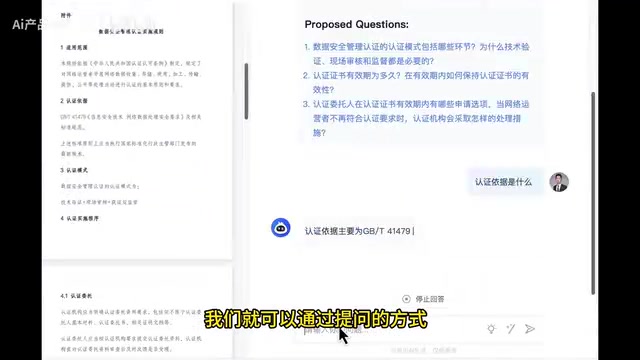
For businesses, typical applications include intelligent customer service, data presentation, and digital employees. In an online customer service scenario, users ask questions and the AI provides accurate answers — not from the model's own "memory," but retrieved in real time from the company's own knowledge base. This enables a 24/7 intelligent customer service agent that reduces costs, improves efficiency, and boosts customer satisfaction.

System Architecture: How the Core Modules Work Together
The entire system revolves around a single architecture diagram, which can be broken down into several key modules. The first is the local application layer, which handles user interactions and business logic. The second is the vectorized data store, which holds knowledge chunks after they've been split and embedded.
At the model layer, the system connects to a local LLM and a local embedding model. The LLM is responsible for generating the final answers, while the embedding model converts text into vector representations for retrieval. These modules work together to complete a full knowledge base Q&A cycle.
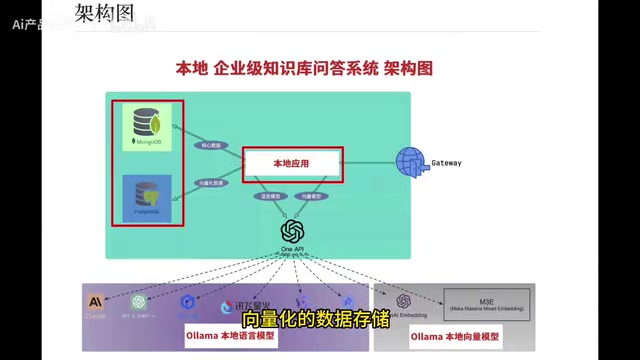
One important point: the entire approach emphasizes "local deployment" — both the LLM and the embedding model run on-premises rather than via external cloud APIs. This is a deliberate architectural decision with clear reasoning behind it.
The embedding model is the prerequisite that makes the entire architecture function, and it's worth understanding on its own. Its job is to map text into points in a high-dimensional mathematical space, so that semantically similar texts end up close together. For example, "refund policy" and "how do I request a refund" look quite different on the surface, but after vectorization they land in neighboring positions, allowing the retrieval system to correctly associate them. Popular open-source embedding models for local deployment include the BGE series (from BAAI) and Nomic-Embed — both run without internet access on a standard GPU or even CPU, forming the backbone of the "zero cost" promise.
Core Concept: RAG — Retrieval-Augmented Generation
The heart of the system is RAG (Retrieval-Augmented Generation). The core logic is: when a user asks a question, the system first retrieves the most relevant content chunks from the knowledge base, then passes those chunks along with the question to the LLM, which generates an answer grounded in the retrieved context.
This "retrieve first, then generate" mechanism is what enables large language models to answer enterprise-specific questions. It bypasses the limitation that training data doesn't include internal business information, and also helps suppress the model's tendency to hallucinate. The tutorial author notes that a detailed breakdown of how RAG works will be covered in a future video — this introductory piece only lays the conceptual groundwork.
RAG can be broken into two phases: an offline knowledge ingestion phase and an online retrieval and Q&A phase. During ingestion, documents are split into smaller chunks, each chunk is converted into a high-dimensional vector by the embedding model, and the vectors are stored in a vector database. During online Q&A, the user's question is also converted into a vector, and the system calculates cosine similarity (or other distance metrics) to find the most relevant chunks. These chunks are then appended to the prompt as "context" and handed to the LLM to generate the final answer. This architecture is inherently interpretable — every answer can be traced back to a specific source document chunk, making human review straightforward and significantly reducing the risk of misinformation from model hallucination.
Why Stick with Local Deployment
Local deployment may seem to add complexity, but the author argues it offers two irreplaceable advantages.
The first is data security. When you use an external model or third-party service, your private data and users' queries are sent to third-party servers. This exposes proprietary information to potential leaks — in serious cases, it can result in actual data breaches. Keeping both the model and the data on-premises fundamentally eliminates this risk.
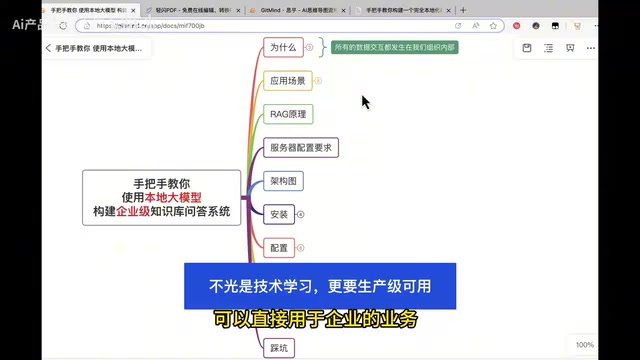
The second is flexibility. As your business grows, if a general-purpose model no longer meets your needs, local deployment lets you fine-tune the model to better fit your specific use case. This means you can ensure data security while retaining the ability to optimize and adapt later — combining safety with flexibility is the greatest value of a local-first approach.
Wrap-Up: The Path from Introduction to Implementation
As the opening entry in this tutorial series, this piece is primarily about building a mental model: what knowledge base Q&A can do, what modules make up the system, why RAG matters, and why local deployment is worth the effort. The actual hands-on work — model deployment, data vectorization, retrieval optimization, and more — will be covered step by step in upcoming videos.
For individuals and small-to-medium businesses looking to lower the barrier to AI adoption without compromising on data security, a local RAG knowledge base is an exceptionally cost-effective path. It doesn't rely on expensive cloud services, and all core components can be replaced with open-source alternatives — which is exactly what backs up the "zero cost" promise.
Related articles

Chain of Thought Isn't Just for AI: How Humans Can Use CoT to Improve Thinking Quality
Chain of Thought isn't just a prompt trick for large models. Starting from a Hacker News discussion, this article analyzes why CoT works for human thinking too, breaks down actionable ways to transfer it, and highlights the key differences between human CoT and machine CoT.
Cloudflare Teams Up with OpenAI: Closi…
Cloudflare Teams Up with OpenAI: Closing the Loop from Vulnerability Discovery to Defense with AI
Cloudflare uses OpenAI Daybreak to investigate security vulnerabilities and generate reviewable remediation plans, while developers use Codex to boost coding efficiency and quality.

Orca Multi-Agent Orchestration in Practice: A Guide to Parallel Collaboration with Claude and Codex
Orca is Stable AI's free open-source agent workbench supporting 34 agents like Claude Code and Codex in parallel. Learn its Git worktree isolation, multi-model orchestration, and mobile management.