Build n8n Workflows Automatically with Natural Language: A Deep Dive into the Open-Source N8n-MCP Tool
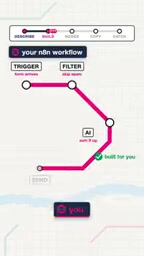
N8n-MCP lets AI generate n8n workflows from natural language, with extensive node knowledge, but beware of live editing risks.
N8n-MCP is a free open-source MCP tool that lets users describe automation tasks in natural language and have AI generate corresponding n8n workflows. It includes detailed information on over 3,000 n8n nodes and 2,000+ workflow templates, enabling AI to accurately understand node purposes and configurations. Through the MCP protocol, it integrates with coding agents like Cursor and Windsurf, allowing developers to design workflows in familiar interfaces and lowering the barrier to automation development. The creator specifically warns: never let AI directly edit live workflows—duplicate and test first, then apply manually. Additionally, you need your own n8n environment, and n8n itself uses a fair-code license rather than being fully open-source, so commercial use requires attention to its terms.
From Description to Workflow: What Is N8n-MCP?
If you've used n8n, you know its power lies in connecting everything—but building workflows is often a headache: dragging nodes, configuring parameters, debugging logic. A full setup can be time-consuming and labor-intensive. N8n-MCP aims to change that.
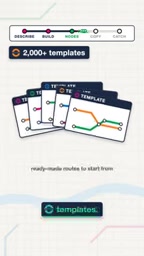
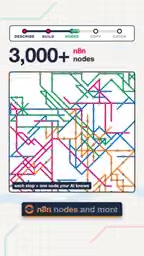
It's a free and open-source MCP tool with a straightforward core function: you describe an automation task in natural language, and the AI generates the corresponding n8n workflow for you. It comes with detailed information on over 3,000 n8n nodes and more than 2,000 workflow templates, enabling the AI to accurately understand each node's purpose and configuration.
For developers unfamiliar with the finer details of n8n nodes, this is like giving the AI a comprehensive n8n encyclopedia. You no longer need to manually scour documentation to confirm a node's parameter names—the AI can generate usable workflow configurations directly from this information.
How It Works: Integration with Coding Agents Like Cursor and Windsurf
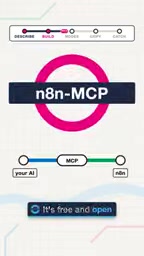
Another highlight of N8n-MCP is its compatibility. It isn't tied to a specific AI tool; instead, it works with various coding agents—including Cursor and Windsurf—via the MCP (Model Context Protocol) protocol.
This means if you're already using these AI coding tools, you can have the AI design and generate n8n workflows right in your familiar interface, without switching to n8n's graphical UI for manual work. The whole process feels more like chatting with an assistant that understands n8n: you describe your needs, and it outputs a structured JSON workflow file.
This integration lowers the barrier to automation development. Even if you're not deeply familiar with n8n's node system, the AI can offer reasonable configuration suggestions leveraging the knowledge base provided by N8n-MCP.
MCP (Model Context Protocol) is an open protocol proposed by Anthropic, designed to provide a standardized communication interface between AI models and external tools/data sources. You can think of it as the "USB-C port" of the AI world: regardless of the underlying model or application, as long as both sides follow the MCP specification, they can plug and play, exchanging context and instructions. In the context of N8n-MCP, the MCP server exposes n8n's node metadata, template library, and other resources to the AI, while coding agents call these capabilities through the protocol—extending the model's knowledge boundaries without modifying the model itself.
Key Warning: Never Let AI Directly Edit Live Workflows
Despite the tool's power, the creator himself offers a crucial safety reminder: never let AI directly edit your live workflows.
The right approach is to first duplicate the workflow for testing, confirm everything is correct, and then manually apply it to production. AI-generated content may contain logical deviations or configuration errors, and directly modifying live processes could lead to data loss or automation interruptions.
This warning is not unnecessary. n8n workflows often connect to critical business systems, and any accidental change can trigger a chain reaction. Positioning AI as an auxiliary design tool—rather than an executor directly operating the production environment—is currently the safer approach.
Usage Requirements and Open-Source License Notes
N8n-MCP itself is free and open-source, but to use it, you need your own n8n environment. In other words, this tool doesn't host n8n for you; it only helps you generate workflow configurations more efficiently.
Another point to note: n8n itself is not fully open-source, but uses a fair-code license model. This means there may be some restrictions on commercial use and distribution. If you plan to use n8n-based automation solutions in commercial products, it's advisable to review its license terms first.
Overall, N8n-MCP addresses the efficiency issue in building n8n workflows. It uses AI to bridge the gap between natural language requirements and structured configurations, while reducing the cognitive load of using nodes through its built-in knowledge base. But no matter how good the tool is, testing and caution in production environments remain indispensable.
fair-code is a "sustainable use" license model adopted by n8n, sitting between fully open-source and proprietary software: the source code is publicly available, can be self-deployed and modified, but has additional conditions for commercial distribution and hosting services (such as requiring derivative services to maintain the same license or imposing restrictions on resale). This differs from standard open-source licenses defined by OSI (like MIT, Apache 2.0), which allow almost unrestricted commercial use. Therefore, if you plan to embed n8n in commercial products or provide n8n-based services externally, be sure to read its specific terms to confirm compliance boundaries.
Related articles

Gemini 4 Neon Released: A Balance Between Frontier Intelligence and Efficient Task Execution
Google DeepMind releases Gemini 4 Neon, focused on frontier intelligence and fast end-to-end task execution. This article breaks down its benchmark performance in coding, enterprise analysis, scientific reasoning, and cybersecurity, its four thinking levels, pricing, and safety alignment data.

Is AI the Culprit Behind Global Outages? The Trust Crisis Behind the NSA and FAA Failures
Fourth major failure in five days hits NSA classified network. Microsoft blames a software bug, FAA denies its new AI system, NSA says routine maintenance. Senator Warner suggests AI accelerates vulnerability discovery, leading to rushed fixes — while 39% of Americans already view AI negatively, exposing a deepening trust crisis.

Robot Developer Builds Custom B-rep Kernel with 3,487 Tests
A robot developer builds a custom B-rep geometry kernel with 3,487 tests, exploring why robotics needs dedicated CAD tools and the barriers to building one.