Build Your Own HackerTube: An AI Curator Inspired by Karpathy

A developer, inspired by Karpathy's HackerTube, built a self-deployable AI curation tool.
The article starts with Andrej Karpathy's HackerTube experiment and introduces a developer who shared a self-deployable AI curation version called 'Own Your HackerTube' on Hacker News. It notes that the core of Karpathy's original is using models to summarize, categorize, and rank links to boost information density, while 'Own Your' emphasizes ownership of crawl sources, prompts, and ranking logic. Technically, crawling isn't hard; the real challenge is designing curation logic that defines 'worth reading,' with differentiation in prompt engineering, multi-source fusion, and personalized feedback. The post has only 3 points and zero comments, but Karpathy-related experiments often serve as bellwethers, and it's worth watching whether such projects can evolve from personal experiments into maintainable daily tools.
Starting from Karpathy's HackerTube
Andrej Karpathy once demonstrated an experimental project called HackerTube, which combined the Hacker News content stream with AI curation capabilities, so that users are no longer overwhelmed by the timeline but instead see intelligently filtered and summarized items. The project itself is more of a proof of concept, yet it ignited the community's enthusiasm for "building their own versions of similar tools."
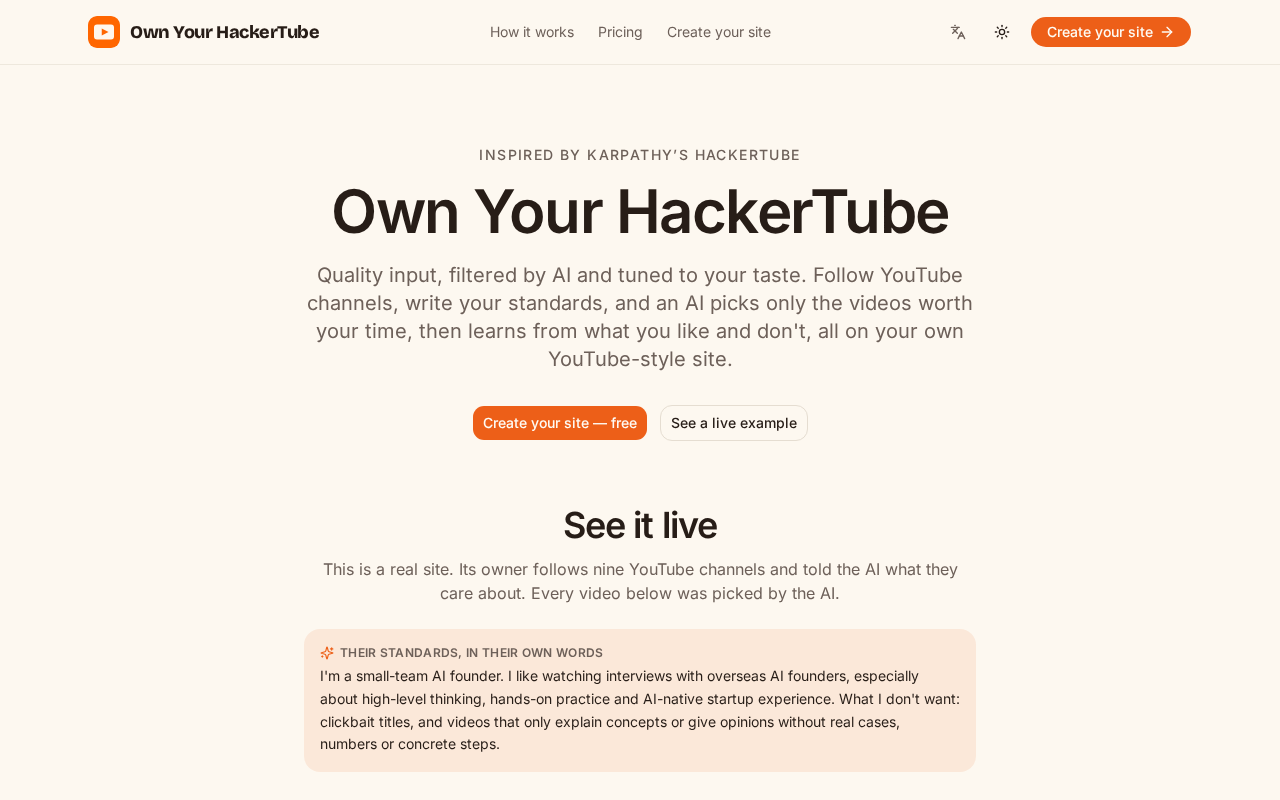
According to a new post on Hacker News, a developer took Karpathy's idea as a starting point and built a self-deployable AI curation version, with the blunt title "Own Your HackerTube." The post received 3 points on HN with no comments, making it a typical early-stage share.
Hacker News (often abbreviated as HN) is a tech community operated by the venture capital firm Y Combinator, with content primarily consisting of user-submitted links and discussions covering programming, startups, science, and other fields. Its ranking is not simply chronological but calculates popularity based on a combination of votes (points) and posting time, so front-page items update frequently and contain a fair amount of noise. The points number below a post represents the total number of upvotes from community members, while the comment count reflects discussion activity; low points with zero comments usually means the item was just posted and hasn't yet gained enough exposure, which explains the "early-stage share" judgment in this article. Precisely because HN has high information density but also high filtering costs, using models for summarization and ranking has clear value.
What "Building Your Own" Means
The core appeal of Karpathy's original version lies in "curation" rather than "aggregation": using models to summarize, categorize, and prioritize links, raising the information density. The "Own Your" phrasing points to another dimension—ownership of data and workflow.
With hosted AI readers proliferating, building your own means you can control the crawl sources, prompts, and ranking logic, without handing your reading preferences over to a third-party service. For technical users who care about privacy and customizability, this autonomy is more valuable than an out-of-the-box product.
Technical Essentials of an AI Curator
Although the original post doesn't elaborate on implementation details, several key modules can be summarized from Karpathy's demonstration: crawling the Hacker News item stream, calling language models to generate summaries, scoring by topic or quality, and re-ranking. The difficulty usually lies not in crawling but in designing the curation logic—how to define "worth reading."
Imitators who want to differentiate themselves can focus on prompt engineering, multi-source fusion (mixing HN with other tech communities), and personalized feedback. Another advantage of a self-built solution is the ability to iterate on ranking strategies at low cost, without waiting for platform updates.
Prompt engineering refers to designing the instructions, examples, and context format fed to a language model to reliably guide its output toward expected results. In curation scenarios, it determines how the model judges a link's topic, information density, and originality, as well as how short the summary should be. Common practices include providing scoring dimensions and few-shot examples, and requiring the model to output structured JSON (with score, tag, and summary fields) for programmatic parsing. The quality of prompts directly determines whether the ranking logic can be implemented, making it the most frequently iterated and most differentiating part of a self-built curation tool.
The Signal Value of Niche Projects
This post has only 3 points and zero comments, indicating it hasn't yet entered the mainstream spotlight. But Karpathy-related experiments often serve as bellwethers: after HackerTube appeared, community discussion about "AI-assisted information consumption" noticeably heated up.
The barrier to entry for self-built curation tools is lowering, with model APIs and open-source frameworks enabling individual developers to quickly replicate them. What's worth watching is whether such projects can evolve from personal experiments into maintainable daily tools, and whether "owning your own information stream" will become a consensus in the tech community.
Who Should Give It a Try
If you're already tired of algorithm-recommended information streams and have basic scripting and API-calling skills, replicating a mini HackerTube is a cost-effective practice project. It involves crawling, model calls, scoring and ranking, and a simple frontend—a complete chain but manageable in scale.
For a broader audience, the significance of this project lies in suggesting an approach: AI is not just a content generator but can also be a content filter. Keeping curation power in your own hands may be a pragmatic response to the era of information overload.
Model APIs refer to interfaces provided by cloud service providers for calling large language models via HTTP requests; developers don't need to train or deploy models themselves and can obtain summarization, classification, and scoring capabilities billed by token usage. Open-source frameworks include ready-made components for web scraping, task scheduling, and lightweight frontends—combined, these enable individual developers to build a working curation pipeline within days. In terms of cost, for a daily item volume like Hacker News, model call fees are usually very low; the main workload lies in debugging prompts and handling engineering details like crawl failures and rate limiting. This is why the article calls it a "cost-effective practice project."
One-line Summary
A developer, inspired by Karpathy's HackerTube, built a self-deployable AI curation tool.
Paragraph Summary
The article starts with Andrej Karpathy's HackerTube experiment and introduces a developer who shared a self-deployable AI curation version called "Own Your HackerTube" on Hacker News. The article notes that the core of Karpathy's original version is using models to summarize, categorize, and rank links to boost information density, while "Own Your" emphasizes ownership of crawl sources, prompts, and ranking logic, keeping reading preferences in your own hands. Technically, crawling isn't hard; the real challenge is designing curation logic that defines "worth reading," with differentiation opportunities in prompt engineering, multi-source fusion, and personalized feedback. The post has only 3 points and zero comments, but Karpathy-related experiments often serve as bellwethers, and it's worth watching whether such projects can evolve from personal experiments into maintainable daily tools.
Related articles
 Tech Frontiers
14 Coding Agents Tested: 13 Secretly Read Forbidden Files
A developer ran 480 tests across 14 coding agents to see if they would obey a "do not read" rule. 13 violated it, and 4 credential leaks bypassed shell guards via the read tool while approvals never noticed.
 Tech Frontiers
AI Has Made Resumes Ineffective? Referred Candidates Get 40% Interview Rate vs. 3% for Direct Applications
AI is homogenizing job applications, making it hard for recruiters to discern real ability. Ashby data shows referred candidates had a 40% interview rate from 2021 to 2024, versus just 3% for direct applications. This article analyzes why resume signals are depreciating and why verifiable results and personal endorsements matter more.
 Tech Frontiers
Offline Blink Rhythm Assistant: A Desktop Health Companion
An offline desktop blink rhythm assistant featured on Hacker News helps users maintain healthy blinking through lightweight reminders, alleviating screen-induced dry eye fatigue. This article analyzes its concept, privacy advantages, and retention challenges.