Building a 3D Da Vinci Museum in Code: A Show HN Project Experience

Procedurally building a Da Vinci 3D museum in code, exploring digital humanities' maintainability and immersion limits.
The article covers a project on Hacker News' Show HN: a Da Vinci-themed 3D virtual museum built entirely in code. It analyzes procedural generation's advantages over traditional DCC modeling in maintainability, parametric iteration, and first-screen loading, while noting its ceiling in geometric detail and lighting realism. The guided mechanism treats space as a timeline to help viewers follow Da Vinci's interdisciplinary content. It also discusses Web 3D tech choices, open-source reproducibility, and digital museums' educational value, while stressing they can't replace physical museums' scale and atmosphere. The takeaway: readable, modifiable code assets offer long-term compound value in the generative AI era.
When Code Meets the Renaissance
On Hacker News' Show HN board, a project called "A guided 3D Leonardo da Vinci museum, built in code" drew community attention. It's not a traditional 3D modeling and rendering product, but a Da Vinci-themed virtual museum entirely "built" in code. The author translated the artistic and engineering heritage of the Renaissance into an interactive, walkable three-dimensional digital space.
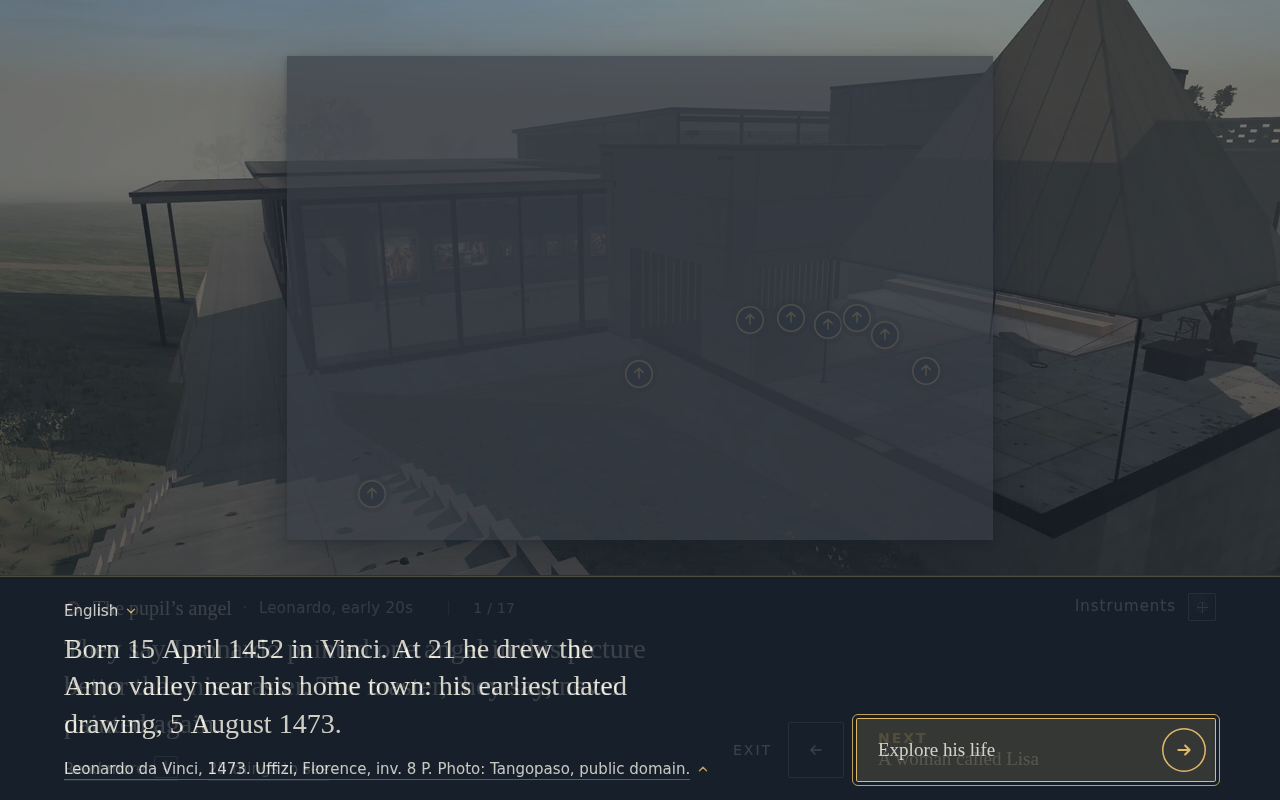
The core idea behind this project is worth pondering: it doesn't rely on assets exported from modeling software like Blender or Maya, but instead lets geometry, materials, lighting, and navigation logic all be generated procedurally. For developers, this means the museum itself is readable, modifiable source code, rather than a pile of hard-to-maintain binary model files.
What It Means to "Build" a Museum in Code
Procedurally Generated 3D Space
The traditional 3D content production pipeline usually goes: modelers create assets in DCC tools, artists paint textures, then engineers import them into an engine to assemble scenes. This Da Vinci museum took a different path—describing spatial structure directly with code.
The advantages of this approach may not be obvious in a project's early stages, but it's very friendly for long-term iteration. Exhibition hall layouts, exhibit positions, and visitor flow can all be controlled by parameters. Want to adjust the position of a wall or add an exhibition area? You change a few lines of code rather than remodelling. For individual developers or small teams, procedural generation dramatically lowers the barrier to producing 3D content.
Of course, there are costs. Pure code construction struggles to achieve the fine detail precision of hand-sculpted work. Those exquisite mechanical structures and flying machine designs in Da Vinci's manuscripts inevitably lose some visual persuasiveness when approximated with geometric primitives. How to trade off between "maintainability" and "expressiveness" is the core challenge of such projects.
DCC tools stands for Digital Content Creation, referring to professional software like Blender, Maya, 3ds Max, and ZBrush used for modeling, sculpting, texturing, and animation. They manually edit vertices, UVs, and materials through a graphical interface, producing binary asset files (such as .blend, .fbx, .obj) that are difficult to compare via text diff or merge with code. Compared to procedural generation, the DCC pipeline is better suited for high-precision, one-off artistic assets, while code solutions are better for parametric scenarios requiring frequent iteration or batch variants. The two are not mutually exclusive: in practice, a common approach is to create core exhibits in DCC, then procedurally generate architectural frameworks, lighting, and repetitive decorations with code, balancing precision and maintainability.
Designing the Guided Experience
As a "guided museum," the project clearly has some navigation mechanism built in. Visitors don't wander freely but are guided through exhibition areas in sequence. This design is especially suitable for a theme as sprawling as Da Vinci—he was a painter, anatomist, engineer, and architect. Without a narrative thread, visitors easily get lost in the information density.
A guided tour essentially treats space as a timeline. Each stop corresponds to a piece of content, and visitors receive the narrative while moving. This "space as interface" approach is completely different from how traditional web pages or videos organize information, and is closer to the cognitive experience of a physical museum.
Technical Choices and Trade-offs Behind Show HN
3D Solutions Suitable for the Browser
To run 3D scenes smoothly in the browser, options include Three.js, Babylon.js, PlayCanvas, and others. This project's ability to earn a showcase spot on HN suggests it has reached an acceptable level in performance and loading experience.
A major challenge of pure Web 3D is first-screen loading. If model and texture assets are too large, user wait times increase significantly. Code-generated solutions actually have an advantage here—geometry is computed at runtime, so there's no need to download large model files, and the initial bundle can be kept small.
Another key point is cross-device compatibility. Desktop browsers, mobile devices, and even VR headsets have very different requirements for 3D rendering. A scene running at a full 60 frames on a development machine might stutter on a phone. Projects need to find a balance within these constraints.
Three.js is a JavaScript 3D library based on WebGL, offering high-level abstractions like scene graphs, cameras, lighting, materials, and loaders. It has a massive ecosystem and abundant examples, but developers must assemble the rendering pipeline themselves. Babylon.js is more complete, with built-in physics, GUI, animation, and a shader editor, plus friendly TypeScript support—suitable for medium-to-large projects. PlayCanvas leans toward a visual editor and team collaboration, similar to a Unity workflow on the web. All three share WebGL as their foundation (WebGPU for the newer generation), ultimately compiling to GLSL/WGSL shaders that execute on the GPU. When choosing, one typically weighs bundle size, API style, community activity, and fit with the existing tech stack; pure code-generation projects often prioritize Three.js because its geometry and materials can be constructed directly in code without an additional asset pipeline.
Open Source and Reproducibility
The Show HN community usually has extra appreciation for "built in code" projects, because they're naturally reproducible and learnable. Anyone can clone the code, modify parameters, and generate their own version. This openness turns a project from "a work" into "a tool."
Following HN discussion conventions, such projects often receive specific feedback on code structure, rendering performance, and content accuracy. For historical subjects like Da Vinci, the historical accuracy of exhibits is also carefully scrutinized—the proportions of the Mona Lisa, the mechanical logic of flying machine manuscripts. There are plenty of knowledgeable viewers in the community.
Show HN is a section on Hacker News dedicated to showcasing creators' new work. Users post with "Show HN: project name" along with an accessible link, and the community provides technical feedback, challenges, and improvement suggestions in the comments. It favors independent, open-source projects with runnable demos, especially appreciating "built in code" works whose source can be read directly. Unlike Product Hunt, which emphasizes product launches, Show HN values the intrinsic interest and reproducibility of the technical implementation itself. A successful Show HN often brings a surge in GitHub stars, an influx of issues and PRs, and may also expose performance bottlenecks or historical accuracy problems. For developers, it's a low-cost channel to get high-quality peer review, and a stress test for a project's long-term maintainability.
The Value and Limits of Digital Museums
Educational Tools That Break Physical Constraints
Physical museums are constrained by venue, exhibition period, and geographic location. Da Vinci's authentic works are scattered across the Louvre, the Uffizi, the British Museum, and elsewhere around the world—ordinary people can hardly see them all in a single trip. Digital museums have a natural advantage here—they gather dispersed collections into the same virtual space.
More importantly, procedural museums can be copied, distributed, and embedded. Teachers can put them in classrooms, developers can transform them into other themes. This is a dissemination efficiency that physical museums cannot achieve.
The Ceiling of Immersion
But digital substitutes cannot fully replicate physical experience. That sense of scale shock, brushstroke detail, and the atmosphere created by surrounding visitors standing before the original Mona Lisa cannot be conveyed through a screen. The value of 3D museums is not "replacement" but "supplement"—it's a means of preview, review, and outreach, not the endpoint.
There's also a ceiling at the technical level. Current Web 3D still struggles to match offline rendering in lighting realism and material expression. The more complex the code-generated geometry, the greater the performance pressure. These limits determine that today's digital museums are more "indicative" than "archival."
Offline rendering refers to using algorithms like path tracing and photon mapping to compute a single frame over seconds to hours on CPU/GPU clusters, achieving photo-level realism. Representative tools include Blender Cycles, Arnold, and V-Ray. Web 3D must complete a frame within 16 milliseconds to guarantee 60-frame interaction, so it generally uses a rasterization pipeline with approximate algorithms to simulate shadows, reflections, and global illumination. Real-time ray tracing (such as WebGPU's hardware ray tracing extensions) is narrowing the gap, but remains unrealistic for mobile and low-end devices. This performance gap dictates that code-generated digital museums typically use stylized materials and baked lighting to trade "indicativeness" for smooth interaction; if archival-level fidelity is desired, pre-rendered video or static panoramas are needed as a supplement.
Takeaways for Developers and Creators
What's most worth learning from this project may be the new posture for content creation it demonstrates: encoding knowledge structures directly as interactive space. Da Vinci's manuscripts were themselves a kind of "interdisciplinary notebook," and the code museum is a digital homage to that way of thinking.
For creators in AI and technology, this kind of project points to a path—as generative tools become more powerful, the ability to "describe the world in code" actually has more long-term value. Models will become obsolete, but readable, modifiable, and composable code assets will continue to generate compound returns.
If you're interested in 3D visualization, procedural generation, or digital humanities, this Show HN project is worth taking the time to wander through—and to read its source code.
One-line Summary
Procedurally building a Da Vinci 3D museum in code, exploring the maintainability and immersion boundaries of digital humanities.
Paragraph Summary
The article introduces a project featured on Hacker News' Show HN board: a Da Vinci-themed 3D virtual museum built entirely in code. The author analyzes the advantages of procedural generation over traditional DCC modeling in maintainability, parametric iteration, and first-screen loading, while also noting its ceiling in geometric detail and lighting realism. The guided mechanism treats space as a timeline, helping viewers build narrative threads amid Da Vinci's interdisciplinary content. The article also discusses Web 3D technology choices, open-source reproducibility, and the value of digital museums as educational and preview tools, while emphasizing that they cannot replace the scale shock and atmospheric experience of physical museums. The ultimate takeaway: readable, modifiable, and composable code assets have greater long-term compound value in the era of generative AI.
Related articles

Chain of Thought Isn't Just for AI: How Humans Can Use CoT to Improve Thinking Quality
Chain of Thought isn't just a prompt trick for large models. Starting from a Hacker News discussion, this article analyzes why CoT works for human thinking too, breaks down actionable ways to transfer it, and highlights the key differences between human CoT and machine CoT.
Cloudflare Teams Up with OpenAI: Closi…
Cloudflare Teams Up with OpenAI: Closing the Loop from Vulnerability Discovery to Defense with AI
Cloudflare uses OpenAI Daybreak to investigate security vulnerabilities and generate reviewable remediation plans, while developers use Codex to boost coding efficiency and quality.

Orca Multi-Agent Orchestration in Practice: A Guide to Parallel Collaboration with Claude and Codex
Orca is Stable AI's free open-source agent workbench supporting 34 agents like Claude Code and Codex in parallel. Learn its Git worktree isolation, multi-model orchestration, and mobile management.