Building a Claude Code Skill from Scratch: Let AI Auto-Generate Daily News Reports

How to build a custom Claude Code Skill that auto-generates daily AI news reports.
This article explains how to build a custom Claude Code Skill that automatically fetches, filters, and generates daily AI news reports. It covers the Skill's execution logic, task decomposition using Chain-of-Thought and Task Planning, HTML visualization output, and RAG-based source-tracing design—offering a complete reference for personal automation workflows.
From Conversation to Daily Report: The Birth of a Custom Skill
As AI tools become increasingly widespread, more and more developers are exploring how to package the capabilities of large models into reusable "Skills" to automate their workflows. Bilibili creator "Dolphin Beat" shared a particularly practical example: by building a custom Claude Code Skill called Dolphin Beat AI News, Claude Code can automatically fetch, filter, and generate a daily AI news report.
Claude Code technical background: Claude Code is a command-line AI coding assistant for developers released by Anthropic. Its Skill system allows users to package complex multi-step tasks into reusable modules through a CLAUDE.md configuration file or custom instruction sets. Notably, CLAUDE.md is essentially a persistent "system prompt" file—it automatically injects context at the start of every session, enabling Claude Code to "remember" the user's work preferences, project structure, and custom toolchains. This mechanism is analogous to "higher-order abstraction" in functional programming—by pre-defining the underlying prompt engineering, tool-calling chains, and output templates, users can trigger a complete execution flow with just one natural language sentence, greatly reducing the operational cost of repetitive work. Compared to other AI coding tools on the market (such as GitHub Copilot and Cursor), Claude Code's Skill system places greater emphasis on "task-level programmability" rather than merely providing code completion, making it more suitable for building end-to-end automation workflows.
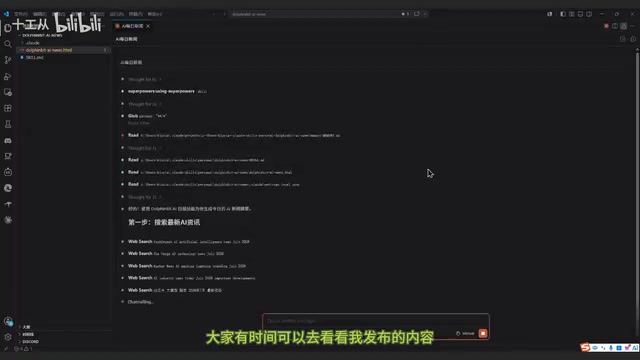
The entry point to the entire process is remarkably simple. In VS Code, click on Claude Code in the top-right corner. Since the API is already configured in advance, the tool will automatically complete the login. Then, you simply type a natural language command like "AI Daily News" into the dialog box to trigger the complete execution chain of this custom Skill. This "one-sentence invocation" interaction is the greatest convenience brought by Skill packaging—condensing complex multi-step tasks into a single simple conversation.
The Execution Logic Behind the Skill
Preset News Sources and Task Checklist
The core design philosophy of this Claude Code Skill is worth learning from. The author configured 5 cutting-edge AI news websites inside the Skill, and the tool traverses and reads each site one by one. More importantly, the author set up a clear To-Do List for the AI, executing in the following order: search first, then filter, then generate HTML.
This structured task decomposition is key to enabling stable AI output. Its theoretical foundation comes from research on "Chain-of-Thought" (CoT) and "Task Planning." CoT was first systematically proposed by Google Research in the 2022 paper Chain-of-Thought Prompting Elicits Reasoning in Large Language Models. The core finding was that when a model is asked to "think step by step" rather than give an answer directly, its accuracy on complex tasks such as mathematical reasoning and logical judgment can improve severalfold. Researchers found that this step-by-step decomposition forces the model to allocate more attention resources within the "thinking space," thereby reducing the accumulation of errors caused by skipping steps.
"Task Planning" is a further engineering extension built on top of CoT—decomposing a single problem into an ordered sequence of subtasks, where the output of each subtask becomes the input of the next, forming a verifiable execution chain. This approach gave rise to a series of Agent frameworks such as ReAct, HuggingGPT, and AutoGPT. Compared to having the model complete a vague instruction "in one shot," decomposing tasks into verifiable substeps essentially transforms a single large model call into a multi-step Agent workflow—where each step has clear input-output boundaries. This can significantly improve execution reliability and greatly reduce the probability of the model hallucinating or deviating from its goal.
In this case, the search phase handles data collection, the filtering phase extracts the top 10 most important news items from the vast pool of information, and the generation phase handles the final presentation format. The three phases have clear, decoupled responsibilities. This "pipeline-style" task design not only improves execution stability but also allows the output of each phase to be individually verified and debugged, greatly reducing troubleshooting costs.
From Filtering to Visualized Output
Once execution is complete, the Skill generates a complete "Dolphin Beat AI Daily Report," marked with the specific date and listing the 10 most important AI news items of the day. The author further instructed the AI to output an HTML page—simply copy the generated address and open it in a browser to see a beautifully formatted daily report page.

It's worth mentioning that the tool also automatically generated a dolphin-themed logo for the report, echoing the author's "Dolphin Beat" brand image. This reflects AI's current multimodal capabilities in content generation—it can not only handle text but also automatically design visual elements. This kind of generation process, driven by pure text prompts and ultimately producing output containing both visual and structured content, is generally classified in the industry as an early practical form of "Generative UI." The core concept of Generative UI is that the interface is no longer a pre-designed static template, but is dynamically generated by the model based on user intent and data content—Vercel's AI SDK and Anthropic's Artifacts feature are both representative explorations in this direction, foreshadowing a future trend toward dynamic and personalized human-computer interaction interfaces.
Detailed Experience: Localization and Source Tracing
This daily report has two thoughtful design touches in terms of user experience. First, the fetched English news is automatically localized into Chinese, greatly lowering the reading barrier for Chinese users. Second, each news item retains its original source—after a user selects a news item and clicks "View Original" in the bottom-right corner, they can directly jump to the original source page of that news item.

The design of retaining the original source aligns closely with the current mainstream RAG (Retrieval-Augmented Generation) architecture concept. RAG was first proposed by Meta AI Research in the 2020 paper Retrieval-Augmented Generation for Knowledge-Intensive NLP Tasks, aiming to solve two chronic problems of purely parametric large models: the static nature of the knowledge cutoff date, and the "black box" problem where generated content cannot be traced back to its source.
The core idea of RAG is to decouple the "retrieval" and "generation" modules: the retrieval module is responsible for pulling the most relevant content snippets to a query in real time from an external knowledge base (such as web pages, databases, or document repositories), while the generation module uses these retrieval results as "anchors" to organize language output on a factual basis. The retrieval results are equivalent to providing the model with reference materials for an "open-book exam," so it doesn't have to rely on the parametric memory fixed during training, but instead generates "evidence-based" content grounded in real-time data. This architecture both resolves the limitation of large models' knowledge cutoff dates—because it retrieves real-time data—and provides a traceable original basis for each piece of generated content, making it clear which statement comes from which source.
In an era where AI-generated content is increasingly proliferating and "hallucinations" and misinformation are frequent, mandatory source attribution is not only an effective means of combating AI hallucinations but also a demonstration of compliance and copyright awareness. For news aggregation applications, source-tracing links also carry important legal significance—they clarify the original copyright ownership of the content, avoiding the copyright infringement risks that large-model-generated content may bring.
In addition, all data source websites are specifically listed at the bottom of the page. This emphasis on information source-tracing is especially valuable. Enabling users to verify the original text with one click both ensures information credibility and reflects a responsible AI application design philosophy.
The Value and Insights of Custom Claude Code Skills
A New Paradigm for Personal Automation Workflows
Although the author jokingly calls this case a "newbie's unorthodox hack," the underlying approach is quite representative. It essentially achieves end-to-end automation of the common information workflow of information collection + content filtering + formatted output through a Claude Code Skill. For professionals who need to keep up with industry trends daily, a tool that automatically generates daily reports can save a great deal of information-gathering time.
More importantly, this model is highly transferable. Replace the news sources with websites from other fields, and you can generate daily reports for the corresponding domain; adjust the filtering criteria and output format, and you can adapt it to different use cases—for example, legal professionals could replace the data sources with court judgment databases and legal regulation update pages to generate a daily judicial trends briefing; investors could connect to financial news sites and listed company announcements to generate customized market intelligence reports. The configurability of Skills makes personalized automation tools readily accessible.
From AI User to Tool Creator
The author mentioned that they will later teach everyone how to build this Skill, which is particularly noteworthy. The current trend in AI tool development is evolving from "using off-the-shelf products" to "everyone can customize."
This trend is in line with the rise of No-Code/Low-Code platforms: information aggregation tools that previously required mastery of multiple skills—such as crawler development (like Scrapy, Playwright), data processing (Pandas), and frontend rendering (HTML/CSS)—can now be achieved by ordinary users through reasonable prompt engineering and task decomposition, enabling end-to-end automation with the help of large models.
The technical foundation supporting this paradigm shift is the maturity of large models' Tool Use (Function Calling) capabilities. In 2023, OpenAI was the first to officially introduce Function Calling in the GPT-4 API, followed by mainstream model vendors such as Anthropic and Google. The essence of this capability is that the model is no longer just a "conversationalist" but an "executor" that can proactively call external APIs, read and write file systems, and execute code. Through structured function signature descriptions, the model can understand when to call a tool and what parameters to pass, thereby unifying "thinking" and "acting" within the same agent framework. It is precisely the maturity of Tool Use capabilities that makes the cross-system operation chain of "read web page → extract content → generate HTML" in this case possible.
With development environments like Claude Code that support custom Skills, ordinary developers and even non-professionals can build their own dedicated automation assistants according to their needs. This "hands-on building" capability dramatically lowers the barrier to developing automation tools. The democratization of technology allows everyone to become the architect of their own workflow.
Conclusion
From a single command of "AI Daily News" to a beautifully formatted, source-traceable AI daily report, this case vividly demonstrates the enormous potential of custom Claude Code Skills in the field of personal automation. The technical implementation may not be complex, but the ideas it embodies—"structured task decomposition," "RAG source-tracing awareness," and "from using to creating"—are highly valuable practical samples for every user who hopes to harness AI tools. We look forward to the author's upcoming Skill-building tutorial, and to more people joining the ranks of those who "hand-build" their own automation tools.
Related articles

ChatGPT Space Launches: Team Collaboration and New Pages Features Explained
ChatGPT Space is OpenAI's new team collaboration feature with Pages, real-time collaboration, and Slack/Google Drive sync. We break down its privacy design, multi-platform integration, and the full workflow from conversation to document.

Migrating Apache Spark UDFs to GPU Acceleration with AI Agents
NVIDIA developer blog explains how AI Agents rewrite Apache Spark UDFs for GPU acceleration, covering migration criteria, agent rewriting and verification workflows, plus pitfalls like result consistency and CPU-GPU transfer overhead.

Zed Editor v0.40.4-rc2 Released: Usage Credits Now Available Without Upgrading
Zed editor releases v0.40.4-rc2, allowing users to use usage credits for AI features without upgrading to a paid plan, lowering the trial barrier.