Building a Decision Tree from Scratch: A Hands-On Guide to Implementing ML Algorithms

A learner implements a decision tree from scratch on day 13, discovers recursion and overfitting firsthand, and plans to tackle Bagging next.
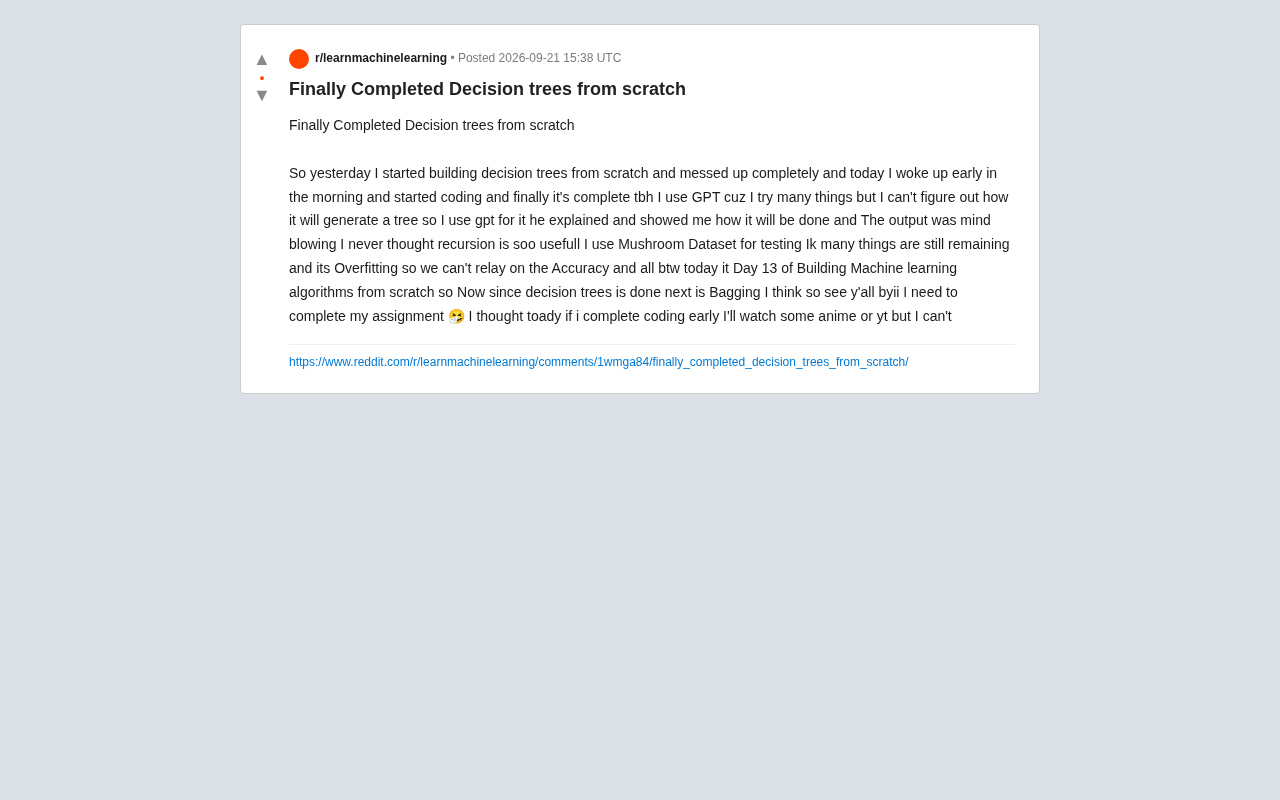
A machine learning beginner documented their day-13 challenge of implementing a decision tree from scratch on Reddit. The post highlights two key insights: an "aha" moment around recursion — the tree-building process is essentially repeated cycles of selecting the best feature, splitting data, and recursing on subsets — and proactively identifying overfitting when testing on the Mushroom Dataset. The author plans to move on to Bagging as a natural next step for addressing the high variance of single trees.
A machine learning learner shared their experience implementing a decision tree algorithm from scratch on Reddit. This was day 13 of their "Build ML Algorithms from Scratch" challenge. While the post was brief and candid about the struggles involved, the learning approach and technical insights it reflects are genuinely valuable for anyone wanting to understand the fundamentals of machine learning.
Why Implement a Decision Tree from Scratch
Many beginners go straight to calling DecisionTreeClassifier from scikit-learn — a few lines of code and you have results. But the best way to truly understand how an algorithm works is to build it yourself.
The author mentioned that their first attempt on day one was a complete mess, and they had to start over the next morning before finally getting it to work. This kind of trial and error is exactly what it takes to deeply understand an algorithm. The core challenge in a decision tree is figuring out how to recursively partition a dataset — splitting data in two at each node based on some feature and threshold, then repeating the process on each subset until a stopping condition is met.
The author admitted to using GPT to understand "how the tree is actually built." This is a pragmatic approach for today's learners: when you're stuck on a concept, use an AI tool to clarify the abstract logic, then implement it yourself — that's far more valuable than just copying code. They described being "mind-blown" by the output and marveled at how useful recursion turned out to be.
Recursion: The Soul of a Decision Tree
The author's key insight was recursion. Building a decision tree is fundamentally a recursive process:
The Core Logic of Decision Tree Construction
- Select the best splitting feature: Use metrics like information gain or Gini impurity to find the feature and split point that best separates the data.
- Partition the dataset: Split the data into left and right subsets based on the chosen condition.
- Build recursively: Repeat the above process for each subset to generate child nodes.
- Set stopping conditions: Stop splitting when a node is pure enough, has too few samples, or has reached the maximum depth — forming a leaf node.
Once you understand this recursive structure, the seemingly complex tree hierarchy becomes much clearer. That's why the author was so surprised by the power of recursion — just a few dozen lines of recursive code can build a complete classification tree.
Information gain measures the reduction in "disorder" after splitting on a feature, and it relies on Shannon Entropy under the hood: lower entropy means purer data. Gini impurity is another common purity metric that's computationally cheaper than entropy and is scikit-learn's default splitting criterion. In practice, the two perform similarly, and the choice rarely has a significant impact on the final model. When implementing from scratch, the most time-consuming part is often the brute-force search for the optimal split point: computing information gain for every feature and every possible threshold, then taking the maximum. This step has a time complexity of O(n·m·log n), where n is the number of samples and m is the number of features — and it's the main bottleneck in decision tree training speed.
The Mushroom Dataset and a Real Lesson in Overfitting
The author used the classic Mushroom Dataset to test their implementation. This dataset contains various mushroom features used to predict whether a mushroom is poisonous, making it a common teaching example for decision trees — its categorical features are a natural fit for tree-based models.
Notably, the author was sharp enough to recognize that their model "overfitted, so I can't really rely on its accuracy." That's a mature observation. A basic decision tree implemented without constraints (like maximum depth, minimum sample count, or pruning) will easily memorize the entire training set, achieving near-perfect accuracy on training data while generalizing poorly.
Recognizing overfitting matters far more than blindly celebrating high accuracy. It shows the author isn't just "getting the code to run" — they're genuinely thinking about the model's limitations.
Overfitting essentially means the model has learned the noise in the training data, causing a significant performance drop on new data. The most straightforward way to detect it is to compare training set accuracy against validation/test set accuracy: if training accuracy is nearly 100% while test accuracy is noticeably lower, overfitting is almost certain. For an unconstrained decision tree, in the extreme case every leaf node contains just one training sample — the tree memorizes all training data, which statistically means zero bias but extremely high variance. Common constraints include: limiting maximum tree depth (max_depth), requiring at least N samples before a node can split (min_samples_split), and post-pruning — growing the full tree first, then trimming branches from the bottom up that don't improve performance on a validation set.
Next Step: From a Single Tree to Ensemble Learning
The author teased that their next challenge would be Bagging (Bootstrap Aggregating). This is a natural progression.
The biggest problem with a single decision tree is high variance and a tendency to overfit — exactly the issue the author just ran into. Bagging addresses this by sampling the training data with replacement, training multiple decision trees, and aggregating their predictions, effectively reducing variance and improving stability. Random Forest is the classic application of the Bagging idea.
Moving from a single tree to ensemble methods is a well-designed learning path: first understand the base model's principles and limitations, then learn how ensembles can compensate for those shortcomings.
The core idea behind Bagging comes from Bootstrap resampling in statistics: sample n times with replacement from a training set of n samples to construct a new "bootstrap sample," which will contain roughly 63.2% of the original samples. The remaining ~36.8% (called Out-of-Bag, or OOB samples) can naturally serve as a validation set without any additional splitting. After repeating this process to train multiple trees, classification tasks use majority voting while regression tasks use averaging. Random Forest adds another layer of randomness on top of Bagging: instead of considering all features at each split, it randomly selects √m candidate features, reducing correlation between trees and improving ensemble performance. This "trade high variance for lower variance" tradeoff is the core logic of ensemble learning.
The Value of Daily Practice
This "Build ML Algorithms from Scratch" challenge has now reached day 13, and this kind of sustained daily practice is an effective way to master the underlying principles. The author jokingly noted at the end of the post that they had wanted to finish coding early to watch anime or YouTube, but still had homework to do. That honest depiction of the learning experience is deeply relatable — learning is never a smooth ride.
For learners who want to take a similar path, here are a few takeaways:
- Implementing beats passive reading: Writing an algorithm yourself is the only way to truly understand each step.
- Use AI to aid comprehension: When stuck, use tools like GPT to explain concepts — but always write the code yourself.
- Stay critical: Question high accuracy the way the author questioned overfitting.
- Progress incrementally: Move from basic algorithms to ensemble methods step by step, building a complete knowledge foundation.
Hand-coding machine learning algorithms may not be part of everyday engineering practice, but the deep understanding it builds is something no amount of library-calling can replicate.
Related articles

Chain of Thought Isn't Just for AI: How Humans Can Use CoT to Improve Thinking Quality
Chain of Thought isn't just a prompt trick for large models. Starting from a Hacker News discussion, this article analyzes why CoT works for human thinking too, breaks down actionable ways to transfer it, and highlights the key differences between human CoT and machine CoT.
Cloudflare Teams Up with OpenAI: Closi…
Cloudflare Teams Up with OpenAI: Closing the Loop from Vulnerability Discovery to Defense with AI
Cloudflare uses OpenAI Daybreak to investigate security vulnerabilities and generate reviewable remediation plans, while developers use Codex to boost coding efficiency and quality.

Orca Multi-Agent Orchestration in Practice: A Guide to Parallel Collaboration with Claude and Codex
Orca is Stable AI's free open-source agent workbench supporting 34 agents like Claude Code and Codex in parallel. Learn its Git worktree isolation, multi-model orchestration, and mobile management.