Building a Free Alternative TV Network from the Internet Archive's Forgotten Videos

Spelunkr re-curates forgotten Internet Archive videos into a free alternative TV network, highlighting the value of curation.
Spelunkr is a project that mines forgotten material from the Internet Archive's public videos and re-curates it into a free alternative TV network, earning 179 points and 28 comments on Hacker News. The article notes that it addresses not a content shortage but a curation shortage: content supply is in surplus, and what's truly scarce is the curatorial ability to make people want to stay—the core asset of a traditional TV network being its program schedule and eye for selection. Open archives can serve as zero-cost content infrastructure for independent developers, but uneven material quality, non-standard metadata, and ambiguous copyright status are real constraints. The project's community appeal comes from a "serendipitous discovery" viewing experience, and its sustainability depends on establishing a stable material-screening process. The article also notes that when generative tools drive content production costs toward zero, the judgment involved in curation and filtering becomes a scarce resource instead.
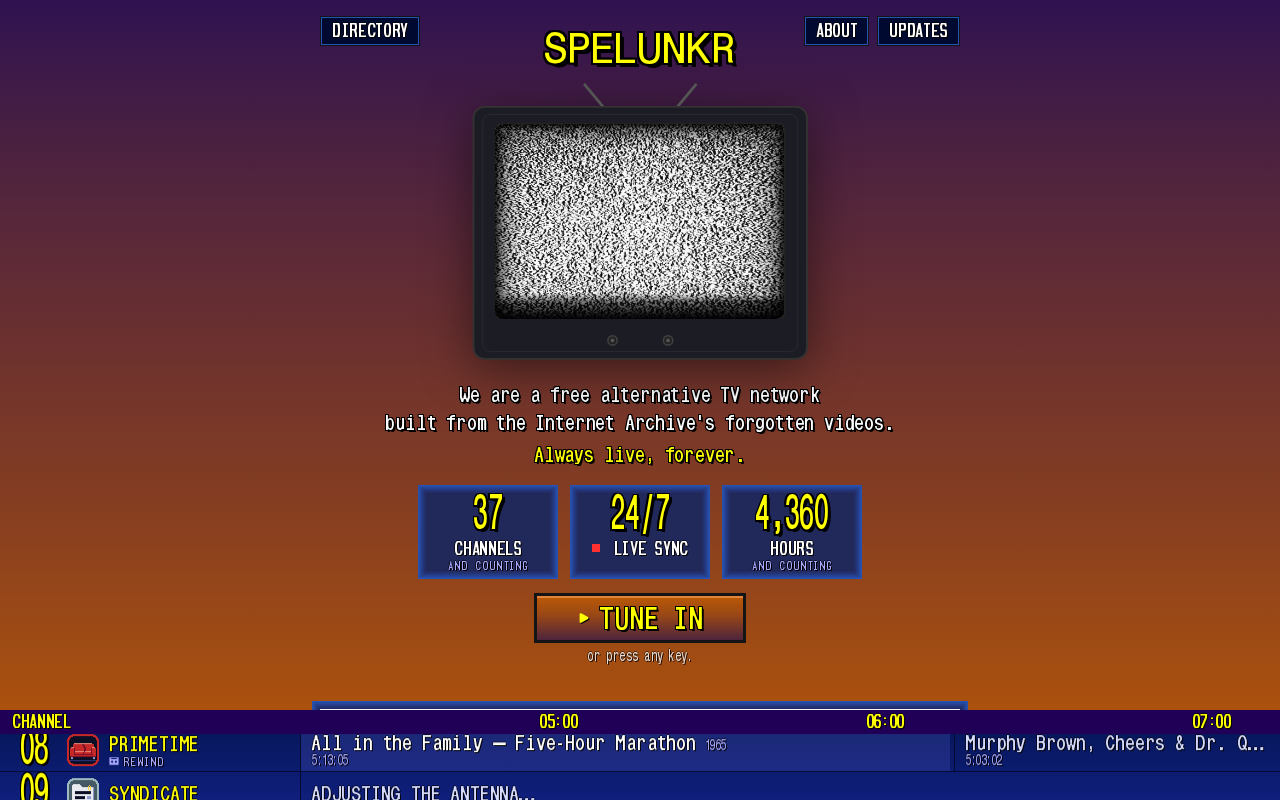
In an era dominated by streaming platforms, a project called Spelunkr goes the other way: it digs through publicly available videos in the Internet Archive to surface material forgotten by the mainstream, then re-curates it into a free alternative TV network. According to discussion on Hacker News, the project earned 179 points and 28 comments, showing that the idea of "making new content from old material" has sparked genuine interest in the tech community.
What It Solves Isn't a "Content Shortage" but a "Curation Shortage"
The Internet Archive has long preserved a vast amount of public-domain and openly licensed video resources, but ordinary users almost never go there to "find something to watch." Spelunkr's angle isn't producing new content—it's reorganizing this dormant material into a viewing experience that resembles a TV channel.
The value of this approach lies in the fact that content supply has long been in surplus; what's genuinely scarce is the curatorial ability to make people want to stay. The core asset of a traditional TV network was never the cameras—it was the program schedule and the eye for selection. Spelunkr grafts that layer of capability onto an open archive, sidestepping the cost of licensing content and the high risk of original production.
Judging from community feedback, the appeal of projects like this often comes from "serendipitous discovery"—users don't know what they'll see, and that uncertainty is precisely the experience algorithmic recommendation struggles to replicate.
Open Archives as Content Infrastructure
The role of the Internet Archive in this project deserves separate discussion. It's not just a download site but de facto public content infrastructure: video, audio, and web snapshots persist long-term in a searchable form. For independent developers, this means access to a legally usable pool of material at zero cost.
But the boundaries of this model are clear too. Content quality in the archive varies widely, metadata isn't necessarily standardized, and many videos lack clear titles, descriptions, and categories. Turning this material into watchable channels requires extra cleaning, tagging, and filtering work—engineering effort that is often underestimated.
Another practical constraint is copyright status. Public-domain and openly licensed content can be used directly, but the archive also holds a great deal of material with ambiguous status, and the project team must judge the risk boundaries for itself. How far Spelunkr can go depends heavily on how it handles this gray area.
The Internet Archive is a nonprofit digital library founded in 1996 with the mission of "universal access to all knowledge." Its best-known service is the Wayback Machine, which preserves historical snapshots of billions of web pages; but its holdings go far beyond that, including tens of millions of text, audio, video, software, and image resources. The video portion gathers a large number of public-domain films, government records, educational materials, old TV programs, and user-uploaded content under open licenses. For developers, the archive offers public search interfaces and metadata that allow programmatic access—precisely the precondition that makes projects like Spelunkr possible. Note that not all of the archive's holdings are in the public domain; the licensing status of many items must be verified case by case, and "accessible" cannot be equated with "free to use."
Public domain and open licensing are key to understanding the legal boundaries of such projects. Public domain refers to works that can be freely used by anyone because copyright has expired, been waived, or never applied; in the US, works published before 1929 are generally in the public domain. Open licensing means creators voluntarily permit others to use their work through agreements such as Creative Commons, but often with conditions like attribution, non-commercial use, or share-alike. The archive also contains a great deal of material with ambiguous or unknown licensing status; if such "gray area" content is re-curated and distributed, it may invite takedown notices or even legal risk. So when building a curation-oriented project, establishing a licensing verification and tiering mechanism matters more than quality control of the material itself.
Cold Start and Community Validation for Independent Projects
179 points on Hacker News isn't a blockbuster, but 28 comments show the discussion had substance. Projects like this usually attract community attention not because of technical complexity but because the concept itself is worth debating: it challenges the default assumption that "streaming must win through exclusive content."
For independent developers, this is a reusable validation path—combine a public data source with a clear experience design, quickly build an accessible prototype, then hand it to the community for testing. Feedback in the comments is often more direct than any market research, quickly exposing real issues like material quality, playback experience, and content update frequency.
One caveat: the currently available public information comes mainly from the project link and community discussion, and details about its technical architecture, content scale, and operating model remain limited. Whether it can sustain itself depends on whether it can establish a stable material-screening process rather than remaining at the concept-demo stage.
Takeaways for Content Creators
Spelunkr's approach can be transferred to smaller scenarios: you don't need to build your own platform to create curated content around publicly available material in a given vertical. The key is to treat "what to select and in what order to present it" as product design, rather than treating a pile of material as content.
For AI and tech content creators, this project also offers an observation sample: when generative tools drive the cost of content production toward zero, the value of curation, filtering, and sequencing rises instead. What's truly scarce is judgment, not production capacity.
Whether this project ultimately becomes a long-running "alternative TV network" remains to be seen. But it proves at least one thing: forgotten public video material still has viewing value after being reorganized—and that is one of the most underrated uses of open archives.
One-line Summary
Spelunkr re-curates forgotten Internet Archive videos into a free alternative TV network, highlighting the value of curation.
Paragraph Summary
Spelunkr is a project that mines forgotten material from the Internet Archive's public videos and re-curates it into a free alternative TV network, earning 179 points and 28 comments on Hacker News. The article notes that it addresses not a content shortage but a curation shortage: content supply is in surplus, and what's truly scarce is the curatorial ability to make people want to stay—the core asset of a traditional TV network being its program schedule and eye for selection. Open archives can serve as zero-cost content infrastructure for independent developers, but uneven material quality, non-standard metadata, and ambiguous copyright status are real constraints. The project's community appeal comes from a "serendipitous discovery" viewing experience, and its sustainability depends on establishing a stable material-screening process. The article also notes that when generative tools drive content production costs toward zero, the judgment involved in curation and filtering becomes a scarce resource instead.
Related articles

Michael Nielsen Takes Down His Classic Neural Network Textbook, Sparking Community Discussion
Michael Nielsen's classic free textbook Neural Networks and Deep Learning has been taken offline, sparking discussion on Hacker News about the reasons and impact.

Inside the AI Training Data Market: The Trade-off Between Exclusivity and Discounts
G2i founder Gabe Greenberg reveals the dual-track pricing of the AI training data market: labs pay a premium for exclusive data or accept discounts that allow others to buy it.

SessionGraph: Unifying All Coding Agent Sessions in One Interactive Graph
SessionGraph aggregates coding agent sessions into an interactive graph, helping developers review, debug, and manage AI coding workflows across sessions. This article examines its positioning, value, and open questions.