Building a Local Autonomous Agent for E-Commerce Listings: Architecture Choices and Open-Source Tools in Practice

How small e-commerce sellers can incrementally upgrade listing workflows into controllable AI Agent pipelines using LangGraph and Instructor.
A dropshipping seller wants to unify manual sourcing, copywriting, and API publishing into an end-to-end autonomous agent workflow. This article analyzes hardware constraints (RTX 4070 Ti, 12GB VRAM), anti-bot risks, and framework selection, recommending a hybrid approach: local models for batch copywriting, commercial APIs for complex planning, official catalogs over scraping, and Instructor+Pydantic for output validation. LangGraph with human-in-the-loop nodes is recommended over multi-agent systems for this linear workflow.
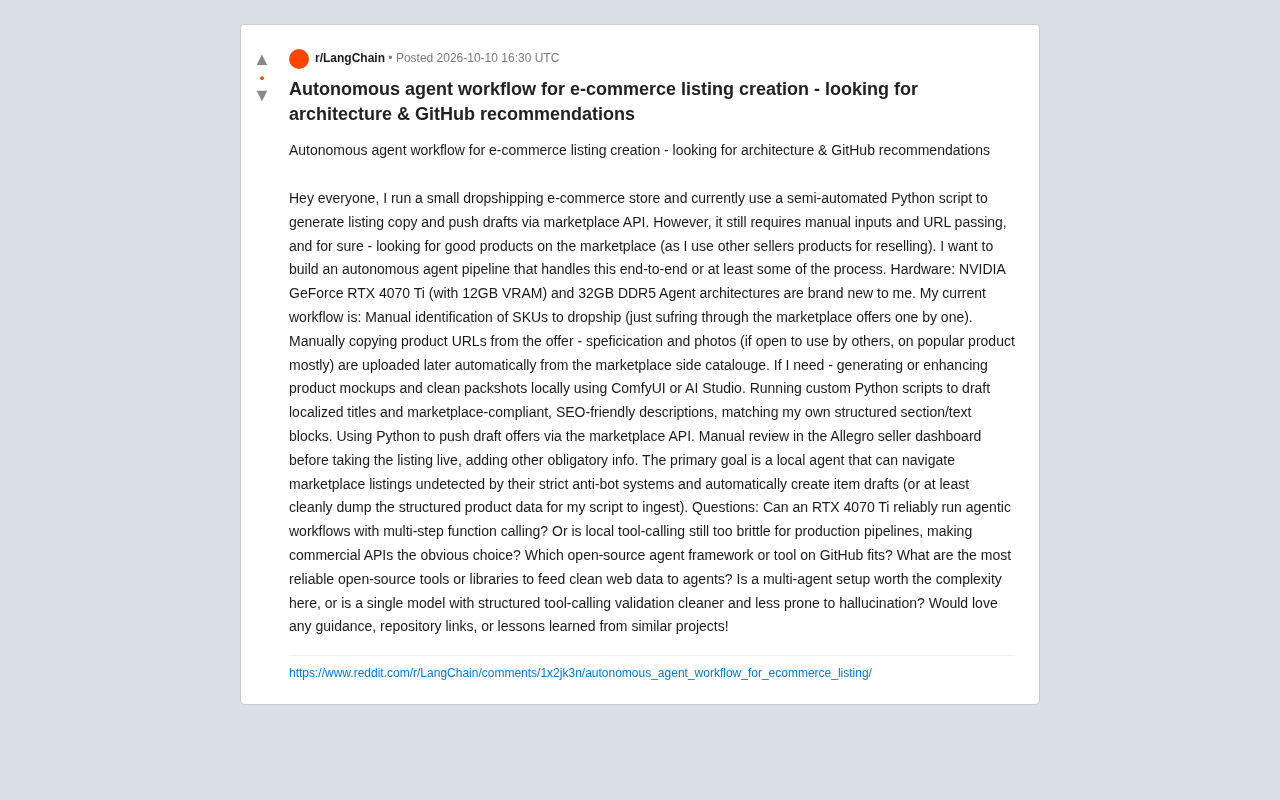
A seller running a small dropshipping store posted a remarkably representative question on Reddit: how to upgrade a semi-automated e-commerce listing workflow into a fully end-to-end autonomous agent pipeline. Behind this question lies the real confusion shared by many small and mid-sized e-commerce operators in the age of AI Agents — can local hardware handle it? Which open-source framework should you pick? Is a multi-agent setup even worth it?
This article uses that seller's specific situation as a lens to break down the architectural design considerations for autonomous agents in product sourcing and listing workflows, along with practical tool selection recommendations.
The Status Quo: A Typical Semi-Automated E-Commerce Workflow
The seller's current workflow is highly representative and can be broken down into several stages:
- Manual product sourcing: Browsing competitor listings on a marketplace (e.g., Allegro) one by one, manually picking SKUs suitable for resale.
- Manual data handoff: Copying product URLs, with specs and images then pulled in automatically via the platform's catalog.
- Local image processing: Using ComfyUI or AI Studio to generate and enhance product renders and clean packaging images.
- Script-based copywriting: Custom Python scripts generate localized titles and SEO-friendly, platform-compliant descriptions using structured text templates.
- API draft publishing: Pushing draft listings through the marketplace API.
- Manual review: Filling in required fields in the Allegro seller dashboard before officially publishing.
The core pain point is clear: product sourcing and data scraping remain highly manual, and the platform's strict anti-bot systems make automated navigation tricky. The seller wants to build a local agent that can browse listings without being detected, auto-create drafts, or at minimum cleanly export structured product data for use by existing scripts.
Hardware Question: Can an RTX 4070 Ti Run an Agent?
The seller's setup is an RTX 4070 Ti (12GB VRAM) with 32GB DDR5 RAM. Whether this can reliably run a multi-step function-calling agent workflow is one of his top concerns.
Realistically, 12GB VRAM is a clear bottleneck. It's sufficient to run quantized models in the 7B–14B range (such as 4-bit quantized versions of Qwen2.5 or Llama 3.1 8B), which are already usable for structured output and basic tool calling — but remain unstable for complex multi-step reasoning and long-horizon planning.
The more practical takeaway:
- Tasks like copywriting, field extraction, and SEO description rewriting are well within a local model's capabilities — low cost and data never leaves the machine.
- For high-reliability planning decisions and complex tool orchestration, small local models are prone to hallucinations and calling errors. Commercial APIs (e.g., GPT series, Claude) remain the safer choice in production pipelines.
In other words, it doesn't have to be all-or-nothing. The sensible approach is a hybrid architecture: use a commercial API as the planning brain, and use local models for high-frequency, low-risk, privacy-sensitive batch text tasks — balancing cost and reliability.
Anti-Bot Navigation: The Most Fragile Link in an Agent Architecture
The seller wants the agent to browse platform listings "without being detected." This is precisely the highest-risk part of the entire concept, and the one that demands the most caution.
Modern e-commerce platforms' anti-bot systems perform composite detection across request fingerprinting, behavioral timing, and browser automation signatures. Having an agent directly drive a browser for large-scale scraping is not only technically unstable — it may also violate platform terms of service and put the account at risk.
More sustainable approaches include:
- Prioritize official APIs and catalog data first. The seller already mentioned that product specs and images can be pulled in automatically via the platform catalog, indicating that compliant data channels do exist.
- If scraping is necessary, use mature browser automation libraries (Playwright with anti-detection plugins), but keep the frequency low and respect robots rules.
- Decouple "navigation and scraping" from "data processing" — let the agent focus on cleaning, structuring, and generating copy after receiving data, rather than using it as a tool to circumvent risk controls.
Modern anti-bot systems (such as Cloudflare Bot Management and PerimeterX) detect far beyond simple User-Agent identification. They cover dozens of signals including TLS fingerprinting, Canvas/WebGL rendering characteristics, mouse movement entropy, and request timing distributions. Even using Playwright with anti-detection plugins like
playwright-stealthonly reduces — not eliminates — the probability of detection. More importantly, platform Terms of Service (ToS) typically explicitly prohibit automated scraping. If a ban is triggered, you don't just lose the account — historical sales data and reviews may disappear along with it. Therefore, positioning "navigation scraping" as a step that should be handled by human intervention or compliant APIs first — rather than a domain for autonomous agent decision-making — is a key design principle for reducing overall system risk.
Framework Selection: Single Agent or Multi-Agent?
The seller raised a critical architectural question: go with a multi-agent system, or use a single model with structured tool calls and validation?
For this particular scenario, the answer leans toward the latter. Multi-agent systems may be conceptually trendy, but they significantly increase orchestration complexity, debugging overhead, and failure surface area. For a relatively linear pipeline like "source product → scrape data → generate copy → push draft," a single-model pipeline with structured tool calling and strict output validation is typically cleaner, more controllable, and less prone to hallucinations.
On the open-source framework front, here are the key categories to consider:
Workflow Orchestration
- LangGraph: Defines nodes and state transitions as a graph structure. Well-suited for pipelines with clear steps that need conditional branching and human-review nodes.
- CrewAI / AutoGen: Worth considering if multi-role collaboration becomes necessary in the future — no need to introduce them at the start.
Structured Output and Validation
- Pydantic + Instructor: Forces the model to output JSON conforming to a schema. This is the core weapon against hallucinations and ensures listing fields stay compliant.
- Outlines / Guidance: Constrained decoding for local models, improving structured output reliability.
Instructor is a lightweight wrapper around OpenAI and compatible APIs. It uses Pydantic models to define expected output schemas and automatically triggers retries and corrections when the model returns non-compliant results — essentially merging "function calling" and "data validation" into a single declarative interface. For e-commerce listings, this means you can pre-define a Pydantic model with constraints like maximum title character count, required attribute lists, and price format rules. If the model's output violates any rule, Instructor automatically feeds the error back to the model and requests a correction — instead of letting a malformed draft silently enter the publishing queue. Outlines works at the inference layer with constrained decoding, directly restricting the sampling range of each token the local model generates, ensuring at the probability level that output conforms to regex patterns or JSON schemas. It's well-suited for local model scenarios with higher demands on latency and accuracy.
Web Data Retrieval
- Playwright: The mainstream choice for browser automation.
- Firecrawl / Crawl4AI: Open-source tools designed specifically for "clean web data to feed LLMs." They convert pages into structured, noise-reduced Markdown or JSON — a great fit for the seller's goal of "cleanly exporting structured data."
LangGraph is a stateful agent orchestration framework from the LangChain team. Its core idea is to model workflows as directed graphs: nodes represent an LLM call or tool execution, and edges represent state transition conditions. Compared to linear chain-style calls, it natively supports loops, conditional branching, and human-in-the-loop interrupt checkpoints — especially useful for e-commerce listing workflows that need to pause at certain nodes for manual review. By contrast, CrewAI and AutoGen focus on multi-agent role-playing and task delegation; while they can use LangGraph as an execution engine under the hood, the extra coordination overhead is rarely worth it for a single linear workflow.
Recommended Architecture: A Pragmatic, Incremental Approach
All things considered, rather than aiming for a fully autonomous agent all at once, an incremental upgrade approach is far more sensible:
- Keep existing scripts as the execution layer — they already reliably push drafts, no need to tear them down.
- Use LangGraph as the orchestration skeleton, keeping manual review as an explicit human-in-the-loop node in the workflow — both safe and platform-compliant.
- Use Instructor + Pydantic to constrain all LLM outputs, ensuring titles, descriptions, and fields strictly match structured templates.
- Prioritize official API/catalog data for scraping; use Crawl4AI as a supplement when needed — rather than having the agent attempt to bypass risk controls.
- Tiered model usage: run copy batch processing locally on the 4070 Ti; call commercial APIs for complex decisions.
This approach is realistically feasible within the 12GB VRAM constraint, while minimizing risks like account bans and hallucinated listings.
Final Thoughts
Autonomous agents genuinely have enormous potential in e-commerce operations — but for small and mid-sized sellers, the real value isn't in "full automation." It's in handing repetitive, low-value steps over to a controllable pipeline, while retaining human oversight at high-risk nodes like sourcing judgment and compliance review. Getting the process stable with structured tool calling first, then gradually expanding the automation boundary, is a far wiser path than blindly stacking multi-agent complexity.
Related articles

Why Does the Tesla Roadster Need to Fly? A Deep Dive into Musk's Wild Demo
Tesla's Roadster launch showed wall-climbing, upside-down driving, and flying stunts—but The Vergecast notes the demo car may lack a battery, the Rocket version is invite-only and not street-legal, and the website terms don't guarantee delivery. After nine years of delays, why does this car still need to exist?

AI Is Not a Replacement: Human-AI Collaboration Through the Lens of Factory Root Cause Analysis
Starting from factory root cause analysis, this article explains how AI accelerates evidence chain construction rather than replacing human experts, exploring the pragmatic implementation logic and business value of 'AI supporting people rather than replacing them.'

AI Agent Decision Auditing: Building an Evidence Chain in Regulated Workflows
Starting from a Reddit discussion, this article analyzes three core issues in AI agent decision auditing within regulated workflows: what fields audit records should contain, how to handle feedback latency for erroneous decisions, and how to continuously calibrate LLM judge consistency with human judgment.