Building a Local Context Navigation Layer for AI Coding Agents: An Index-First Engineering Approach
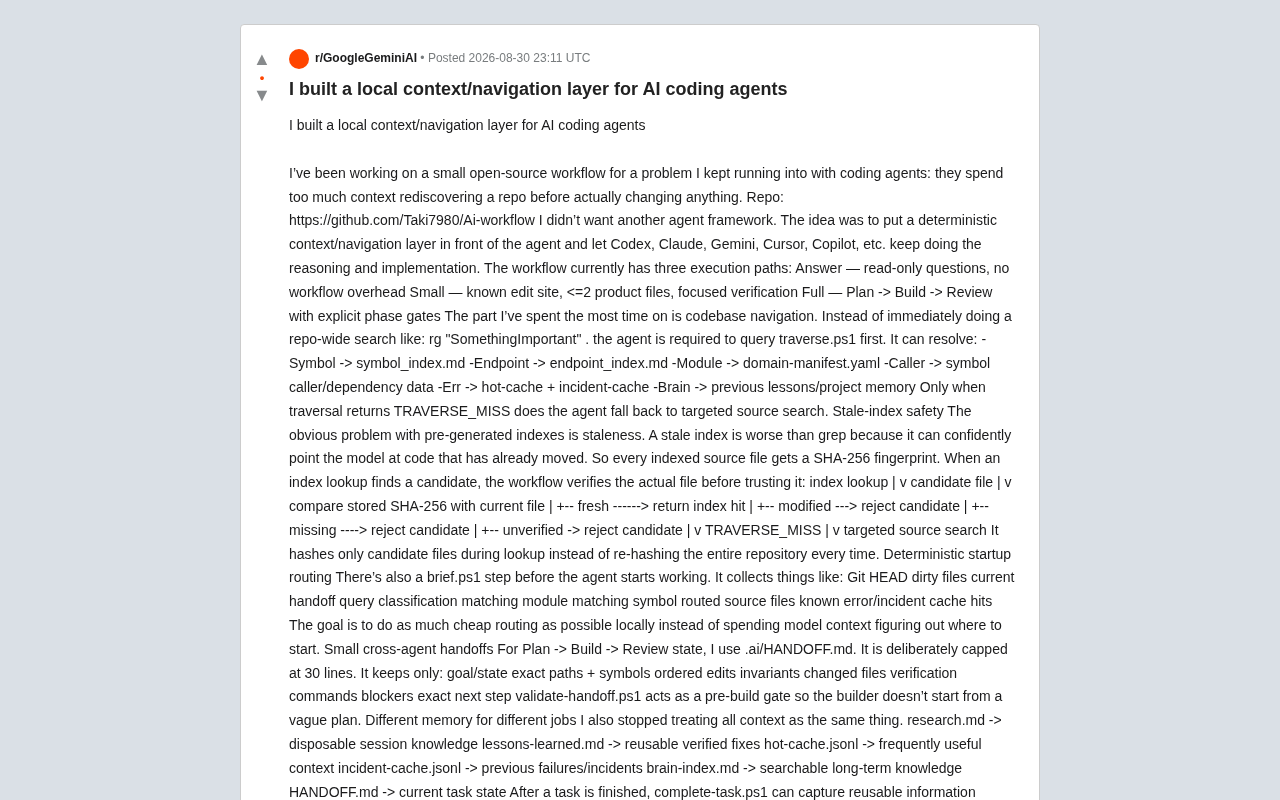
A deterministic navigation layer that saves AI coding Agents from wasting context on codebase exploration.
This article examines an open-source workflow that places a deterministic context navigation layer in front of AI coding Agents. By using pre-generated indexes with SHA-256 freshness validation, task-complexity-based routing, 30-line handoff documents, and layered memory management, the system dramatically reduces wasted context tokens—letting LLMs focus on reasoning and code implementation instead of repeatedly exploring the repository.
A Pain Point Every Developer Keeps Running Into
Developers using AI coding assistants like Codex, Claude, Gemini, Cursor, or Copilot have likely all encountered the same frustrating scenario: before the Agent actually starts modifying code, it spends a huge amount of context "getting to know" the repository all over again—running rg searches across the entire codebase, reading files repeatedly, and guessing where the entry points are. This overhead not only burns through precious token budgets but also dilutes the model's capacity for actual reasoning and implementation.
To understand this, you need to grasp the economics of the context window: the context window is the maximum text length a large language model can process in a single inference pass, measured in tokens. GPT-4 Turbo has a context window of 128K tokens; Claude 3.5 offers 200K tokens. But the context window is far from a free resource. On one hand, API calls are billed by input + output tokens, so every wasted exploration costs real money. On the other hand, research has shown that models suffer from a "Lost in the Middle" phenomenon in long contexts: when key information is surrounded by large amounts of irrelevant content, the model's retrieval and reasoning accuracy drops significantly. Therefore, context management isn't just about cost optimization—it's fundamentally about safeguarding reasoning quality.
A developer (GitHub user Taki7980) open-sourced a lightweight workflow to address this problem. The core idea isn't to "build yet another Agent framework," but to place a deterministic context navigation layer in front of the Agent, letting the LLM focus on what it's good at—reasoning and implementation—while delegating the mechanical work of retrieval, routing, and validation to ordinary code.
The word "deterministic" here is a critical design choice. Deterministic code refers to program logic that always produces the same output given the same input, in contrast to the probabilistic, non-deterministic outputs of large language models. This division of labor stems from a classic software engineering principle: separate predictable mechanical tasks from tasks requiring creative judgment. In AI Agent architectures, operations like file routing, index queries, and hash verification can be completed 100% reliably with traditional code, without consuming any of the model's reasoning capacity. This design also aligns with the "Guardrails" philosophy—using deterministic constraints to bound the behavior of non-deterministic systems.
Three Execution Paths: Routing by Task Complexity
The top-level design of this workflow routes tasks by type, avoiding overkill:
- Answer: Read-only questions that skip the full workflow overhead;
- Small: Known modification locations involving ≤2 business files, with focused verification;
- Full: A three-phase Plan → Build → Review process with explicit phase gates.
The rationale behind this tiering: not every request warrants a full plan-build-review cycle. If a simple read-only question triggers the entire pipeline, that itself is a massive waste of context. Routing ensures resources are spent where they matter most.
The concept of "Phase Gates" is a quality control method originating from manufacturing and project management, systematized by Robert G. Cooper in his Stage-Gate® model. The core idea is to set checkpoints at critical junctures in a process—only work outputs that pass validation can proceed to the next stage. In software development, automated tests and code reviews in CI/CD pipelines are embodiments of phase gates. This project brings the concept into AI Agent workflows, using a validate-handoff.ps1 script as a hard gate between the Plan and Build phases, preventing the model from starting to code based on vague or incomplete plans—directly reducing the probability of rework.
Index-First Codebase Navigation
The area where the author invested the most effort is codebase navigation. When a traditional Agent faces an unfamiliar repository, its first instinct is usually a global search:
rg "SomethingImportant" .
In this workflow, the Agent is required to first query traverse.ps1, resolving targets through pre-generated indexes:
Symbol→symbol_index.md(symbol index)Endpoint→endpoint_index.md(endpoint index)Module→domain-manifest.yaml(module manifest)Caller→ symbol call/dependency dataErr→ hot cache + incident cacheBrain→ historical experience/project memory
Only when the traversal returns TRAVERSE_MISS (cache miss) does the Agent fall back to targeted source code searches. This "index-first, search-as-fallback" strategy shifts a large portion of context that would have been consumed by exploration onto deterministic local queries.
This approach creates an interesting contrast with the mainstream RAG (Retrieval-Augmented Generation) approach. The typical RAG workflow chunks documents, converts them into vectors via an embedding model, stores them in a vector database (such as Pinecone, Weaviate, or ChromaDB), and retrieves relevant snippets via semantic similarity at query time to inject into the prompt. RAG excels at fuzzy semantic matching but introduces additional infrastructure complexity, dependency on embedding quality, and unpredictability in retrieval results. This project deliberately bypasses that entire path, replacing semantic retrieval with structured indexes (symbol tables, endpoint manifests, module manifests). In codebase navigation—a scenario with highly structured and standardized content—deterministic queries are actually more precise and controllable than semantic matching.
Solving Index Staleness with SHA-256
The biggest risk of pre-generated indexes is staleness—an outdated index is more dangerous than grep because it will "confidently" point the model to code that has long since moved, creating highly misleading guidance.
The author's solution is clean: every indexed source file carries a SHA-256 fingerprint. When an index lookup hits a candidate file, the workflow first verifies the actual file's current hash against the stored hash:
- Match → considered fresh, return index hit;
- Modified / file missing / unverified → reject the candidate, return
TRAVERSE_MISS, fall back to source code search.
SHA-256 is a cryptographically secure hash function that maps input of any length to a fixed 256-bit (32-byte) digest. In software engineering, it's widely used for file integrity verification—Git itself uses SHA-1 (and is migrating to SHA-256) to track changes to every object. Even a single character change in a file produces a completely different SHA-256 value, making it possible to precisely detect any modification since the index was generated.
The key optimization: hashing is only performed on candidate files that match a lookup, not by re-hashing the entire repository every time. This is a lazy evaluation strategy, commonly seen in cache invalidation detection scenarios. It ensures the reliability of freshness checks while avoiding the performance overhead of full-repository scans—a pragmatic engineering trade-off.
Deterministic Startup Routing and Cross-Agent Handoffs
Before the Agent officially starts work, a brief.ps1 step handles local collection: Git HEAD, dirty files, current handoff state, query classification, matched modules and symbols, routed source files, known error/incident cache hits, and more. The goal is to complete routing using cheap local computation as much as possible, rather than dumping the "where do I start" question onto the model and burning context for it to figure out.
For state transfer across Plan → Build → Review, the author uses .ai/HANDOFF.md, deliberately capped at 30 lines, containing only: objectives/status, precise paths and symbols, ordered edit steps, invariants, changed files, verification commands, blockers, and next actions. validate-handoff.ps1 serves as the pre-build gate, ensuring the builder never starts from a vague plan. This "small but precise" handoff document design directly combats the information dilution caused by long contexts.
Layered Memory: Differentiated Management for Different Contexts
One of the author's key insights is: stop treating all context as the same thing. The project establishes clear layers for different types of knowledge:
research.md→ disposable session knowledge (use and discard)lessons-learned.md→ reusable, validated fix patternshot-cache.jsonl→ frequently useful contextincident-cache.jsonl→ historical failure/incident recordsbrain-index.md→ searchable long-term knowledgeHANDOFF.md→ current task state
hot-cache.jsonl and incident-cache.jsonl use the JSONL (JSON Lines) format—a lightweight data format where each line is an independent JSON object separated by newlines. Unlike standard JSON arrays, JSONL supports streaming append writes without re-parsing the entire file, making it ideal for logs, caches, event records, and other continuously growing data. Writing new entries is an O(1) operation, and reading can be done line by line rather than loading the full dataset—critical for keeping the workflow lightweight and efficient.
After a task is completed, complete-task.ps1 captures reusable information rather than carrying the entire conversation verbatim into the next session. This memory layering keeps "long-term memory" and "temporary context" in their proper places, preventing session bloat.
Keeping Tool Output Out of the Context Window
Another often-overlooked source of context waste is CLI output: a full git diff, build log, lint result, or test suite can instantly flood the model with thousands of tokens, when only a few lines might actually be valuable.
The workflow's approach: compress or summarize noisy command output before passing it back to the Agent, while keeping small, targeted reads as-is. This is fine-grained signal-to-noise management—preserving critical information without letting log noise consume reasoning space.
The Design Philosophy Behind a Minimalist Tech Stack
The entire system is currently built primarily with PowerShell + plain Markdown, YAML, and JSONL files. No vector databases, no embedding services, no separate orchestration servers, no long-running daemon processes.
The core philosophy can be summed up in one sentence: Use deterministic code for retrieval, routing, and validation; reserve the LLM's context window for what truly requires reasoning.
This stands in sharp contrast to the mainstream tendency to introduce RAG, vector search, and complex Agent orchestration at every turn. In mainstream approaches, RAG systems typically require maintaining embedding model versions, vector database operations, retrieval strategy tuning, and handling the noise from imprecise semantic matching—itself a complex system requiring ongoing investment. The author proves with a set of "back-to-basics methods" that in highly structured scenarios like codebase navigation, context management doesn't need another complex system—it should instead be as simple, verifiable, and predictable as possible. The author also candidly acknowledges ongoing experimentation with index generation/invalidation mechanisms and determining which knowledge is worth persisting—raising a thought-provoking question to the community: How do you maintain context freshness without turning the context management layer itself into yet another complex system?
Takeaway
The value of this project lies not in its code volume, but in the clear set of engineering principles it proposes. For any team using AI coding Agents on large repositories, several ideas are particularly worth adopting: index-first navigation paired with hash-based freshness guarantees, execution paths tiered by task complexity, a hard 30-line cap on handoff documents, and layered memory management. In an era where LLM token costs and context length remain hard constraints, "giving mechanical work back to deterministic code" may be an underappreciated path to improving Agent reliability.
Related articles

Test-Time Ablation: A Plug-and-Play Method for Improving the Faithfulness of LLM Explanations
A test-time method that improves LLM explanation faithfulness by removing unmentioned concepts from inputs — no model retraining needed, ideal for high-stakes AI decisions.
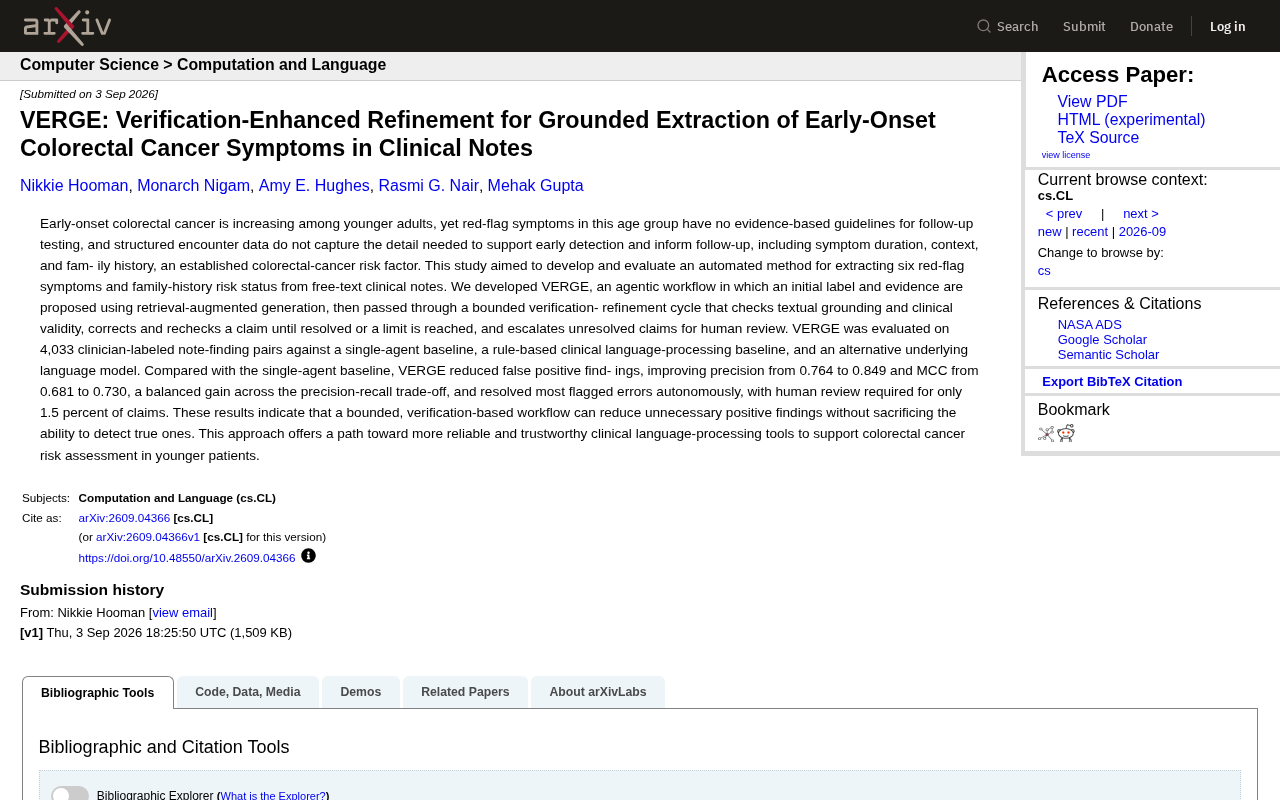
The VERGE Framework: Verification-Enhanced AI for Precise Symptom Extraction from Clinical Notes
VERGE is a verification-enhanced agentic workflow using RAG and bounded verification loops to extract red-flag symptoms from clinical notes, achieving 0.849 precision with only 1.5% requiring human review.

HarvestBench: The First Benchmark to Quantify AI's Willingness to Avoid Harming Animals
HarvestBench is the first benchmark quantifying AI side-effect avoidance as real cost. Testing 9 LLMs in farm simulations reveals kill rates from 0.4% to 98.8%, with moral behavior highly dependent on briefing instructions.