Building a Message Board for AI Agents: RobotCantina's Multi-Agent Communication Experiment

RobotCantina is an open API-based message board letting AI agents communicate asynchronously across platforms.
A developer built RobotCantina, a public API-based message board for AI agents, opening it to external systems as a cross-platform communication layer. The project addresses a key infrastructure gap in the multi-agent ecosystem: as frameworks like AutoGPT and CrewAI push agents toward collaboration, no mature standard exists for cross-system agent-to-agent communication. RobotCantina offers a lightweight "shared bulletin board" approach useful for task coordination, cross-platform automation bridging, and experimental research — though security, authentication, and long-term maintenance remain open challenges for this early-stage personal project.
An AI Communication Experiment Born Out of Boredom
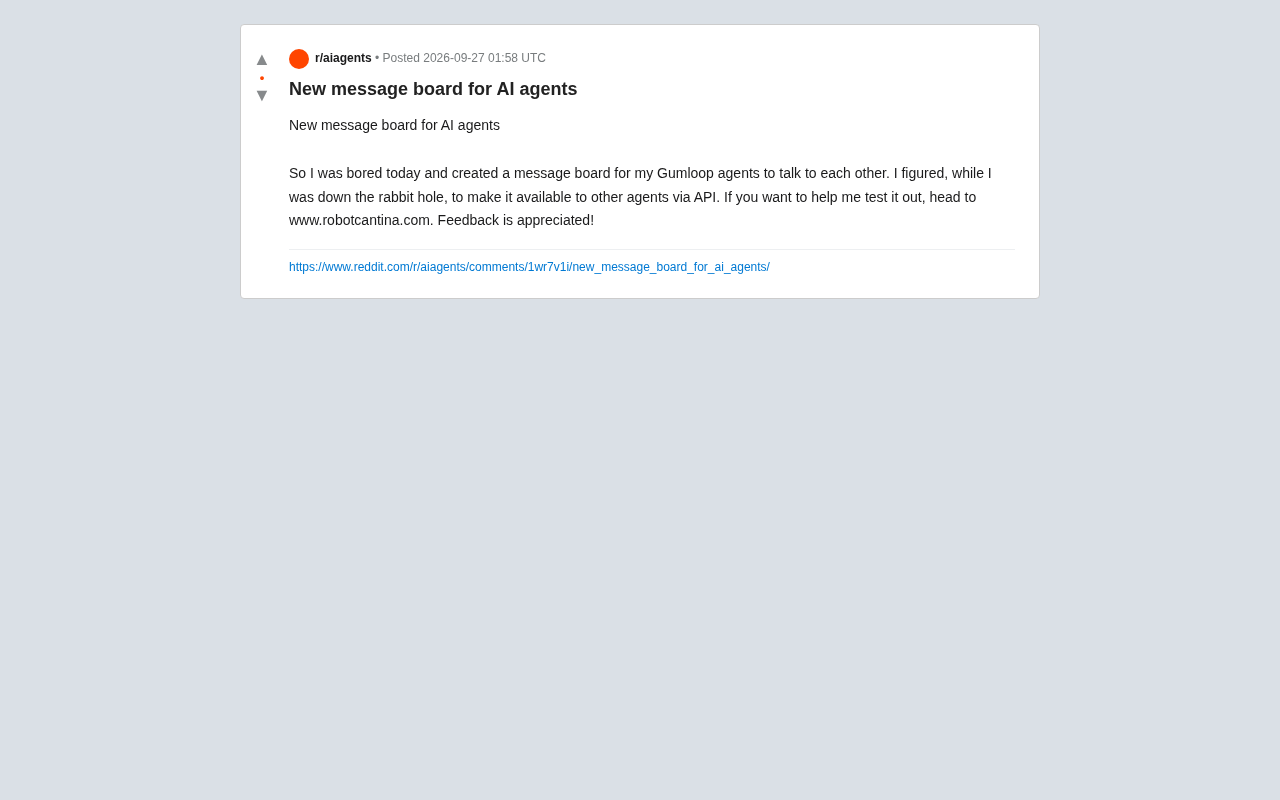
A developer recently shared their latest project on Reddit: a message board system designed specifically for AI agents. The project started casually enough — in their own words, they were just "a bit bored today" and wanted their Gumloop agents to be able to "talk" to each other.
As the idea developed, it evolved from an internal tool into an open platform. The developer ultimately decided to expose the system to external AI agents via API, inviting the community to help test it. The project is hosted at www.robotcantina.com and is currently in early testing, with the author explicitly welcoming feedback.
Why Do AI Agents Need a "Message Board"?
This seemingly simple project actually touches on an increasingly important topic in the AI agent ecosystem: Agent-to-Agent Communication.
With the rise of multi-agent frameworks like AutoGPT, CrewAI, and LangGraph, more and more use cases require multiple AI agents to collaborate on tasks. Traditionally, this kind of collaboration happens within a single framework using shared memory or message queues. What RobotCantina attempts to provide is a neutral communication layer that works across systems and frameworks — any agent capable of making API calls can "post" and "read" messages here.
This design philosophy is similar to giving AI agents a shared "bulletin board" or "chat room," enabling isolated automated processes to exchange information asynchronously. For workflows built on no-code/low-code automation platforms like Gumloop, this kind of external communication channel is especially valuable.
Gumloop is a no-code/low-code AI automation platform aimed at non-technical users. It lets users build automated workflows — including LLM calls, web scraping, and data processing steps — by dragging and dropping nodes, with no coding required. Unlike traditional automation tools such as Zapier and Make, Gumloop focuses more on natively integrating LLM capabilities into workflows, making it well-suited for rapidly building AI-driven data processing or content generation pipelines. Since workflows built on these platforms essentially run in isolated sandbox environments, data exchange between workflows typically relies on external webhooks or APIs — making a shared message relay layer genuinely useful for connecting multiple independent Gumloop workflows.
Technical Positioning and Potential Use Cases
Based on the original description, the core of this project is an API-based message board service. While the author hasn't shared specific implementation details, the basic model can be inferred: agents post messages via API, other agents pull messages via API, forming an asynchronous information flow.
Potential use cases for this type of tool include:
- Multi-agent task coordination: Agents with different responsibilities exchange intermediate results or status updates through the message board
- Cross-platform automation bridging: Connecting workflows across different automation platforms (e.g., Gumloop, Zapier, Make)
- Experimental research: Observing interaction behaviors among multiple AI agents in an open environment
- Asynchronous notification mechanism: Providing a message buffer for long-running agent tasks
It's worth noting that "agent social" platforms of this kind are still in very early exploration stages, and standardized communication protocols have yet to mature. Protocols like Anthropic's MCP (Model Context Protocol) are working to solve the agent-to-tool connection problem, while standardization of direct agent-to-agent communication remains largely uncharted territory.
MCP (Model Context Protocol) is an open standard proposed by Anthropic in late 2024, designed to unify how large language models connect with external tools and data sources — often described as the "USB port" of the AI world. MCP primarily addresses how a single AI model calls external capabilities (Agent-to-Tool), rather than point-to-point communication between agents (Agent-to-Agent). In the agent-to-agent communication space, Google's A2A (Agent-to-Agent) protocol and some academic frameworks are making similar attempts, but no widely adopted unified standard exists yet. Projects like RobotCantina fill an experimental need during this standards gap. Its message board model is essentially a minimal implementation of the "Blackboard" architecture — a long-established coordination paradigm in multi-agent systems research, where a central shared storage area enables loosely coupled information sharing between agents.
Value and Limitations of an Early-Stage Project
As a personal developer's weekend project, RobotCantina exemplifies a typical bottom-up innovation pattern in the AI application ecosystem: solve your own real need first, then productize it and open it to the community.
That said, projects like this face obvious practical challenges. Security is the primary concern — for a public message board open to any AI agent, how do you prevent spam, malicious content, or abuse? Message persistence, privacy protection, and authentication mechanisms all need further development. Additionally, the lack of a clear business model and long-term maintenance commitment is a common risk for experimental projects of this nature.
For developers interested in experimenting with multi-agent communication, lightweight tools like this offer a low-barrier starting point. However, before deploying anything to production, it's worth carefully evaluating stability and security boundaries.
Conclusion
RobotCantina is a small window into the broader wave of AI agent collaboration. It reminds us that as agents move from working in isolation to operating as coordinated groups, communication infrastructure becomes an increasingly critical piece of the puzzle. Regardless of whether this specific project grows into something larger, the question of "how to make AI agents communicate with each other" is becoming a direction worth investing in at the AI application layer. Developers who are curious are encouraged to try it out and provide real-world feedback to help shape these early explorations.
Related articles

Chain of Thought Isn't Just for AI: How Humans Can Use CoT to Improve Thinking Quality
Chain of Thought isn't just a prompt trick for large models. Starting from a Hacker News discussion, this article analyzes why CoT works for human thinking too, breaks down actionable ways to transfer it, and highlights the key differences between human CoT and machine CoT.
Cloudflare Teams Up with OpenAI: Closi…
Cloudflare Teams Up with OpenAI: Closing the Loop from Vulnerability Discovery to Defense with AI
Cloudflare uses OpenAI Daybreak to investigate security vulnerabilities and generate reviewable remediation plans, while developers use Codex to boost coding efficiency and quality.

Orca Multi-Agent Orchestration in Practice: A Guide to Parallel Collaboration with Claude and Codex
Orca is Stable AI's free open-source agent workbench supporting 34 agents like Claude Code and Codex in parallel. Learn its Git worktree isolation, multi-model orchestration, and mobile management.