Building a Million-Dollar Software Product from Scratch with AI Coding Agents: A Complete Practical Breakdown

How a non-technical sales founder used AI coding agents to build a million-dollar SaaS from scratch.
This article breaks down how a sales-background founder with no backend skills used AI coding agents to build a seven-figure SaaS product. The methodology covers four layers: defining problem, market, and solution before writing code; using a PRD to drive AI-powered MVP development with iterative refinement; structuring the product around frontend (Next.js + Vercel), backend (Supabase), and AI layer (OpenRouter + system prompts); and using a 17-page design system to avoid "AI slop" while pricing based on ROI to create an obvious buying decision. The core lesson: if you can't sell it, it's a bad product — validate willingness to pay first.
A founder running a software company with seven-figure annual revenue openly admits: he can't write backend code. The entire product's interface and feature logic were designed by himself using AI coding agents. This isn't another round of AI hype — it's a repeatable methodology. From identifying a problem to pricing to delivery, he's broken down software entrepreneurship into steps that anyone can execute. This article walks through his complete process and dissects the decision-making logic worth learning from.
Think It Through First: Problem, Market, Solution — All Three Are Non-Negotiable
Many people stumble at the starting line. The author emphasizes that before writing a single line of code, you need to complete three things: find the problem, lock in the market, and design the solution.
He himself came from a sales background, deeply familiar with the full cycle of sales team management — hiring, training, and coaching — so he positioned his product as a sales team management tool (product name: Kendo). The key is that he first established a "thesis" like writing a research paper — "I believe I can do this better than anyone else" — and then went to validate it.
When finding a market, you can't stop at the coarse-grained level of "sales teams." You need to drill down: what type of sales team? Who specifically are they selling to within the team? What are that person's pain points? The more specific you get, the clearer your product direction becomes.
One interesting insight is that the author believes SaaS (software as a service) and service businesses are converging into the same thing. This is the underlying logic behind his repeated emphasis that "everyone should learn software" — even information products and managed services are ultimately becoming software.
Building the MVP: PRD + Frontier Models + Iterative Refinement
Once the solution is clear, the core action is building a minimum viable product (MVP). The author's path is remarkably straightforward:
Step one: Write a PRD (Product Requirements Document). Take everything you've thought through — the problem, market, solution, and feature points — and feed it all to ChatGPT, letting it organize everything into a PRD. This document essentially serves as an "instruction manual" for your coding agent. He specifically warns: at the MVP stage, pick only one or two core features, rather than piling on an entire SaaS from day one. For Kendo, only two features were built initially: "call review" and "role-play training."
Step two: Hand the PRD to a frontier model. The author mentions Opus 5.5, Codex, and others as options, emphasizing "use a smart frontier model" — which specific one you choose isn't the critical factor.
Step three: Accept that v1 is going to suck. He puts it bluntly: "v1 is going to suck." The following week or longer is all about continuous iteration — v2, v3... And during this phase, only clean up and optimize — don't add new features. He recalls that the early version of Kendo "was so bad it would shock you," and it was only through repeated refinement that it reached its current quality.
The entire business loop is: build MVP → sell to customers → if you can't sell it, it's a bad product or bad idea → if you can sell it, reinvest the money (hire real developers or buy more tokens) → build a better MVP → repeat. All bootstrapped (no external funding), and he started with only $20,000 in his account.
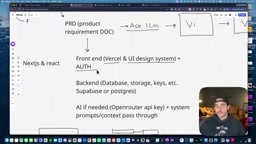
PRD (Product Requirements Document) is a document used in software development to describe product goals, feature scope, and user scenarios — traditionally written by product managers to align engineers and designers. In an AI coding agent workflow, the PRD plays the role of "architectural blueprints" — the clearer and more specific it is, the less the AI deviates when generating code. A good PRD typically includes: who the target user is, what problem needs solving, a list of core features (and explicitly excluded features), and success metrics. For non-technical founders, the process of using ChatGPT to organize your thinking into a PRD is itself a forced validation exercise — if you can't write it clearly in a document, your product direction probably isn't fully thought through yet.
Frontend, Backend, AI Layer: How Software Actually Runs
The author breaks down software's three-layer structure in plain language — this section is especially friendly for newcomers.
Frontend: What Users Can See
The frontend is the interface your eyes see. He recommends using Next.js (or React) and emphasizes that "the language is just a language, like the difference between English and Spanish" — don't get caught up in the choice. For hosting, he recommends Vercel — sign up for an account, click to connect, and let the AI deploy the frontend. The cost is minimal. For basic functionality like login authentication (auth) and email verification, just let the AI build those too.
Backend: The Foundation That Makes Everything Run
The backend includes the database, storage, API keys, customer information, and more. For the MVP stage, he recommends Supabase, or Postgres via Neon. The author openly acknowledges that this approach "won't be enterprise-grade, and security won't be great," but for the starting phase it's "more than enough — stop making excuses."
AI Layer: The Source of Model Capabilities
If your product has AI features, you'll need an OpenRouter API Key — the advantage being that you can switch between models at any time without rebuilding your infrastructure. Using Kendo's call scoring as an example, the flow is: receive call recording → transcribe → vectorize (making it easily retrievable by AI) → run through system prompts (they have about 15 system prompts) → output call summaries, scorecards, and other results. He openly admits they currently use "cheap Chinese models" or "GPT's Luna."
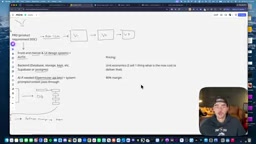
Understanding these three layers helps non-technical founders avoid being completely lost when communicating with AI or developers. The frontend handles user interaction, with code running in the user's browser. The backend runs on servers, handling business logic, permission control, and data read/write operations. The database is where data is persisted — Supabase is a managed Postgres database service with built-in authentication and real-time subscriptions, ideal for getting started quickly. These three layers communicate via APIs (Application Programming Interfaces) — the frontend sends requests, the backend processes them and retrieves data from the database, then returns the results to the frontend. Understanding this framework explains why "backend security" was a shortcoming the author patched up later: MVP-stage Supabase configurations are typically in a permissive development mode, and before going live with real customer data, a professional developer needs to tighten permissions and conduct a security audit.
Vectorizing is a key step in AI applications for processing unstructured content (like call recording transcripts). The principle involves converting text into high-dimensional numerical vectors, where semantically similar content sits closer together in vector space — enabling semantic search rather than simple keyword matching. OpenRouter is a routing service that aggregates multiple LLM APIs. Developers only need to integrate OpenRouter's interface once to freely switch between dozens of models including GPT-4, Claude, Gemini, and DeepSeekAd, without maintaining separate API keys and SDKs for each provider. This is especially valuable for early-stage products: when a model drops in price or improves in performance, you can switch instantly without changing the underlying infrastructure. System Prompts are instructions pre-loaded to the model before each user request, used to lock in the model's role, output format, and evaluation criteria — Kendo uses approximately 15 different system prompts to handle different sub-tasks such as summarization, scoring, and recommendations.
Design Systems: The Dividing Line Between "AI Slop" and a Real Product
The author spends considerable time discussing design, because this is where "AI slop" is most likely to show. "If your product looks terrible, nobody will trust it or want to use it."
His solution is to build a design system — his own document is 17 pages long, defining fonts, spacing, colors, overall visual tone, and all other visual standards. This design.md file lives in the project folder, and whenever the AI makes changes to the interface, it automatically follows these standards, ensuring consistent visual identity across the entire product.
How do you build a design system quickly? He offers a few shortcuts:
- Use tools like Refero to find a web or AI app you like (such as Claude's UI), and directly export its
design.mdfile; - Use Mobbin to do the same;
- Or simply screenshot software interfaces you admire, feed these materials to the AI, and ask it to "create a design system based on these UIs."
Worth emphasizing: he claims the entire interface was built with "zero Figma, zero graphic design," completed entirely through AI paired with a design system.
Pricing and GTM: Using ROI to Make Your Price a "No-Brainer"
Pricing is something the author believes "you should have figured out on day one." His two core principles:
First, understand your unit economics. Whether you're pricing by seat, by usage, or using a hybrid model like Kendo, you need to know "what's the maximum delivery cost per unit sold." Kendo's base seat is $55 per month, bundled with a fixed usage allocation, with additional usage purchasable beyond that — so the maximum cost remains controllable. His rule of thumb is to target 80% gross margins per unit.
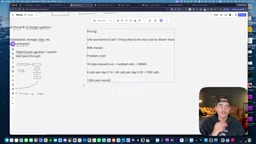
Second, work backward from ROI to justify price. He runs the numbers live: suppose a customer has 10 salespeople generating about 1,500 calls per month, creating three major pain points — review time (a single manager simply can't review 1,500 calls, and hiring multiple six-figure managers is extremely costly), close rate (improving from 20% to 30% could mean millions in additional revenue), and overall efficiency. Meanwhile, 10 seats of Kendo costs just $550–600 per month. "Would you pay $600 a month for that ROI? That's what a no-brainer looks like."
As for GTM (go-to-market, meaning sales plus marketing), his loop is: lead comes in → free trial → qualification (ask how many salespeople they have) → schedule meeting → sales does a "white-glove account setup" service → close the deal. Using this approach, they added nearly $200,000 in new ARR in the past 30 days — and "haven't even run ads yet."
ARR (Annual Recurring Revenue) is the most core metric in the SaaS industry for measuring business scale, reflecting the annualized total of subscription-based revenue, excluding one-time revenue. GTM (Go-to-Market) refers to the complete strategy for bringing a product to market, including target customer definition, sales channel selection, pricing model, and customer acquisition path. The "white-glove account setup" mentioned in the article is a common conversion strategy that combines PLG (Product-Led Growth) with sales assistance — sales staff directly help potential customers configure their accounts during the demo phase, lowering the barrier to trial use and shortening the path from "free trial" to "paid conversion." Unit Economics refers to the ratio of revenue to cost generated per customer unit acquired or served — an 80% gross margin means that for every $1 of revenue, delivery costs are no more than $0.20, which is the healthy benchmark widely recognized by SaaS investors and founders.
A Key Division of Labor: You Don't Have to Know Everything
The author repeatedly conveys a liberating mindset: you don't need to master the entire tech stack. He himself never touches the backend and doesn't plan to learn it, but he focuses on designing the product, defining features, and controlling the experience and logic. The truly dirty work — enterprise-grade security, data schema — is handled by the two developers he later hired.
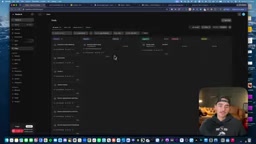
He doesn't even let AI invent everything autonomously; instead, he "lets AI give me ideas, then I judge and execute." Kendo's Deals panel was born this way: from a user perspective, he realized "I hate using my own CRM," and so he had AI automatically update deal progress based on each incoming call.
"That's all software is," the author concludes. He acknowledges that software is "a mile wide and five miles deep," but at the starting phase, the core of the game is: think clearly about the problem, build the MVP, understand how software works, then iterate until it's "good enough to sell."
Final Thoughts
The value of this methodology isn't in any specific tool, but in how it reduces software entrepreneurship from "you need a full-stack engineer" to a combination of "understand the business + know how to use AI agents + have aesthetic sensibility." Of course, the author also honestly points out that MVP-stage security and enterprise-grade capabilities are lacking — these ultimately need to be patched by real developers. For entrepreneurs looking to enter the space, perhaps the most important thing to remember is this: a product you can't sell is simply a bad product — first find someone willing to pay, then worry about everything else.
Related articles

Python 3.15 New Feature: Is the sentinel Type Better Than None?
Python 3.15 adds the sentinel type, using named unique sentinel objects to replace None and bare object(), resolving confusion among missing values, explicit emptiness, and invalid input while avoiding type hint failures.

Deep Learning's Three Architectures and the Universal Approximation Theorem: A Complete Guide to MLPs, CNNs, and Transformers
Explaining the inductive bias differences among MLP, CNN, and Transformer, the existence meaning of the Universal Approximation Theorem (UAT), and the role of Taylor expansion in approximation analysis, while clearing up common misconceptions.

GitLab Emergency Patch Release: Analysis of Critical Security Fixes
GitLab releases critical patch 19.5.1, sparking 355 points of discussion on Hacker News. This article analyzes the background, upgrade steps for self-hosted instances, and verification points to help DevOps teams respond quickly to security updates.