Building a Navigation Website in 2.5 Minutes: Hands-On Review of Miaoda AI Website Builder

AI website builder Miaoda generates a complete tool navigation website from a single sentence
The AI website builder Miaoda can generate a navigation website covering 300+ practical tools in just two and a half minutes through natural language interaction. Its core uses a multi-agent collaborative architecture, supports both visual editing and dialog-based modification modes, and offers one-click deployment. Compared to other AI website builders, Miaoda shows clear advantages in generation speed, page quality, and editing efficiency, with applications extending to mini-games, personal portfolios, enterprise management systems, and WeChat Mini Programs.
Generating a Practical Tool Navigation Website with a Single Sentence
Without writing a single line of code, using only a natural language description, you can generate a navigation website covering over 300 practical tools — this sounds like a fairy tale, but with AI website building tools, it's now reality.
Recently, a creator shared their entire process of building a practical tool navigation website using the AI website builder "Miaoda" (秒搭). From requirement description to website launch, it took only two and a half minutes. The website covers multiple categories including productivity tools, design tools, learning tools, and entertainment tools, with support for category browsing, keyword search, and bookmarking — delivering impressively high completeness.

Tool Directory websites represent a long-standing traffic goldmine on the internet, with a business logic traceable to the early "website navigation" era, such as hao123 and 360 Navigation. With the explosion of AI tools, this model is experiencing a new wave of opportunity — hundreds of new AI tools emerge globally each month, and user demand for "tool aggregation" has surged dramatically. From a monetization perspective, navigation sites typically follow three paths: first, display advertising (CPT, cost-per-time), where premium positions can command thousands of yuan per month; second, CPS affiliate revenue sharing, where users click paid tool links through the navigation site and commissions are paid based on conversion rates; third, paid listings, where tool developers pay to be featured for exposure. Because navigation sites have inherently strong SEO properties (covering massive long-tail keywords), once they accumulate a certain volume of indexed pages, organic search traffic often grows exponentially — this is the core reason they're considered "passive income" projects. More importantly, AI website building tools have dramatically lowered the barrier to entry, making this path accessible to everyone.
Miaoda's Website Building Process: Full Natural Language Interaction
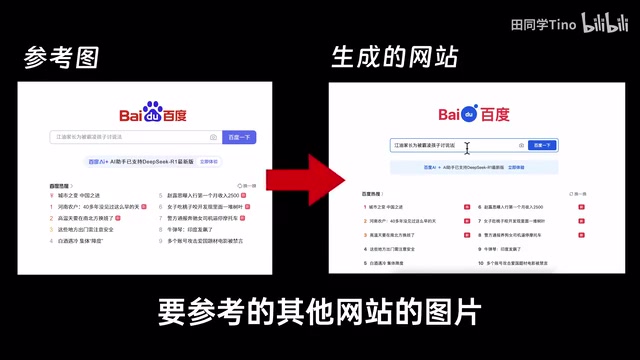
The core tool throughout the entire website building process is "Miaoda," and its usage is extremely intuitive: simply describe your website requirements in text within the dialog box. Beyond text descriptions, you can also upload screenshots of reference websites to have the AI mimic their layout and design.
After inputting requirements, Miaoda automatically invokes multiple agents working collaboratively — an architect handles structural design, an engineer handles functionality implementation, and a designer handles visual presentation. This Multi-Agent collaborative architecture represents a cutting-edge paradigm in current AI engineering. Unlike a single large model completing tasks independently, multi-agent systems decompose complex tasks into multiple specialized roles processed in parallel or sequence — an approach derived from the "separation of concerns" principle in software engineering. The Architect Agent understands requirements and plans information architecture, the Engineer Agent generates HTML/CSS/JavaScript code, and the Designer Agent ensures visual style consistency and aesthetics. This division of labor allows each Agent to deeply optimize within a narrower domain, ultimately producing output quality far superior to a single model's all-in-one approach. Research from leading institutions like OpenAI and Anthropic has shown that multi-agent collaboration achieves over 30% higher completion rates on complex tasks compared to single Agents — this is why Miaoda can generate websites with fewer bugs and higher completeness in such a short time. Throughout the entire process, users never need to touch code, and can receive a complete website within minutes.
Visual Editing and Natural Language Modifications in Parallel
No-Code website building isn't a new concept — platforms like Wix, Squarespace, and Webflow achieved drag-and-drop website building over a decade ago. However, the essence of traditional low-code tools is "template filling," where users still need to understand component logic and manually configure data structures. The revolutionary aspect of AI website building tools is introducing natural language as the sole interaction interface, shifting the burden of "intent understanding" from users to the model. On the technical level, such tools typically combine large language model (LLM) code generation capabilities with component-based rendering from frontend frameworks (like React, Vue), and some integrate cloud functions and database services, enabling dynamic features (like search and bookmarking) without users needing to configure backends.
After website generation, Miaoda offers two modification methods:
- Direct click editing: Click any element on the webpage to modify it, including text size, font, color, icons, images, etc. — what you see is what you get
- Dialog box modification: Describe modifications in natural language, and the AI automatically understands and executes adjustments
This dual-track editing mode is highly practical. Compared to tools like Webflow, AI website building's advantage lies in "zero-to-one" speed, while its disadvantage is the ceiling on fine-grained customization — this is why Miaoda simultaneously provides visual editing as a supplement to compensate for pure AI generation's limitations in detail control. Simple text replacements and color adjustments are more efficient with direct clicking; while complex needs involving layout adjustments or feature additions are more convenient to describe in natural language.

One-Click Deployment, Eliminating Traditional Website Building Hassles
Once the website is refined, clicking the publish button causes Miaoda to automatically deploy the website to servers and generate a publicly accessible link. The "one-click deployment" behind this relies on modern cloud computing's Serverless and static hosting technologies. Traditional website building requires users to independently purchase cloud servers (ECS/EC2), configure Nginx or Apache, manage SSL certificates, and handle domain resolution — each step requiring certain operations knowledge. Static hosting platforms represented by Vercel, Netlify, and Cloudflare Pages, as well as domestic solutions like Alibaba Cloud OSS+CDN, abstract all these steps away — developers only need to push code to complete deployment. AI website building tools encapsulate this process even further, so users don't even need to understand the concept of "deployment" itself. It's worth noting that such hosting solutions perform excellently for purely frontend navigation websites, with global CDN node distribution ensuring access speed; however, if the website involves user data storage, dynamic content generation, or other backend requirements, additional database and API services are needed — this represents the current capability boundary of AI website building tools. From design, building, to deployment, it truly achieves an end-to-end service, eliminating the tedious steps of purchasing servers, configuring domains, and uploading files in traditional website building.
Hands-On Comparison: Miaoda vs. Other AI Website Building Tools
The creator also tried another Agent-based website building tool to create the same resource navigation website, and the differences were striking:
| Comparison Dimension | Miaoda | Other Agent Tools |
|---|---|---|
| Generation Speed | ~2-3 minutes | Over 10 minutes |
| Page Quality | Fewer bugs, complete display | Issues like incomplete text display |
| Editing Method | Visual click + dialog box dual mode | Only supports dialog prompt modification |
| Simple Edit Efficiency | Direct click, instant effect | Requires writing prompts, longer process |
Visual editing capability is a significant advantage of Miaoda. For minor modifications like changing a title or swapping a color, having to write prompts in the dialog box and wait for AI regeneration every time would severely reduce efficiency.
Beyond Navigation Sites: More Application Scenarios for AI No-Code Website Building
Beyond tool navigation websites, Miaoda's application scenarios are far richer than imagined:
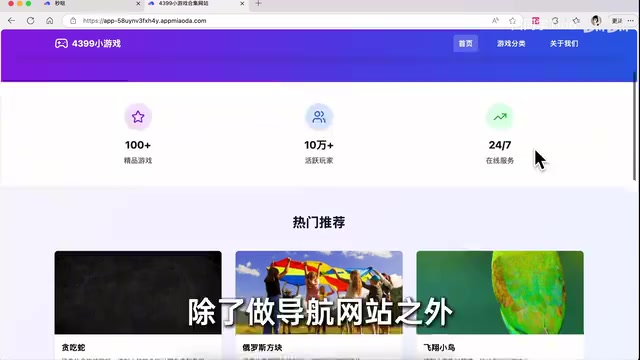
- Mini-game websites: Replicate 4399-style mini-game collection pages where games can run directly online
- Personal portfolio pages: Create polished personal homepages to showcase abilities and work for job interviews
- Enterprise management systems: Build internal management systems for companies, saving significant outsourced development costs
- WeChat Mini Programs: Generated web pages can be published as WeChat Mini Programs with one click for easy sharing and distribution
A New Era for Independent Developers: Technology Is No Longer the Bottleneck
The maturation of AI website building tools is fundamentally redefining the role of "developer."
Related articles
 Product Reviews
The Programmer's Desk Setup Guide: Building a Workspace That Feels Like Home
Discover how programmers build productive, comfortable workspaces. From multi-monitor setups to ergonomic design, explore the desk philosophy that drives focus and flow.
 Product Reviews
Qoder vs Cursor Real-World Comparison: Which $20/Month AI IDE Is Better?
Hands-on comparison of Qoder vs Cursor AI IDEs: Agent autonomy, human interaction count, and architecture decisions. Qoder needed only 2 interactions vs Cursor's 8.
 Product Reviews
Cursor Cloud Agent Demo: Eliminating Bottlenecks Across the Entire Software Development Lifecycle
Deep analysis of Cursor's Cloud Agent demo showing how cloud VMs, automated test artifacts, and a full-chain control plane systematically eliminate human bottlenecks across the software development lifecycle.