Building a Playable Pokémon Battle Demo with Claude Opus 4.5: An AI Coding Experiment

A developer built a fully playable Pokémon battle demo in hours using Claude Opus 4.5, with AI generating almost all assets.
Inspired by a tweet, a developer used Anthropic's Claude Opus 4.5 in high-performance mode to build a browser-playable Pokémon battle demo in just a few hours. Aside from backgrounds made with an image generator, nearly all code, sound effects, music, and animation logic were generated by Opus; pixel sprites were created via an "AI draft + human refinement" workflow. The project illustrates how AI-assisted creation is evolving from generating code snippets to producing complete interactive works — compressing what once took days into a single afternoon. The author notes it remains a rapid prototype rather than a production-grade product.
An AI Coding Experiment Behind a Pokémon Battle Demo
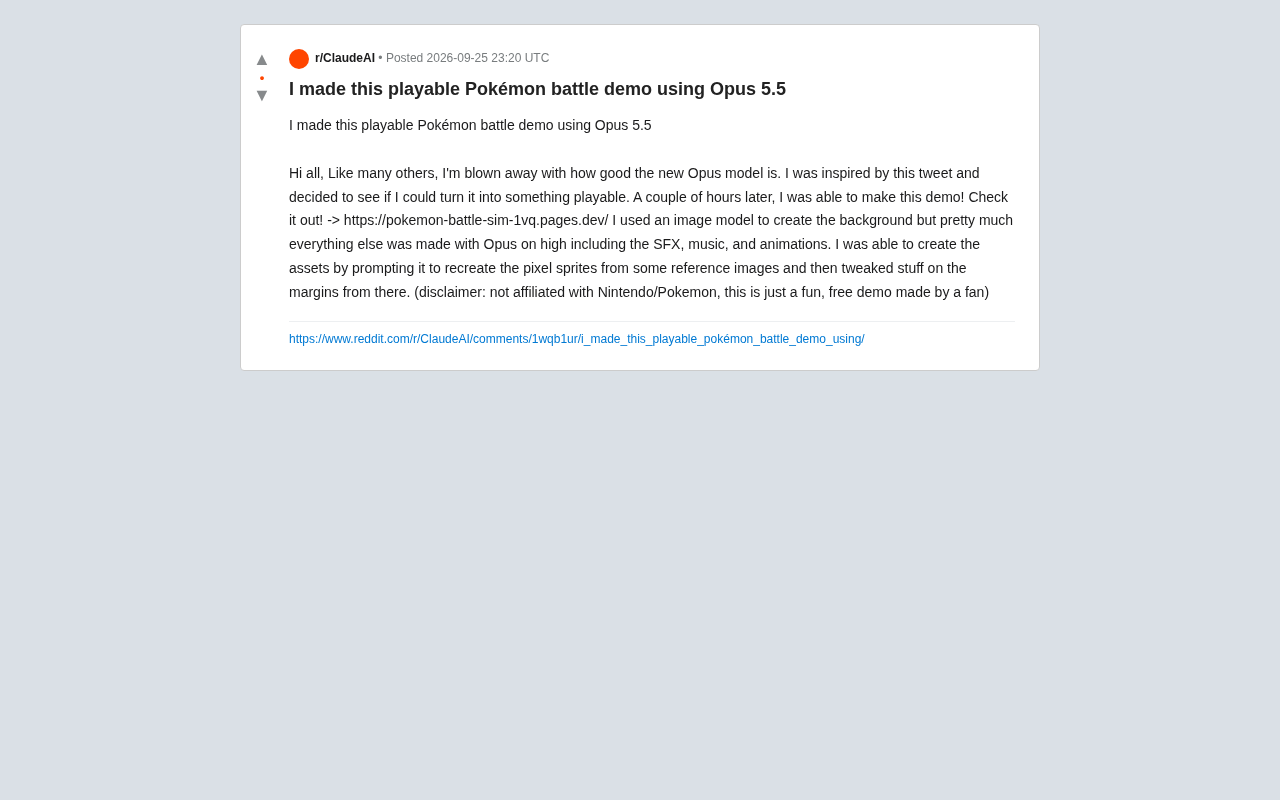
A developer recently shared on Reddit a playable Pokémon battle demo built using Anthropic's newly released Claude Opus 4.5 model, sparking widespread discussion. The author admitted, like many others, he was "blown away" by the new model's capabilities — and spent a few hours turning an idea from a tweet into a fully playable browser-based game.
The demo is now live, and anyone can jump in and experience the battle system directly in their browser. The author clearly noted the project has no affiliation with Nintendo or the official Pokémon franchise — it's purely a free fan-made experiment.
Almost Everything Generated by Opus — Except the Background
From a technical standpoint, what makes this project noteworthy is just how much of the heavy lifting was handled by AI. According to the author, aside from the game backgrounds — which were produced using an image generation model — virtually everything else, including sound effects (SFX), background music, and animation logic, was generated by Opus running in its high-performance mode.
This means the model wasn't just writing game logic code — it also handled battle animation timing, audio triggers, and other interactive and multimedia elements. For a personal project completed in just "a few hours," the level of polish genuinely demonstrates how far large models have come in end-to-end product prototyping.
Where the Pixel Art Came From
For game assets, the author took a clever approach: providing the model with reference images and having it "reconstruct" pixel sprites based on those references, then manually tweaking the edges and finer details.
This "AI-generated draft + human refinement" workflow is rapidly becoming the go-to approach for indie developers and creators. It doesn't demand perfection from the model on the first pass — instead, it treats AI as a collaborator capable of quickly producing usable drafts, while humans handle final quality control and stylistic consistency.
Anthropic's Claude Opus series is the company's most capable model lineup, designed for scenarios requiring deep reasoning and complex tasks. "High-performance mode" (Extended Thinking or a comparable high-compute configuration) typically means the model invests more computational resources in internal reasoning, delivering more consistent results on tasks like code generation and logical planning — though at the cost of higher latency and API call expenses. For game development tasks that require cross-domain coordination (logic, audio, animation timing), the model's context window size and instruction-following ability are equally critical — it needs to maintain a "memory" of the overall architecture throughout a continuous conversation in order to generate coherent code and asset-calling logic.
Pixel sprites are the fundamental visual units for characters and items in 2D games, typically at very low resolutions (such as 16×16 or 32×32 pixels), with every individual pixel requiring careful color design. Traditional production relies on professional pixel artists drawing each pixel by hand — a time-consuming process with strict stylistic consistency requirements. Having a large language model "reconstruct" pixel art essentially leverages the model's multimodal understanding to translate the visual features of a reference image into SVG vector descriptions, HTML Canvas drawing instructions, or directly generated color value arrays, which are then rendered as pixel-style images. Drafts generated this way often closely match the reference in silhouette and color palette, but fine details — such as anti-aliased edges and shadow gradients — still require manual intervention. This is precisely where the "AI draft + human refinement" workflow delivers its value.
From a Tweet to a Playable Product: What This Workflow Reveals
The value of this project isn't in the complexity of the game itself — it's in the increasingly short creative path it demonstrates: spot an idea → break it down with AI → generate code and assets → deploy and share. The entire process compressed into a matter of hours.
By comparison, a small game demo featuring art, sound effects, animations, and battle logic would have taken even an experienced developer days or weeks in the past. Now, a solo developer using a model like Opus can go from idea to shareable link in a single afternoon.
What Trends Does This Reflect?
It's worth reflecting on the fact that community-driven "real-world model capability tests" like this often reveal more about a model's true usability than official benchmarks. When more and more users can produce complete, playable, shareable projects in a short amount of time, it signals that the model's coherence and reliability on complex, multi-domain tasks has crossed some meaningful practical threshold.
That said, a degree of realism is warranted: this is still a small-scale fan demo, and the author hasn't gone into depth on code quality, maintainability, or other engineering concerns. It's a success in the sense of "rapid prototyping" — not a validation of production-grade engineering.
Benchmarks are standardized test suites for evaluating AI model capabilities — examples include HumanEval (code generation) and MMLU (knowledge Q&A). While useful for comparing models side by side, these tests are typically isolated single tasks that can't reflect how a model handles ambiguous requirements, multi-step coordination, and long-context consistency in real development scenarios. By contrast, community tests like "built a playable demo in a few hours" evaluate a model's holistic performance in real workflows — including understanding imprecise natural language requirements, proactively filling in missing details, and maintaining directional consistency across multiple iterations. Crossing this "usability threshold" often means more to working developers than a few percentage points of improvement on a benchmark score.
Conclusion
A Pokémon battle demo built with Claude Opus 4.5 might look like just another community experiment on the surface — but it actually reflects a broader shift: AI-assisted creation is moving from "generating code snippets" to "producing complete, interactive works." For indie developers and creators, mastering the "AI generation + human refinement" collaborative workflow may be far more valuable in practice than obsessing over which model scores highest on leaderboards. If you're curious, head over to the link the author shared and try it out for yourself.
Related articles

Why Does the Tesla Roadster Need to Fly? A Deep Dive into Musk's Wild Demo
Tesla's Roadster launch showed wall-climbing, upside-down driving, and flying stunts—but The Vergecast notes the demo car may lack a battery, the Rocket version is invite-only and not street-legal, and the website terms don't guarantee delivery. After nine years of delays, why does this car still need to exist?

AI Is Not a Replacement: Human-AI Collaboration Through the Lens of Factory Root Cause Analysis
Starting from factory root cause analysis, this article explains how AI accelerates evidence chain construction rather than replacing human experts, exploring the pragmatic implementation logic and business value of 'AI supporting people rather than replacing them.'

AI Agent Decision Auditing: Building an Evidence Chain in Regulated Workflows
Starting from a Reddit discussion, this article analyzes three core issues in AI agent decision auditing within regulated workflows: what fields audit records should contain, how to handle feedback latency for erroneous decisions, and how to continuously calibrate LLM judge consistency with human judgment.