Building a Power Dialect Lexicon with Soft-Label Bidirectional Anchoring and Active Learning

Weakly supervised framework automatically builds a dialect power lexicon, achieving zero-false-positive dialect recognition on Yuxi WeChat data.
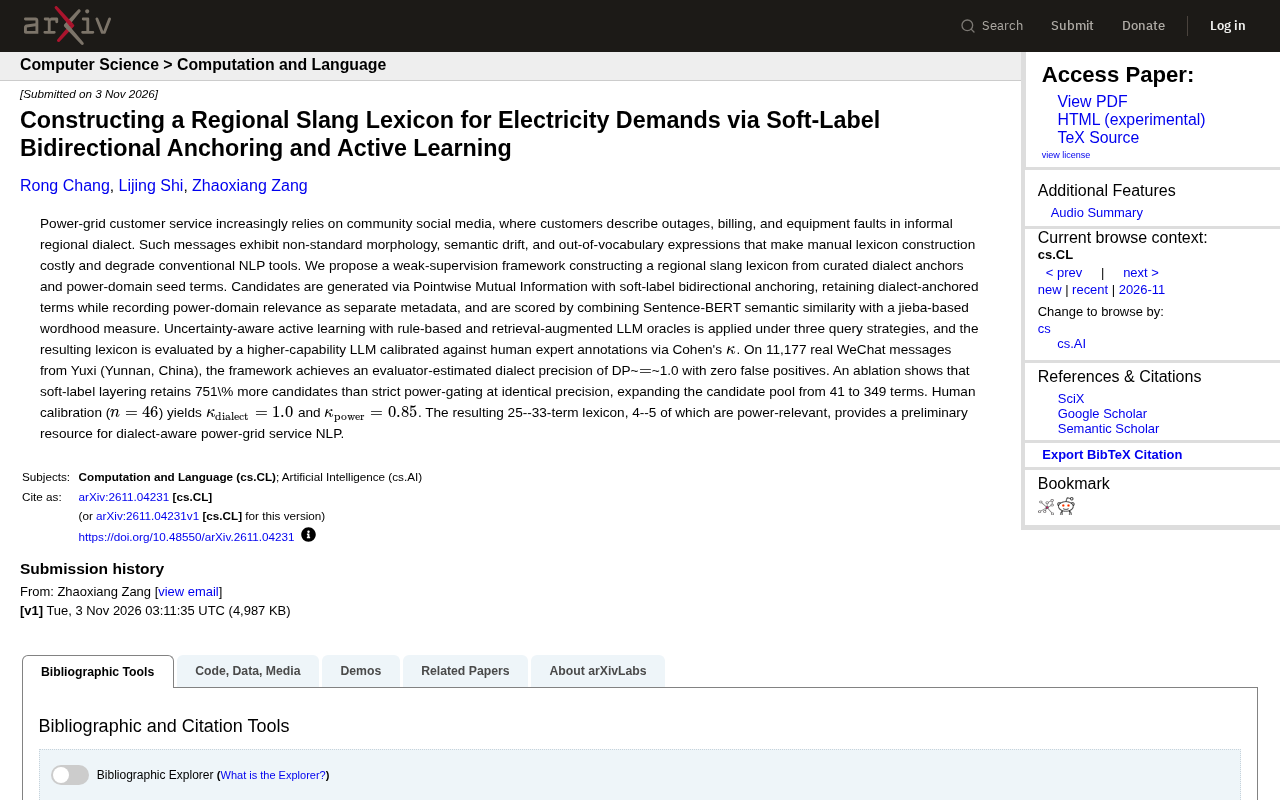
To address non-standard expressions, semantic drift, and out-of-vocabulary words in dialect social media messages in power customer service, this study proposes a weakly supervised framework that starts from dialect anchors and power seed words, uses PMI to generate candidates, and uses soft-label bidirectional anchoring to retain power relevance metadata instead of hard-filtering. Candidate scores combine Sentence-BERT semantic similarity with a jieba part-of-speech measure, followed by uncertainty-aware active learning and LLM oracle filtering. On 11,177 real WeChat messages from Yuxi, Yunnan, dialect precision DP=1.0 with zero false positives, and human calibration κ_dialect=1.0, κ_power=0.85. The final lexicon contains 25-33 entries and is positioned as a preliminary resource for dialect-aware power customer service NLP.
Power grid customer service is increasingly relying on social media to capture user needs, but users in regions such as Yuxi, Yunnan, are accustomed to describing power outages, bills, and equipment failures in dialect. These non-standard expressions pose significant challenges to traditional NLP tools. A new study proposes a weakly supervised framework that automatically constructs a regional slang lexicon starting from dialect anchors and power seed words, achieving zero-false-positive dialect recognition accuracy on real WeChat data.
The Special Challenges Dialect Text Poses for Power Customer Service NLP
Social media messages in power customer service scenarios are often mixed with local dialects, exhibiting non-standard forms, semantic drift, and numerous out-of-vocabulary words. In the Yuxi region of Yunnan, for example, users may describe power outages in WeChat using expressions completely different from Mandarin. Manually building dialect lexicons is costly, while directly applying general-purpose NLP tools yields poor results. This study focuses on this pain point and attempts to automate the lexicon construction process using weakly supervised methods.
According to the paper, the "non-standard forms, semantic drift, and out-of-vocabulary expressions" in such messages make manual lexicon construction costly and degrade the performance of conventional NLP tools. The research team started from carefully curated dialect anchors and power-domain seed words, and designed a candidate word generation and filtering mechanism.
Soft-Label Bidirectional Anchoring: The Key Design for Retaining More Candidates
The core innovation of the framework is "soft-label bidirectional anchoring." Candidate words are generated via pointwise mutual information (PMI), while dialect anchor words are retained and power-domain relevance is recorded as independent metadata rather than hard-filtered. Candidate scores are composed of Sentence-BERT semantic similarity combined with a jieba-based part-of-speech measure.
This soft-label layered design stands in sharp contrast to strict power gating. Ablation experiments show that, at the same precision, soft-label layering retains 751% more candidate words than strict power gating, expanding the candidate pool from 41 words to 349 words. This means the system will not miss a large number of promising dialect expressions due to over-focusing on power relevance.
Subsequently, the study employs uncertainty-aware active learning, combined with rule-based and retrieval-augmented LLM oracles, to perform filtering under three query strategies. The final lexicon is evaluated by a more capable LLM and calibrated against human expert annotations via Cohen's κ.
Pointwise mutual information (PMI) is a statistic measuring how tightly two words co-occur in a corpus, defined as (\text{PMI}(x,y)=\log\frac{P(x,y)}{P(x)P(y)}). In dialect lexicon construction, PMI is used to mine candidate words that frequently co-occur with dialect anchors from massive WeChat messages: if a word frequently co-occurs with known dialect words in the same context, it is likely also a dialect expression. PMI is sensitive to low-frequency co-occurrences and is often used with smoothing or threshold filtering.
Sentence-BERT is a pretrained model that maps sentences to dense vectors, fine-tuned through a siamese network structure so that semantically similar sentences are closer in vector space. In this study, it is used to compute the semantic similarity between candidate words and anchor words, compensating for PMI's reliance solely on co-occurrence statistics and its inability to capture semantic generalization.
Cohen's κ is a statistical metric measuring the degree of agreement between two annotators, typically ranging from 0 to 1, after accounting for the probability of random agreement. κ=1.0 indicates perfect agreement, and κ>0.8 is generally considered high agreement. This study uses κ to calibrate the agreement between LLM automated evaluation and human expert judgment; κ_dialect=1.0 means the automated evaluation perfectly matches experts on dialect determination, while κ_power=0.85 indicates that power relevance determination also reaches high agreement, providing reliability support for the "zero false positive" conclusion.
Real-Data Validation: Zero False Positives and High Agreement
The study was tested on 11,177 real WeChat messages from Yuxi, Yunnan. Results show that the evaluator-estimated dialect precision DP=1.0, with zero false positives. Human calibration (n=46) yielded dialect agreement κ=1.0 and power relevance agreement κ=0.85, indicating that automated evaluation highly matches expert judgment.
The final lexicon contains 25 to 33 entries, of which 4 to 5 are power-related. The paper positions it as a "preliminary resource for dialect-aware power customer service NLP."
Methodological Insights and Limitations
The value of this framework lies in shifting lexicon construction from purely manual to a weakly supervised pipeline, with the soft-label mechanism showing particularly clear advantages in recall. However, the paper also acknowledges that the current lexicon size is limited and is only a preliminary resource. The coverage of 25 to 33 entries remains small for a practical customer service system, and future work needs to extend to more dialect regions and larger-scale seed lexicons.
Another noteworthy point is the combination of active learning with LLM oracles. Rule-based and retrieval-augmented LLMs serve as oracles under three query strategies, offering a reusable approach for annotation efficiency in low-resource scenarios. However, the framework depends heavily on the quality of initial dialect anchors and power seed words; improper anchor selection may directly affect the quality of candidate word generation.
Overall, this study provides an actionable weakly supervised path for domain NLP in dialect-dense scenarios, with practical potential especially in scenarios such as power customer service that require rapid response to local user needs.
Active learning is a strategy in which the model actively selects the most valuable samples to be annotated by annotators (or oracles), aiming to achieve equivalent performance with less annotation. Common query strategies include uncertainty sampling (selecting samples the model is most uncertain about), margin sampling, and entropy sampling. In this study, under three query strategies, rule-based and retrieval-augmented LLMs act as oracles to complete annotation, thereby efficiently expanding the lexicon under low-resource conditions and avoiding the high cost of manually reviewing all candidate words.
One-line Summary
A weakly supervised framework automatically builds a dialect power lexicon, achieving zero-false-positive dialect recognition on Yuxi WeChat data.
Paragraph Summary
To address the challenges of non-standard expressions, semantic drift, and out-of-vocabulary words in dialect social media messages in power customer service, this study proposes a weakly supervised framework that starts from dialect anchors and power seed words, uses PMI to generate candidate words, and employs soft-label bidirectional anchoring to retain power relevance metadata rather than hard-filtering. Candidate scores combine Sentence-BERT semantic similarity with a jieba part-of-speech measure, followed by uncertainty-aware active learning and LLM oracle filtering. On 11,177 real WeChat messages from Yuxi, Yunnan, dialect precision DP=1.0 with zero false positives, and human calibration κ_dialect=1.0, κ_power=0.85. The final lexicon contains 25-33 entries and is positioned as a preliminary resource for dialect-aware power customer service NLP.
Related articles

Glasshand: Giving AI Agents a Real iPhone and Mac
Glasshand lets AI agents rent real iPhones and Macs, supporting Claude Code, Codex, and more to post, book services, and test iOS apps on real devices. This article explains how it works, its use cases, and potential boundaries.

ChatGPT Images 2.6 Released: GIF Generation, Reference Image Reuse, and 50% Speed Boost
ChatGPT Images 2.6 released: prompt-to-GIF animation with frame-by-frame editing, reusable reference images for yourself, pets, or characters, 50% faster generation, plus Flare and Sunburst API model variants and SVG export for developers.

Rerun: Turn Your AI Subscription into an AI Coworker Team
Rerun, #3 on Product Hunt, turns your ChatGPT or Claude subscription into a team of AI coworkers that run on schedules or triggers, each with tools, a computer, and a shared workspace. It asks before risky actions, is open source (AGPL v3), and supports self-hosting.