Building a Reinforcement Learning Walking Robot from Scratch: Teaching a Biped to Walk with PPO

Building and training a simulated biped to walk using PPO reinforcement learning with Box2D and Stable-Baselines3.
A developer shares an open-source project that trains a simulated bipedal robot to walk from scratch using Python, Box2D for 2D physics simulation, and PPO via Stable-Baselines3. The article covers the robot's minimalist 4-joint design, 12-dimensional observation space, continuous action space, reward function design for stable gait learning, and key challenges including sparse rewards, balance fragility, and periodic gait coordination.
Project Overview: A Reinforcement Learning Walking Experiment from Scratch
How do you teach a simulated robot to walk? This seemingly simple question is actually one of the most classic and challenging tasks in reinforcement learning. Recently, a developer shared their walking robot project built entirely from scratch on Reddit, showcasing the complete technical journey from physics simulation setup to policy training.
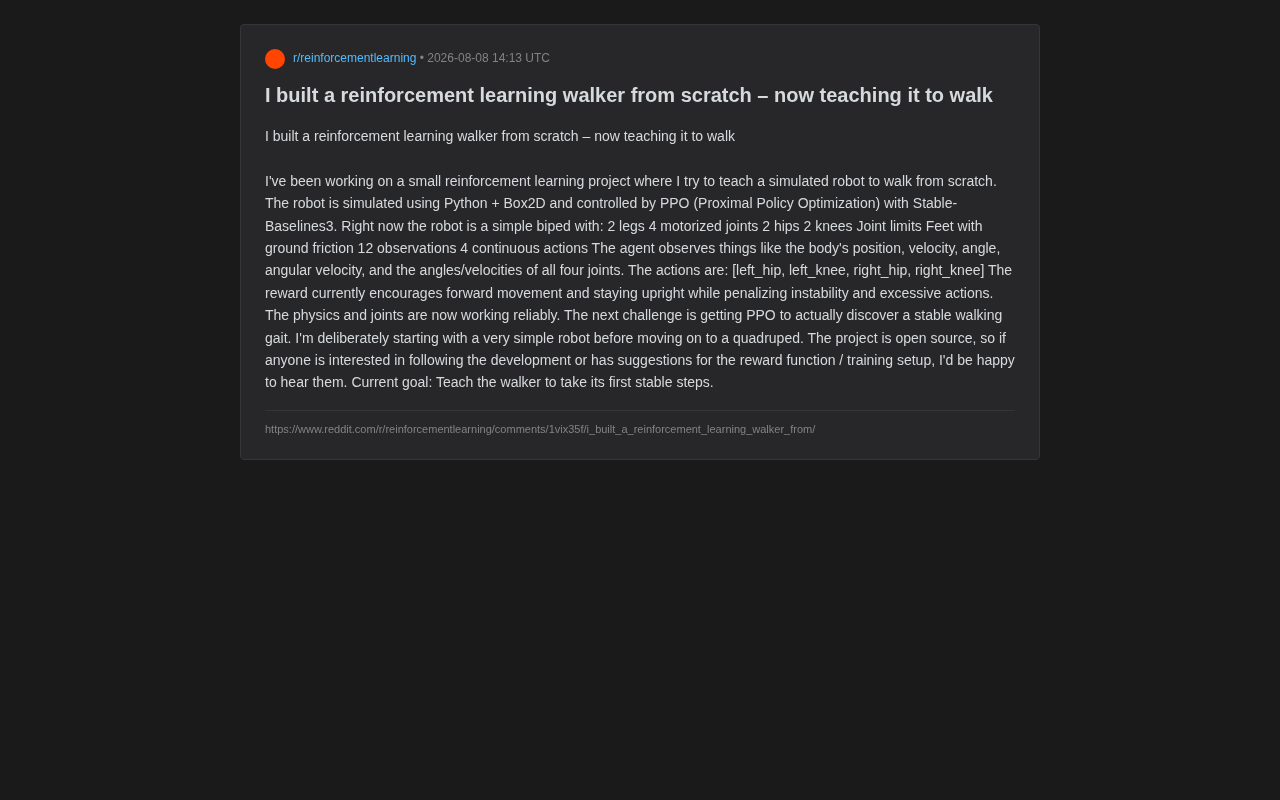
The project's core objective is straightforward: enable a simulated biped to learn a stable walking gait through autonomous learning. The developer uses Python + Box2D as the physics simulation engine and the PPO (Proximal Policy Optimization) algorithm from the Stable-Baselines3 framework to train the control policy. The entire project is open-source, and the author is actively seeking improvement suggestions for reward function design and training configurations.
Box2D is an open-source 2D rigid body physics engine developed by Erin Catto. Originally widely used in game development (such as the classic Angry Birds), it was later extensively adopted by the reinforcement learning community as the foundation for lightweight simulation environments. Compared to 3D physics engines like MuJoCo and PyBullet, Box2D's core advantages lie in its extremely low computational overhead, clean API, and intuitive debugging — making it ideal for prototyping and educational scenarios. Several classic environments in OpenAI Gym (such as LunarLander and BipedalWalker) are built on Box2D. However, 2D simulation also means the robot can only move within a single plane, unable to simulate core 3D walking challenges like lateral balance — a limitation that must be addressed when migrating to more complex simulators.
Stable-Baselines3 (SB3) is a reinforcement learning algorithm library built on PyTorch, a rewrite of the earlier Stable-Baselines (which was based on TensorFlow). SB3 provides high-quality implementations of mainstream algorithms including PPO, SAC, TD3, A2C, and DQN, following a unified API design that integrates seamlessly with Gymnasium (formerly OpenAI Gym) environment standards. For developers, SB3's core value is eliminating the extensive engineering work of implementing algorithms from scratch — including experience replay buffer management, network architecture design, gradient clipping, logging, and other tedious details — allowing developers to focus their energy on environment design and reward engineering.
The Biped's Body Structure: A Minimalist Design Philosophy
The developer deliberately chose a structurally simple biped as the starting point, reflecting an important practical principle in reinforcement learning engineering — start with the minimum viable system, then gradually increase complexity.
The robot's current physical configuration includes:
- 2 legs, each with 2 motorized joints
- 4 motorized joints: left and right hips, and left and right knees
- Joint limits that simulate the range-of-motion constraints of real mechanical structures
- Feet with ground friction, ensuring effective force interaction between the robot and the ground
In robotics, joint limits are hard constraints on a joint's range of angular motion, directly simulating the physical stops in real mechanical structures. For example, the human knee can only bend within approximately 0°-140° and cannot hyperextend in the reverse direction. Setting reasonable joint limits in simulation not only increases the likelihood that trained policies can transfer to real robots (known as sim-to-real transfer), but also significantly narrows the effective search range of the action space, indirectly accelerating the learning process. The number of Degrees of Freedom (DoF) directly impacts the difficulty of policy search — each additional joint adds one dimension to the action space and expands the state space accordingly, causing the required sample count to grow exponentially. This is known as the "curse of dimensionality."
This design preserves the core challenges of bipedal walking (center-of-gravity balance, coordinated actuation) while avoiding the training dimension explosion caused by too many degrees of freedom. The author explicitly stated that they won't attempt the more challenging quadruped until the biped is successfully trained.
State Space and Action Space: The Agent's Perception and Control Mechanisms
The essence of reinforcement learning is an agent continuously optimizing its policy by observing states, taking actions, and receiving rewards in an environment. This project's observation space contains 12 dimensions, covering the robot's key kinematic information.
The 12 Dimensions of the Observation Space
- Body position
- Body velocity
- Body angle
- Body angular velocity
- The angle and angular velocity of each of the four joints
These observations give the agent a relatively complete perception of its own motion state, forming the basis for decision-making.
The 4 Control Variables of the Continuous Action Space
The action space consists of 4 continuous variables, corresponding to the drive signals for the four joints:
[left_hip, left_knee, right_hip, right_knee]
Using a continuous action space is precisely where policy gradient algorithms like PPO excel. PPO is a policy gradient reinforcement learning algorithm proposed by OpenAI in 2017, widely regarded as one of the most practically valuable on-policy algorithms available today. PPO's core innovation is using a clipped surrogate objective to limit the magnitude of each policy update, avoiding the policy collapse caused by overly large update steps in traditional policy gradient methods. Before PPO, TRPO (Trust Region Policy Optimization) addressed the same problem through KL divergence constraints, but at a high computational cost. PPO retains TRPO's stability while dramatically simplifying implementation, requiring only first-order optimization for training. PPO has been extensively validated in scenarios including robot motion control and game AI (such as OpenAI Five's Dota 2 training).
Compared to discrete actions, continuous control can output fine-grained joint torques that more closely resemble how real robots are driven, but it also significantly increases the difficulty of policy search.
Reward Function Design: The Core Mechanism for Guiding Walking Behavior
In reinforcement learning, the reward function almost entirely determines what kind of behavior the agent will ultimately learn. Poorly designed rewards often lead the agent to discover "shortcut" strategies — such as twitching in place or falling forward to game the reward.
The project's current reward mechanism is designed around the following objectives:
- Encouraging forward movement: the primary goal signal for the walking task
- Encouraging upright posture: preventing the robot from falling over
- Penalizing instability: suppressing undesirable behaviors like violent swaying
- Penalizing excessive actions: avoiding overly aggressive joint outputs and encouraging smooth, efficient movement
This reward design philosophy is highly similar to the classic OpenAI Gym BipedalWalker environment, balancing forward progress objectives with stability constraints. However, the author also acknowledges that the current biggest challenge is getting PPO to actually discover a stable walking gait — which often requires iterative tuning across reward weights, exploration noise, and training steps.
Current Progress and Core Technical Challenges
According to the author, the project has completed the physics simulation layer: the physics engine and joint system are running reliably, meaning the infrastructure is solid. The core challenge has now shifted from "can we simulate it" to "can it learn."
From a technical perspective, policy learning for bipedal walking is difficult primarily because of:
- Sparse rewards and the credit assignment problem: The robot needs to coordinate multiple consecutive steps to take a single stable stride, making it very difficult for early random policies to receive positive feedback.
- The fragility of balance: Bipedal systems are inherently unstable — the slightest deviation leads to a fall, resulting in a large volume of failure samples.
- Periodic coordination of gait: True walking requires alternating left and right legs at specific phases, and this periodic pattern poses a significant challenge for pure policy search.
Regarding the first point, sparse reward is one of the thorniest challenges in reinforcement learning. In walking tasks, if reward is only given after the robot successfully walks a certain distance, then during early training, random policies are almost impossible to trigger this condition, leaving the agent with no learning signal. The credit assignment problem is even more subtle: even if the robot happens to take a step, the algorithm struggles to determine which specific actions among the preceding dozens of time steps deserve credit for the success. These two problems combined make reward designs that rely purely on final outcomes virtually unworkable in motion control tasks. Common countermeasures include: dense reward shaping, curiosity-driven intrinsic motivation, and providing initial policy guidance through demonstration data (such as DAgger or inverse reinforcement learning).
The author's current milestone goal is very pragmatic — getting the robot to take its first stable step. While this may seem like a tiny achievement, it's actually the critical turning point for the emergence of full walking capability.
Practical Insights for Reinforcement Learning Developers
Although this project is modest in scale, it offers considerable reference value for developers looking to get started with robot reinforcement learning. It demonstrates a clear technology stack pathway: Box2D handles physics simulation, Stable-Baselines3 provides a mature PPO implementation, and the developer only needs to focus on environment modeling and reward design.
For those interested in following along or contributing, the most worthwhile areas to invest effort include:
- Reward shaping: More precisely guiding the learning process
- Curriculum learning: Gradually transitioning from simple tasks to full walking
- Systematic hyperparameter tuning: Grid search over key parameters like learning rate, batch size, and clip range
Among these, curriculum learning borrows from the "start simple, build up" philosophy of human education, guiding the agent to learn complex skills by progressively increasing task difficulty. In bipedal walking scenarios, a typical curriculum design includes: first having the robot learn to balance while standing, then attempting single steps with external force assistance, then reducing the assistance until fully autonomous walking is achieved, and finally introducing uneven terrain or external disturbances. DeepMind's 2017 landmark paper Emergence of Locomotion Behaviours in Rich Environments demonstrated the powerful effect of curriculum learning in motion control — by training in rich, varied terrains, agents spontaneously developed diverse locomotion behaviors including running, jumping, and turning. At the implementation level, curriculum learning is typically achieved by dynamically adjusting environment parameters (such as ground inclination angle, gravity magnitude, and the randomization range of initial poses) to control the difficulty gradient, allowing agents to receive positive feedback early on and establish foundational movement patterns.
These are precisely the critical factors that determine the success or failure of reinforcement learning projects. The project is open-source, and interested developers are welcome to follow its progress and jointly explore the classic challenge of teaching robots to "learn to walk."
Related articles

Python 3.15 New Feature: Is the sentinel Type Better Than None?
Python 3.15 adds the sentinel type, using named unique sentinel objects to replace None and bare object(), resolving confusion among missing values, explicit emptiness, and invalid input while avoiding type hint failures.

Deep Learning's Three Architectures and the Universal Approximation Theorem: A Complete Guide to MLPs, CNNs, and Transformers
Explaining the inductive bias differences among MLP, CNN, and Transformer, the existence meaning of the Universal Approximation Theorem (UAT), and the role of Taylor expansion in approximation analysis, while clearing up common misconceptions.

GitLab Emergency Patch Release: Analysis of Critical Security Fixes
GitLab releases critical patch 19.5.1, sparking 355 points of discussion on Hacker News. This article analyzes the background, upgrade steps for self-hosted instances, and verification points to help DevOps teams respond quickly to security updates.