Building a SaaS-Grade Product Video with Claude Code Alone, No Editing Software

A creator used only voiceover audio and Claude Code to write an entire SaaS product video as code.
The article covers a creator who supplied only voiceover audio while Claude Code "wrote" a full SaaS product promo video as code: app interface, 3D windows, cursor clicks, and animations all synced word by word to narration, with music, sound effects, and subtitles also generated—no After Effects, Premiere, or editor. The core is replacing manual timeline editing with code generation, binding animation events to each word rather than estimated frame numbers, so voiceover changes don't require realigning keyframes. The creator claims the solution transfers to any product and cuts delivery from weeks to a day, though unverified. The article cautions that model versions, prompts, failure rates, and rendering parameters remain undisclosed, and humans still define storyboards, visual specs, and brand consistency.
A creator on YouTube demonstrated a radically different approach to producing product videos: no After Effects, no Premiere, no hired editor—just Claude Code, resulting in what they call a "Premium SaaS"-grade product promo video. According to the video's description, the creator supplied only their voiceover audio, and Claude "wrote" the entire video as code—the app interface, 3D windows, cursor clicks, every animation, all precisely synced to each word of the narration; background music, sound effects, and subtitles were also generated by the model.

From "Editing" to "Writing Code": A Fundamental Workflow Shift
The traditional product video pipeline is long: write a script, record voiceover, design storyboards, align animations frame by frame on a timeline, mix audio, burn in subtitles—and any change in one link can trigger a full rework. The approach shown in this video replaces "timeline operations" with "code generation": every frame's state and every element's entrance timing is described by code logic, and the code is generated by Claude Code based on the narration content.
The significance of this shift goes beyond saving on software subscription fees. Animations in editing software are "manually placed"; change one line of voiceover and you may need to realign a dozen keyframes. But when animations are code-driven and bound to speech content, modifying the voiceover in theory only requires regenerating the corresponding segment. According to the creator, the on-screen cursor clicks, the unfolding of 3D windows, and all animations are synced to "every word in my voice"—exactly what a code-based timeline can reliably achieve.
Claude Code is Anthropic's command-line agentic coding tool. Unlike the web chat version, it can directly read and write project files, execute commands, and iteratively modify code. In this video-generation scenario, it plays the role of "translating natural language intent into a runnable project": the creator describes animation requirements, the model generates code responsible for rendering the interface and orchestrating the timeline, then repeatedly runs and debugs it. Understanding this is key—the video isn't "drawn" by some video model, but "rendered" frame by frame by code, making it version-controllable and parameterizable. It also means quality depends on the engineering quality of the scaffolding and prompts, not just model capability.
How Speech-Driven Animation Sync Works
The capabilities mentioned in the material include: app screen recording/interface presentation, 3D windows, cursor clicks, word-synced animations, and a full package of music, sound effects, and subtitles. Broken down, none of these is novel individually—screen recording, 3D transforms, and subtitle generation all have mature tools. What's truly scarce is the "word-level alignment" layer: each word of the narration corresponds to a timestamp, and animation events are attached to these timestamps rather than to frame numbers estimated by the human eye.
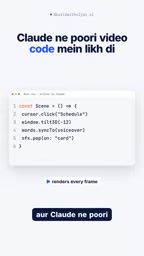
This also explains why the creator emphasizes "only gave the voiceover." The voiceover is both content and the skeleton of the timeline—the rhythm of speech naturally defines the rhythm of animation, and all the model needs to do is choreograph visual events onto this skeleton. For product demo videos, this "speech-as-timeline" paradigm fits remarkably well: demo video narratives naturally follow the explanation.
Word-level timestamps (forced alignment) are the technical foundation of this process. The typical approach is to first run speech recognition on the voiceover audio to get the start and end times of each word, then bind animation events to these timestamps. In traditional editing, alignment relies on eyeballing and dragging keyframes on the timeline; with word-level timestamps, synchronization like "the button is pressed when 'click' is said" can be precisely triggered by code, and after audio changes you only need to re-run alignment. This is why the creator emphasizes "only gave the voiceover"—the voiceover serves simultaneously as content and timeline skeleton.
Reusable Template Potential
One point the creator emphasizes heavily in the video: this workflow isn't only for their own product. "Your software, your product—with any setup, you can make equally professional product videos." In other words, the output isn't a single video but a transferable generation solution—swap products, swap voiceovers, and the process stays the same.

If this solution is indeed as reusable as described, it will disrupt not only editing software but also the product video outsourcing market. The material mentions that demand for such videos is strong and editors and agencies charge high rates, while the creator's comparison is: videos others wait weeks for can be produced here in a day. This time comparison comes from the creator's own account and hasn't been verified by third-party reproduction, but the direction aligns with the logic of code-based generation—faster than manual editing is an inherent advantage of such solutions.

Code-based video generation in engineering typically relies on declarative animation frameworks (such as React/Remotion-style approaches that describe visuals with components and timelines) or procedural rendering pipelines: frames aren't recorded but deterministically computed by frame number. The advantages of such solutions are reusability, diffability, and batch parameter replacement; the cost is the upfront work of building component libraries, visual specifications, and rendering environments. Therefore, the premise of "swap products and voiceovers and it still works" is that the template layer has abstracted interfaces, motion effects, and brand styles into configurable modules—which explains why the complete setup itself has methodological value.
A Sober View: The Gap Between Demo and Engineering Reality
To be clear, this video is essentially a capability showcase. The material doesn't disclose specific technical details: which model version was used, how prompts were organized, what the failure rate was, what rework costs were, or key parameters like final resolution and rendering time—none are mentioned. The creator says the complete setup and prompts are available via comments, meaning the core methodology isn't publicly revealed in the video.
For teams wanting to replicate this workflow, a reasonable expectation is: behind "generate an entire video from one sentence" there's likely still carefully designed project scaffolding, asset specifications, and extensively tuned prompts. Claude Code excels at translating structured intent into runnable code, but the "structured intent" itself—storyboard design, visual specifications, brand consistency—still needs to be defined by humans. Understanding it as "moving the editor's work upstream into engineering configuration" is closer to reality than "completely hands-off."
Implications for Content Producers
The real value of this video isn't another flashy demo, but the thinking it demonstrates: abstract repetitive visual production into code and templates, and let the model handle translation. For SaaS teams that need to frequently produce product demos and feature-update videos, the long-term payoff of this path may far exceed the production cost savings of a single video. The premise is that the team is willing to accept a new division of labor—visual design becomes parameters and specifications, animation choreography becomes version-controllable code, and voiceover once again becomes the true skeleton of the video.
One-line Summary
A creator used only voiceover audio and Claude Code to write an entire SaaS product video as code.
Paragraph Summary
The article describes a case where a creator supplied only voiceover audio and Claude Code "wrote" an entire SaaS product promo video as code: app interface, 3D windows, cursor clicks, and animations all synced word by word to the narration, with music, sound effects, and subtitles also generated by the model—no After Effects, Premiere, or editor throughout. The core is replacing traditional manual timeline editing with code generation, attaching animation events to each word of the narration rather than manually estimated frame numbers, so modifying the voiceover doesn't require realigning numerous keyframes. The creator claims the solution transfers to any product, outputs reusable templates rather than a single video, and shortens delivery from weeks to one day—though this comparison is unverified by third parties. The article also cautions that key details like model version, prompt structure, failure rate, and rendering parameters are undisclosed, and behind "generate an entire video from one sentence" humans still need to define storyboards, visual specifications, and brand consistency.
Related articles

AI Tools Quietly Altering Settings: Postman Silently Installs Plugin, Codex Sharing Option Auto-Resets
AI Daily reports: Postman silently installs a Mac plugin and self-approves startup hooks, logged as auto-existing upgrade; Hacker News developers say Codex data-sharing opt-out flips back. Plus Simon Willison's raw float weight experiment with QEN 3.8-27B.

AI Learns to Rewrite AI: MIT's "Weightspace Programming" Redraws the Path to Recursive Self-Improvement
MIT team proposes weightspace programming: GPT-6 Astra reads and edits AI model weights directly. Math scores jump several-fold, hand-written networks beat trained models. Eight experiments analyzed, plus Anthropic's same-day warning and the real boundaries of recursive self-improvement.

Running Qwen 3.8 on a Laptop to Read Raw Weights: 46 Minutes Per Answer
Simon Willison reproduced weight space programming with Qwen 3.8 27B on a laptop: a 17GB model file, 46 minutes per answer, 43,506 reasoning tokens, Pong over an hour, Freeway failed. Suited for interpretability researchers.