Building a Second Brain with Obsidian: Practical Experience and Methodology from a 6-Million-Word Knowledge Base

How one creator built a 6-million-word Obsidian second brain over five years with bidirectional links and AI.
A Bilibili content creator shares five years of hands-on experience building a 6-million-word Obsidian knowledge base. The article covers why personal knowledge bases outperform public search engines, how bidirectional links and path analysis enable creative thinking, how AI handles automatic classification and tagging at scale, and practical principles for building your own second brain.
Why Build a Personal Knowledge Base
When people talk about "personal knowledge management," the conversation often stays at the tool level—what software to use, how to take notes, how to tag things. But the real question worth asking is: what does knowledge management actually do for you?
One Bilibili content creator spent five years building a 6-million-word Obsidian note library and offered an answer that cuts right to the heart of the matter: speed.
Obsidian is a knowledge management application based on local Markdown files, launched in 2020 by the Dynalist team. Unlike cloud-based note-taking tools such as Notion and Evernote, Obsidian stores all data in plain text format on the user's local hard drive, giving users full control over their data without relying on any cloud service provider. Its core feature is "bidirectional linking"—you can establish connections between any two notes and visualize these connections through a Graph View. This design is deeply influenced by the Zettelkasten (slip-box) method, invented by German sociologist Niklas Luhmann, who used this system to manage over 90,000 note cards and published more than 70 books in his lifetime. Obsidian also boasts an extremely active plugin ecosystem, with the community contributing over 1,500 plugins covering calendars, kanban boards, data queries, mind maps, and more.
Nearly all of us have experienced that awkward moment: a boss, advisor, or client throws out a question out of nowhere, and you're thinking "I've seen this before, I know this"—but when you actually try to answer, the response is far less clear than you imagined. In the past, dealing with this meant rummaging through old books, old notes, and old files—you might preserve the quality of your answer, but others are left waiting, and it's embarrassing for everyone.
So six years ago, the author had an idea: what if there were a system that could store everything you've ever learned, ready to be instantly retrieved whenever someone asks a question? Six years later, that system has matured significantly. Now, whether someone asks about industry regulations, import tariff declarations, or everyday questions like "which cooking oils are healthiest," the author can typically locate the answer from the knowledge base within 5 seconds.
How a Knowledge Base Differs from Encyclopedia Websites: Irreplaceable Value
Some might challenge this: how is that different from Baidu or Wikipedia? Why not just search directly?
For general-purpose content, encyclopedias are indeed more comprehensive and thorough. But the value of a personal knowledge base lies precisely in the blind spots of encyclopedias:
- Content closely tied to your own life: Knowledge intimately connected to your career and daily life is often not covered by encyclopedias;
- Source reliability: Encyclopedia content can sometimes be difficult to trace back to its origins, while personal notes are built on textbooks, research papers, and firsthand experience, offering greater credibility;
- Personal thinking traces: Notes capture "different versions of you across time," and when the moment comes, you can summon all these "past selves" to tackle the problem at hand.
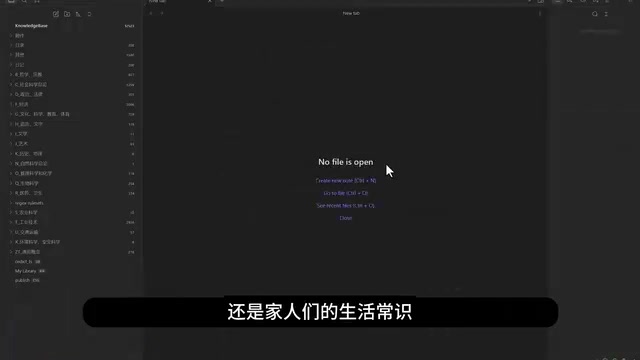
This is a vivid metaphor—a knowledge base isn't a cold data warehouse but rather a way to preserve different stages of yourself, bringing them all together at critical moments. This also reveals the fundamental difference between a personal knowledge base and a general search engine: search engines provide an index of "public knowledge," while a personal knowledge base preserves a network of "private cognition"—it contains your unique perspectives, the pitfalls you've encountered, and the conclusions you've personally verified, none of which can be replaced by any public platform.
From Retrieval to Creation: Advanced Uses of Obsidian's Bidirectional Links
If fast retrieval is the foundational function of a knowledge base, its deeper value lies in creation.
In daily study and work, a vast number of questions don't have standard answers and require us to think hard. The author gave an example from finance: the central bank announces a 0.5 percentage point cut to the reserve requirement ratio (RRR)—what impact will this have on exchange rates? Whether you're a finance professional, a student, or an ordinary investor, this is an open-ended question requiring in-depth analysis.
It's worth explaining what an "RRR cut" means. An RRR cut refers to the central bank lowering the "deposit reserve requirement ratio" for commercial banks—the percentage of deposits that commercial banks must keep deposited at the central bank, which cannot be used for lending or investment. For example, when the reserve ratio is 10%, a bank can only lend out 90 yuan for every 100 yuan in deposits; after a 0.5 percentage point cut, the lendable funds increase, expanding liquidity across the entire financial system. The transmission from an RRR cut to exchange rates is fairly complex: increased liquidity → lower market interest rates → reduced returns on domestic currency assets → greater international capital outflow pressure → depreciation pressure on the domestic currency; simultaneously, RRR cuts stimulate the economy → improved corporate earnings → attract foreign investment inflows → support the domestic currency exchange rate. It's precisely because multiple transmission pathways exist that a systematic knowledge framework is needed to assist analysis.

This is where Obsidian's path search functionality comes into play. By searching for potential connection paths between the two knowledge points "deposit reserve" and "exchange rate," the author discovered that inflation could be a key analytical entry point, while fiscal policy and trade balance are also potential analytical directions.
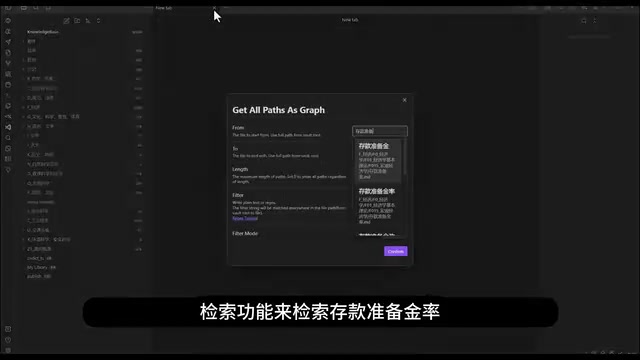
This is the essence of Obsidian's bidirectional linking and graph features—it doesn't just store isolated knowledge points; it reveals the hidden connections between them. When you need to analyze a complex problem, these connections become ready-made thinking frameworks.
From a technical perspective, links in traditional note-taking software are "one-directional"—you insert a link to note B in note A, but when you open B, there's no indication that A references it. Bidirectional links solve this problem: when you link to B from A, B automatically generates a "backlink" pointing to A. This seemingly minor change fundamentally alters the topological structure of knowledge organization—notes shift from a tree-like hierarchy to a network graph. In graph theory, each note is a "node" and each link is an "edge," and the entire knowledge base forms a complex network. When there are enough nodes and edges, a "small-world effect" emerges—any two seemingly unrelated knowledge points can often be reached through just a few intermediate nodes. The "path search" described in the article leverages exactly this principle, using algorithms to find the shortest path or all possible paths between two nodes, thereby revealing latent connections between pieces of knowledge.
The intellectual roots of this "bottom-up" approach to knowledge organization can be traced back to the Zettelkasten (slip-box) method. Its core principles include: atomicity (each note records only one independent idea), unique identifiers (each note has a unique number for easy reference), and explicit connections (notes reference each other via numbers to form a network). Unlike traditional classification systems, Zettelkasten doesn't emphasize hierarchical directories but instead lets structure emerge naturally from the links between notes. This approach is especially suited for creative work—when you need to write an article or analyze a problem, wandering along link paths often leads to unexpected knowledge combinations.
AI Enhancement: Automatic Classification and Smart Tag Management
As the knowledge base expanded to 6 million words, purely manual organization became impractical. The author mentioned incorporating AI capabilities for automatic classification and tagging, keeping the massive note system manageable and searchable. This reflects an important trend in personal knowledge management today: using AI to handle the organization and archiving of knowledge, freeing people from tedious organizing work so they can focus on thinking and creating.
The integration of AI with personal knowledge management is in a period of rapid development, with several technical directions worth noting. First is Semantic Search, which uses text embedding technology based on large language models to convert note content into coordinate points in a high-dimensional vector space. Searches no longer rely on exact keyword matching but instead understand query intent for semantic matching—for example, searching "how to cope with inflation" can find a note titled "strategies for rising prices." Second is automatic tagging and classification, using LLMs to understand note content and automatically generate category tags. Third is RAG (Retrieval-Augmented Generation), which uses a personal knowledge base as a private corpus, allowing AI to prioritize searching your own notes when answering questions and generating responses based on your personal knowledge system rather than generic internet information. These technologies evolve the knowledge base from a passive "storage-and-retrieval system" into an active "thinking partner."
For Obsidian users, combining various AI plugins (such as Smart Connections, Copilot, etc., which provide automatic summarization, semantic search, tag recommendations, and other features) can significantly reduce maintenance costs. Reducing the time to find a piece of information from half an hour to 10 seconds is the direct payoff of this system.
Knowledge Base Building Advice for Everyday Users
While the original video focused on showcasing results and sharing templates, we can distill several principles worth adopting:
- Clarify your purpose before you start: Don't take notes for the sake of taking notes. First think clearly about what problem the knowledge base should solve—fast retrieval, or aiding deeper thinking.
- Prioritize connections between pieces of knowledge: Individual notes have limited value; building links between notes is what creates a "knowledge network," and this is the core differentiator between Obsidian and ordinary note-taking software. Every time you write a new note, spend 30 seconds thinking about which existing notes it relates to, then connect them with bidirectional links. Over time, you'll weave a truly useful web.
- Leverage AI to lower the barrier: AI capabilities like automatic classification and tagging keep the knowledge base from spiraling out of control as it grows.
- Commit to the long game: 6 million words weren't written in a day—five years of consistent accumulation is the real moat. The value of a knowledge base follows a "compound interest effect"—early accumulation is slow, but once the number of notes crosses a certain threshold, the density of connections between notes increases dramatically, and the insights that emerge grow exponentially.
The essence of a personal knowledge base is transforming "use-it-and-forget-it" information into a reusable, interconnected, and ever-growing "second brain." This concept was systematically articulated by Tiago Forte in his book Building a Second Brain—he proposed the CODE framework (Capture, Organize, Distill, Express), arguing that the ultimate goal of knowledge management isn't collecting information but transforming it into creative output. Tools are merely vehicles; what truly determines effectiveness is how you organize your knowledge and your long-term commitment.
Key Takeaways
Related articles
vLLM v0.29.0rc4 Released: Fixing the TRT-LLM Inference Synchronization Bottleneck Explained
Deep dive into vLLM v0.29.0rc4: fixing unnecessary GPU sync in TRT-LLM ragged prefill to eliminate CPU-GPU overhead and boost inference throughput.
OpenAI's Migration to HTTPX: Why They Abandoned the requests Library
In-depth analysis of why OpenAI migrated its Python SDK from requests to HTTPX, covering async dual-mode support, HTTP/2 multiplexing, and the real impact on developers.
PyTorch Conference 2026: Hardware Acceleration and Compute Infrastructure Outlook
In-depth analysis of PyTorch Conference 2026 hardware acceleration core topics, covering heterogeneous chip adaptation, compilation stack evolution, torch.compile optimization, and distributed compute scheduling, examining future trends and industry impact of AI compute infrastructure.