Building a Stickman Sandbox Game in TypeScript: Enter Any URL to Blow Up Any Website

One weekend, pure TypeScript, Cloudflare, and Claude AI: a stickman sandbox that destroys any website you enter.
A developer independently built a creative stickman sandbox game over a weekend: enter any URL and that page becomes a destructible game level. Technically, he used native TypeScript and Canvas 2D to build a custom rendering engine, Cloudflare Durable Objects for multiplayer room state sync, and Cloudflare Workers for hosting. Throughout development, he used Claude Opus 5.5 as a full-cycle collaborator — covering architecture planning, design pattern consistency, and visual effects tuning. He candidly noted the AI required more steering than expected, but the overall combination significantly compressed time from idea to playable product.
One Weekend, One "Destroy Any Website" Stickman Game
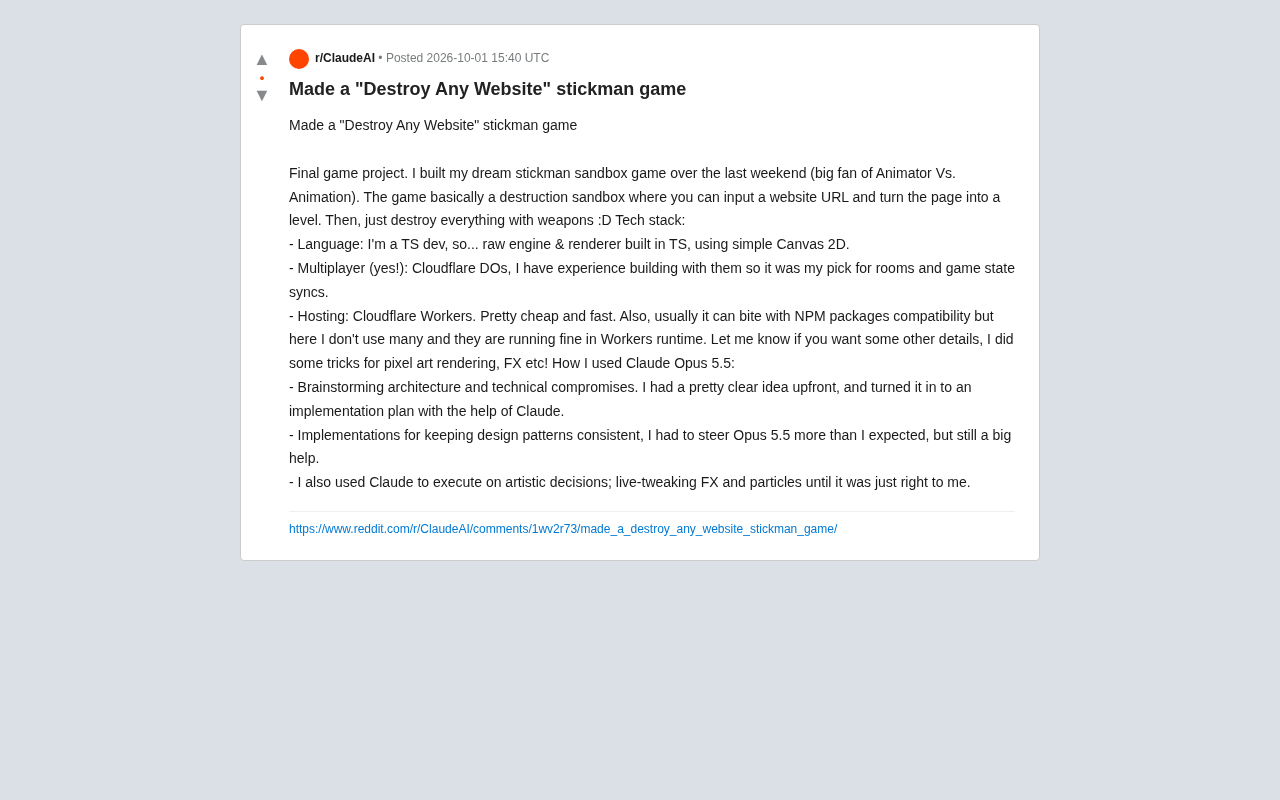
A developer shared a personal weekend project on Reddit: a stickman destruction sandbox game. Its core mechanic is genuinely creative — players can enter any website URL, turn that page into a game level, and smash everything on it to pieces with various weapons.
The author describes himself as a longtime fan of the classic web animation series Animator Vs. Animation, and this game is his realization of a "dream stickman sandbox." Rather than a flashy demo, this project reads more like a complete engineering exercise, covering the full stack from rendering engine to multiplayer networking to deployment.
Tech Stack: A Custom Engine Built in Pure TypeScript
As a TypeScript developer, the author took a fairly hardcore approach — no off-the-shelf game engine. Instead, he built the engine and renderer from scratch in native TS, with Canvas 2D as the underlying drawing layer. While this added significant work, it gave him complete control over the rendering pipeline, physics behavior, and visual effects.
For multiplayer, the game uses Cloudflare Durable Objects (DOs) to manage rooms and synchronize game state. The author mentioned he had prior experience with DOs and chose them as his go-to solution for real-time multiplayer state management. Durable Objects are naturally suited to maintaining stateful sessions, making them a sensible choice for room logic and player data consistency.
On the deployment side, the entire game is hosted on Cloudflare Workers, which the author describes as "cheap and fast." He openly admits that the Workers runtime often causes headaches with NPM package compatibility, but since this project has very few third-party dependencies, it ran smoothly in practice. He also hinted at some "tricks" in areas like pixel art rendering and special effects (FX), suggesting careful attention to detail.
Cloudflare Durable Objects are a stateful computing primitive provided by the Cloudflare Workers platform. Traditional serverless functions are stateless — each request runs in an independent instance, making shared state difficult to maintain. Durable Objects solve this by assigning each "object" a globally unique ID and guaranteeing that all requests with the same ID are routed to the same instance, enabling strongly consistent state storage — fundamentally different from the eventual consistency of typical distributed caches. Each Durable Object has built-in persistent storage (similar to KV) and supports WebSocket connection management. For a multiplayer game, one room maps to one DO instance, and all player connections converge on that single point, naturally eliminating race conditions for in-room state sync without needing Redis or a message queue. The trade-off is that a single DO instance has capped compute resources, making it best suited for small-to-medium real-time sessions rather than massively concurrent game servers.
How Claude Opus 5.5 Was Involved in Development
Another highlight of this project is the author's detailed account of how he used Claude Opus 5.5 throughout development. His approach wasn't "let the AI write the whole game" — instead, he treated it as a collaborator woven into every stage of the process.
Architecture Brainstorming
The author had a clear vision before writing a single line of code. Claude's role was to help translate that vision into a concrete implementation plan and provide input on architectural decisions and technical trade-offs. For a project that needed to balance engine design, multiplayer networking, and deployment, this kind of upfront planning often matters more than the code itself.
Maintaining Design Pattern Consistency
During implementation, he used Claude to keep design patterns consistent across the codebase. He was candid, however, noting that he needed to "steer Opus 5.5 more than expected" — the AI didn't always nail it on the first try. This detail is valuable: it's a reminder that even powerful models still require ongoing developer correction in complex engineering projects, rather than being handed the wheel entirely.
Real-Time Tuning of Art and Visual Effects
One interesting use case: the author also turned to Claude for artistic decisions — iteratively adjusting special effects and particle systems until the visuals met his standards. This shows AI collaboration extending into subjective, aesthetic tuning, not just pure logic and code.
Claude Opus 5.5 is Anthropic's flagship reasoning model released in 2025, with significant improvements over its predecessors in code generation, long-context understanding, and complex instruction following — particularly in maintaining coherence across multi-file engineering codebases. Notably, the author chose "Opus 5.5" over the lighter Sonnet or Haiku variants, a deliberate signal that he anticipated the project's architectural complexity would demand stronger reasoning. At the same time, he honestly documented the model's limitations in long-cycle engineering tasks that still required frequent human guidance. This aligns with a widely observed pattern in the industry: the more capable the model, the higher the single-pass output quality — but for tasks spanning multiple development cycles that require sustained design consistency, human correction remains indispensable.
What This Project Teaches Independent Developers
From an engineering perspective, this is a textbook example of efficient delivery by a solo developer with AI collaboration. The author shipped a complete game — with a custom rendering engine and multiplayer networking — in a single weekend, powered by a clear upfront vision, a familiar tech stack (TS + the Cloudflare ecosystem), and an accurate understanding of where AI assistance helps and where it falls short.
A few takeaways worth highlighting: first, use AI for planning and consistency rather than blind code generation; second, maintain the necessary "steering" and critical eye over AI output, acknowledging it needs human correction; and third, choose infrastructure you already know that stays lightweight (Cloudflare Workers + DOs) to minimize compatibility and operational overhead.
For developers looking to build similar side projects, the reference value of this case lies in the combination: creative gameplay + mature cloud services + AI-assisted development is meaningfully compressing the time from idea to playable product.
Note: The above information is based on the author's self-reported account on Reddit. Some technical details — such as the pixel rendering tricks — were not fully elaborated.
Related articles

Workbuddy for Absolute Beginners: How a Desktop AI Agent Fits Into Real Workflows
A beginner's guide to the Workbuddy desktop AI agent: installation, claiming credits, file management, and building automated workflows—compared with CodeX for fit and cost, helping professionals shift from AI question-askers to AI managers.

OpenAI's New Agent Stack: Computer Use, Decisions API, and Ultra-Fast Workflows
OpenAI Dev Day unveiled a new agent stack: Computer Use outperforms humans, Decisions API delivers ultra-low-latency classification via Luna, Agents API opens the same Computer Use capabilities, and GPT-6.1 Sol costs only one-seventh of Astra. Core updates, benchmark data, and developer insights.

Liang Wenfeng Open-Sources DeepInfo Inference Framework, Takes On U.S. Ban
DeepSeek open-sources its DeepInfo inference framework after its models, featuring GPU/CPU cross-pipelining, small-model prediction with large-model verification, and full Huawei Ascend and NVIDIA chip support—facing the U.S. federal ban head-on. This article analyzes its significance for AI deployment and open-source strategy.