Building a WeChat Mini Program from Scratch in 30 Minutes with Zero Code: How AI Eliminates the Development Barrier

A Bilibili creator used AI tool WorkBuddy to build a full-featured WeChat Mini Program in 30 minutes with zero code.
The article recounts how a Bilibili creator used the AI tool WorkBuddy to complete the "讲懂了吗" WeChat Mini Program in half an hour with zero code, including front end, back end, database, and AI conversation features. The three-step process—detailed prompting, boss-like feedback, and reference-image styling—shows how AI erases the development barrier, making creativity the key competitive edge.
Recently, a Bilibili creator shared his experience of using an AI tool called WorkBuddy to "hand-build" a fully functional WeChat Mini Program in just half an hour. This Mini Program, named "讲懂了吗" (roughly "Did You Get It?"), not only includes a front end, back end, and database, but also integrates AI conversation and knowledge card features—all without him writing a single line of code. This raises a thought-provoking question: when the barrier to development tools is erased by AI, what remains at the core of creation?
From "Just Thinking About It Is Dizzying" to "Done in Half an Hour"
For non-developers, the complexity of traditional Mini Program development is enough to make anyone hesitate. You need to rent a server, design a database, apply for API keys from various model vendors, configure an App ID, install developer tools… Every step represents a steep learning curve. Even "web coding" from a year ago could mostly only handle the visual presentation of front-end pages; back-end logic still required solid programming skills.
But the creator's experience upended this perception. With WorkBuddyAd, through a few rounds of natural language conversation and debugging, he had the Mini Program running on his phone in just over half an hour. He recorded the entire process, demonstrating how AI dismantles each professional barrier one by one.
Web Coding refers to a programming paradigm where the browser serves as the runtime environment, centered primarily around web pages or lightweight web applications. In the context of AI programming tools, "web coding mode" typically means the AI generates front-end code (HTML/CSS/JavaScript and their frameworks) that can be directly previewed and run in a browser, excelling at page layout, visual styling, and simple interactions. However, the back-end logic, database reads and writes, user authentication, and third-party API calls of traditional web applications still need to be built by the developer. This is why the original article says "web coding from a year ago could mostly only handle front-end presentation, while the back end still required programming skills." The key leap made by tools like WorkBuddy is that they bring back-end generation, database design, and cloud model invocation into the scope of natural language-driven development, thereby advancing from "web preview" to "a Mini Program that can go live."
Zero-Code Walkthrough: Building an AI Mini Program in Three Steps
The creator broke down his "hand-building" process into several clear stages, each requiring only a natural language description of the requirements.
Step 1: Define Your Idea with a Detailed Prompt
Open WorkBuddy, create a new task, select "Code Development" mode, and be sure to specify "WeChat Mini Program" in the prompt. The creator emphasizes that the prompt should describe your idea in as much detail as possible—this is the key to ensuring a "one-pass" success.
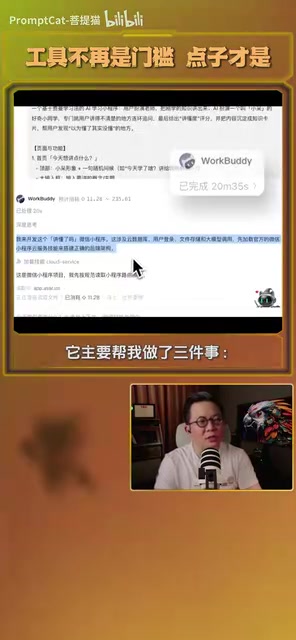
In his case, the first round of "web coding" took 20 minutes and 35 seconds, during which the AI autonomously accomplished three things: it drew the character "小呆" (Xiao Dai) based on the description and designed all page styles; it completed the entire back-end development, including the database and the Mini Program runtime interfaces; and it built in the ability to invoke cloud AI models, so that the conversation and scoring features required no manual API key application from the user. Once done, clicking the share button in the preview window and authorizing it allows you to open and use it on your phone.
WeChat Mini Program AppID is a unique identity assigned by the WeChat Public Platform to each Mini Program, essentially the "ID card" of the app within the WeChat ecosystem. Developers obtain the AppID after registering a Mini Program account and configure it in the developer tools to enable real-device preview, code upload, review submission, and publishing. The AppID is also bound to open capabilities such as WeChat login, payments, and subscription messages: when calling these interfaces, the server needs to use the AppID and AppSecret to obtain an access token. The original article lists "configuring the App ID" as one of the barriers in traditional development precisely because, without it, real-device debugging and the go-live process cannot be completed; and if AI tools can manage or guide users through this step, they further reduce the onboarding cost for non-developers.
API Key is an identity credential issued by model vendors to developers, used for authentication, billing, and quota management when calling large-model interfaces. In the traditional process, developers need to register with each model platform, create a key, write it into back-end environment variables, and handle issues such as key leaks and exhausted quotas—an obvious pain point for non-developers. The original article emphasizes that WorkBuddy "built in the ability to invoke cloud AI models, so that the conversation and scoring features required no manual API key application from the user," which essentially means the tool provider centrally manages model access and billing, fully encapsulating the key-management layer. This way, users only need to describe "I need an AI conversation feature" without having to understand model selection, interface protocols, or authentication details.
Step 2: Give Feedback Like a Boss and Refine the Interface
After the first version was up and running, the creator spent 19 minutes and 34 seconds on a second round of refinement. This round was extremely "idiot-proof": he simply experienced the first version, noted the things that felt uncomfortable, and fed them back to the AI as if a boss were giving instructions to an employee. The AI would automatically adjust based on the feedback, with no need for the user to worry about code implementation.
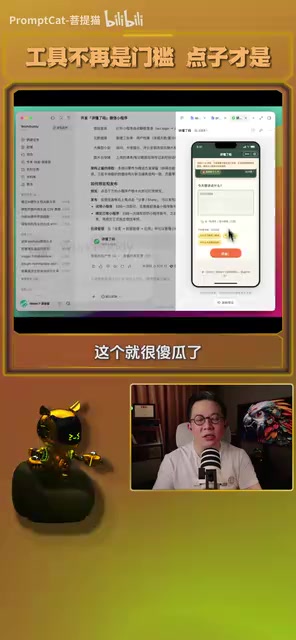
Step 3: Precisely Control the Style with Reference Images
To make the interactive interface more comfortable, the creator provided a reference image in the third round, which took 13 minutes and 6 seconds. He specifically cautioned that when adjusting the page style, one should avoid vague terms like "better looking" or "more comfortable," and instead explicitly state specific requirements such as the theme color scheme. If you don't know how to write it, giving the AI a reference image to optimize against is the most efficient approach.
The Trend Behind It: Democratized Tools, Ideas Rule
The creator's experience is not an isolated case. It points to an ongoing trend: full-stack development capability is becoming as simple as using ordinary software. Users barely need any additional programming knowledge—by supplementing context purely through natural language conversation, they can independently complete a project.
The significance of this change goes far beyond having one more useful development tool. WeChat recently opened virtual payments for Mini Programs registered by individuals, and the platform is also supporting individual developers with cloud resources and AI credits. When the obstacles of infrastructure and toolchains are cleared, the gap between an ordinary person's "if only there were a tool that could solve my problem" and "actually building it" is just a few sentences.
In the past, the competition was about coding skill; now, it's about the size of your imagination. The creator's exclamation at the end of the video is quite representative: "What we're least short of is imagination." When the technical barrier drops to zero, creativity itself becomes the scarcest resource. For every idea that was once discouraged by "I can't write code," now may be the best time to build it.
Virtual payments for Mini Programs registered by individuals refers to WeChat allowing Mini Programs registered under an individual's identity to enable payment for virtual goods or virtual services. Previously, virtual payments were mostly available to entities such as enterprises, making it difficult for individual developers to directly charge for virtual goods such as content, memberships, and knowledge services. With this capability opened up, individual developers can, under compliance, complete the loop of "build it—get it used—earn revenue" without first registering a company or relying on third-party collection agents. This combines with the platform's support in the form of cloud resources and AI credits: on one hand reducing development and operating costs, and on the other opening up commercialization channels. The original article views this as a signal of "further lowering the barrier to Mini Program commercialization," meaning that both the trial-and-error cost and the monetization resistance for individual creators are declining simultaneously.
One-line Summary
A Bilibili creator used the AI tool WorkBuddy to build a fully functional WeChat Mini Program in half an hour with zero code—the development barrier has been erased, and creativity has become the core competitive advantage.
Paragraph Summary
The article tells how a Bilibili creator, with the AI tool WorkBuddy, completed the "讲懂了吗" WeChat Mini Program in half an hour through natural language conversation with zero code, featuring a front end, back end, database, and AI conversation and knowledge card functions. The process has three steps: use a detailed prompt to define requirements and specify "WeChat Mini Program," after which the AI autonomously completes character design, page styles, the back end and database, and cloud model invocation; give feedback like a boss to refine the interface; and use a reference image to precisely control the style. The author notes that full-stack development is becoming as simple as using ordinary software, and that WeChat's opening of virtual payments for individual entities and support for individual developers further lowers the barrier—in the future, imagination rather than code will be what matters.
Related articles

Chain of Thought Isn't Just for AI: How Humans Can Use CoT to Improve Thinking Quality
Chain of Thought isn't just a prompt trick for large models. Starting from a Hacker News discussion, this article analyzes why CoT works for human thinking too, breaks down actionable ways to transfer it, and highlights the key differences between human CoT and machine CoT.
Cloudflare Teams Up with OpenAI: Closi…
Cloudflare Teams Up with OpenAI: Closing the Loop from Vulnerability Discovery to Defense with AI
Cloudflare uses OpenAI Daybreak to investigate security vulnerabilities and generate reviewable remediation plans, while developers use Codex to boost coding efficiency and quality.

Orca Multi-Agent Orchestration in Practice: A Guide to Parallel Collaboration with Claude and Codex
Orca is Stable AI's free open-source agent workbench supporting 34 agents like Claude Code and Codex in parallel. Learn its Git worktree isolation, multi-model orchestration, and mobile management.