Building AI Agent Frameworks with TypeScript: The Core Development Paradigm for Full-Stack Developers

Why TypeScript is becoming the core language for building full-stack AI Agent frameworks.
This article explains why TypeScript is emerging as the preferred language for AI Agent development, covering Zod-powered structured output validation, the underlying design of LangGraph's graph state machine, MCP protocol integration, and a complete learning path for front-end developers to transition into full-stack AI engineering.
Why AI Agent Development Is No Longer Just Python's Domain
When it comes to AI application development, many people's first instinct is still Python. But in real-world engineering scenarios—especially in job requirements involving full-stack AI development—the situation is quietly changing. According to sharing from various tech bloggers, most medium-to-large companies today, when hiring for "full-stack AI development," actually build their tech stacks primarily around Node.js and TypeScript solutions that combine server-side, front-end, and AI.
There's a practical logic behind this: simply calling APIs from vendors like OpenAI has long been insufficient to support complex AI application needs. The complexity of true AI application development far exceeds what most people imagine. When you need to handle structured outputs, multi-step task orchestration, and tool-call scheduling, a robust type system and a mature engineering ecosystem become critically important—and this is precisely where TypeScript's core strengths lie.
Background: Why Isn't Python Enough? Python's dominance in the AI/ML space stems mainly from its data science and model training ecosystem (NumPy, PyTorch, Hugging Face, etc.). But as AI capabilities shift from "training models" to "calling models to build applications," the weighting of engineering requirements undergoes a fundamental transformation. Python's dynamic type system tends to produce type errors that are difficult to trace in large engineering projects, and its lack of native front-end integration capabilities also makes full-stack delivery more costly. In contrast, TypeScript naturally offers static type constraints, isomorphic front-end/back-end code, and a mature npm ecosystem, giving it a clear structural advantage in this new track of "AI application engineering."
Worth special mention is Node.js's architectural advantage in concurrency handling. Python's GIL (Global Interpreter Lock) is a mutex in the CPython interpreter that ensures only one thread executes Python bytecode at any given moment. While this mechanism simplifies memory management, it prevents Python from fully utilizing multi-core processors in CPU-intensive multi-threaded scenarios. For application scenarios like AI Agents that need to make large numbers of external API calls simultaneously, Node.js's single-threaded, asynchronous, non-blocking model based on the Event Loop is actually more advantageous—it can efficiently handle thousands of concurrent I/O operations without creating multiple threads, which fits perfectly with the core working pattern of Agents that frequently call model APIs and tool APIs.
The Essence of AI Agents: From "Tools" to "Autonomous Agents" The fundamental difference between an AI Agent and a traditional AI application lies in autonomy and tool-use capability. Traditional AI applications are single-turn Q&A models: input → model inference → output, with a fixed and linear flow. Agents, on the other hand, adopt the ReAct (Reasoning + Acting) paradigm—proposed by Yao et al. in the 2022 paper "ReAct: Synergizing Reasoning and Acting in Language Models"—allowing the model to iterate repeatedly within a "think-act-observe" loop: the model first reasons about the current state, then decides which tool to call, observes the tool's returned result, and continues reasoning until the goal is accomplished. This architecture gives Agents the ability to solve multi-step, uncertain tasks, but it also brings higher engineering complexity: how to manage intermediate state, how to prevent infinite loops, and how to handle fallback logic when a tool call fails all require robust engineering frameworks. It is precisely this complexity that makes TypeScript's static type system and Zod's runtime validation indispensable in Agent engineering.
The MCP Protocol: A New Standard for AI Agent Tool Calling MCP (Model Context Protocol) is a standardized protocol open-sourced by Anthropic in November 2024, designed to unify the communication interface between large models and external tools and data sources. Before MCP appeared, each AI application framework had its own tool-calling specification, resulting in severe fragmentation of the tool ecosystem. MCP draws on the design philosophy of LSP (Language Server Protocol)—LSP was proposed by Microsoft to unify the communication standard between IDEs and language analyzers, allowing any language server to be reused by any LSP-supporting editor. MCP brings this idea into the AI domain: any tool that implements the MCP Server interface can be directly called by any model or Agent framework that supports the MCP Client. TypeScript/Node.js holds a core position in the MCP ecosystem—the official SDK first provided a TypeScript version, and a large number of community MCP Servers are written in Node.js, further reinforcing TypeScript's strategic position in the AI Agent engineering field.
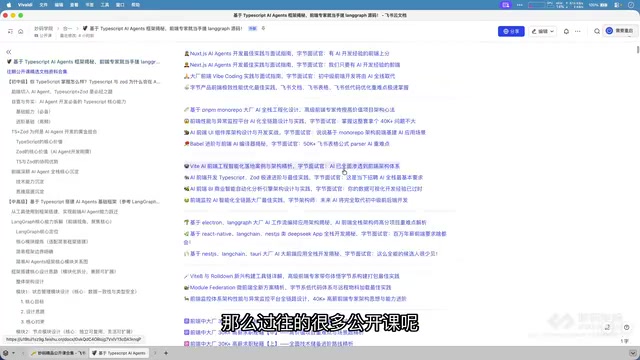
For developers in the front-end and full-stack directions, AI Agent development based on TypeScript is actually an entry point with a lower barrier than Python and higher migration value. The front-end engineering skills you already have can be seamlessly reused in AI server-side development, making this path more efficient than learning Python from scratch.
TypeScript and Zod: The Golden Combination for AI Agent Development
Why is the combination of TypeScript and Zod so widely adopted in Agent development? The core lies in one word: "structured."
Structured Output: A Rigid Requirement for AI Agents
The biggest difference between an AI Agent and a traditional chatbot is that it needs to produce structured data that can be directly consumed by programs, rather than plain text. When a large model returns JSON, how do you guarantee that the types, formats, and constraints of the fields are correct?
Structured Output Technical Background Structured Output refers to the technical capability to constrain a large model to return responses in a specific format (usually JSON). OpenAI officially launched the Structured Outputs feature in August 2024, which constrains model output through a JSON Schema, fundamentally solving the format errors caused by model "hallucinations." Before this, developers typically relied on Prompt Engineering or few-shot examples to guide models toward JSON output, with reliability far inferior to native constraints. Anthropic and Google subsequently rolled out similar capabilities. The maturation of structured output further highlights the value of Schema-definition tools like Zod—developers can directly convert Zod Schemas into JSON Schemas to pass to models, forming a complete closed loop from definition to validation.
What Is Zod? Zod is a TypeScript-first Schema declaration and runtime validation library, released by Colin McDonnell in 2020. It currently has over 20 million weekly downloads on npm, making it one of the most popular data validation solutions in modern TypeScript projects. Zod's core design philosophy is "define once, auto-infer types": after you declare a data structure with APIs like
z.object(), Zod automatically infers the corresponding TypeScript static type, eliminating the need to manually writeinterfaceortypedefinitions. In AI application development, Zod is widely used to constrain the structured output of large models—a model's "hallucination" characteristic may cause returned JSON to have missing fields, type errors, or unexpected fields. Zod's runtime validation can intercept these problems before they propagate to business logic, providing clear error descriptions and greatly reducing the risk of production failures caused by unstable model output. Both the OpenAI official SDK and the Vercel AI SDK have built-in deep integration with Zod.
Token Economics: Understanding the Cost Structure of Large Models A Token is the basic unit through which large models process text; typically an English word corresponds to about 1-2 Tokens, and a Chinese character corresponds to about 1-3 Tokens. Vendors like OpenAI charge by the number of Tokens (with input Tokens and output Tokens priced separately), making Token management an economic issue that cannot be ignored in AI application engineering. In Agent scenarios, due to the presence of multiple rounds of tool calls and state passing, each iteration requires passing historical messages and tool results into the model as context, causing Token consumption to grow linearly or even non-linearly with the number of iterations. Although the context window of mainstream models has expanded from the original 4K to 128K or even larger, a larger context means higher inference latency and cost. Therefore, designing reasonable context compression strategies and choosing the appropriate model tier are important optimization directions for production-grade Agent engineering—and this is precisely a scenario where TypeScript's type system can add value at the state management level: through precise type definitions, developers can constrain, at the compilation stage, which state fields must be passed into the context and which can be compressed or omitted.
As a runtime type validation library, Zod can define strict data Schemas, verify at runtime whether model output meets expectations, and also reverse-generate TypeScript type definitions.
This "define once, benefit both ways" capability allows TypeScript's static type checking and Zod's runtime validation to form a complete closed loop. Developers can get precise type hints while writing code, and intercept invalid model output at runtime, greatly reducing the risk of production failures.

SDK Layer Design: The Advanced Value of TypeScript's Type System
When you move from the application layer deep into the design of SDKs and frameworks, TypeScript's type system capabilities are truly pushed into more advanced application scenarios. For example, designing a type-safe tool registration mechanism or a call chain that can automatically infer return value types are all inseparable from advanced TS features such as generics, conditional types, and mapped types.
Practical Applications of TypeScript's Advanced Type Features in AI SDK Design Take Tool Calling (Function Calling) as an example: when executing an Agent task, a large model needs to call external tools (such as search, computation, database queries). Developers need to declare the tool's parameter Schema to the model, and then execute the corresponding function after the model returns a call instruction. When designing this mechanism, TypeScript's Generics allow the tool's input parameter types to be automatically bound to the Zod Schema; Conditional Types can automatically infer the call parameter types based on the tool name; and Mapped Types can batch-convert multiple tool definitions into a unified registry structure. The Vercel AI SDK's
tool()function is a typical example of such advanced type design—when registering a tool, the caller only needs to pass in a Zod Schema, and the SDK automatically infers the parameter types of theexecutefunction without any manual type annotation, achieving "zero-boilerplate" type safety.Notably, TypeScript's type system has been proven by the community to be Turing Complete, meaning that theoretically, arbitrary computational logic can be implemented at the type level. For AI SDK design, this means developers can implement complex type inference through pure type operations with zero runtime overhead—for example, automatically inferring the corresponding TypeScript interface from a Zod Schema, or automatically constraining call parameters based on the type definitions of a tool registry. These capabilities can detect potential errors during the static analysis stage without waiting until runtime for problems to surface, significantly improving the engineering reliability of large AI applications.
This is also why "level of TypeScript mastery" has almost become a mandatory question in interviews for current AI-related positions.
Learning from LangGraph: Building the Agent Foundation with TypeScript
When building complex agents, there's no getting around the design philosophy represented by LangChain and LangGraph. Even if you don't use them directly, you often need to follow similar process paradigms during development, and understanding their core design is a necessary step to advancing in AI Agent development.
Background of LangChain and LangGraph LangChain was released by Harrison Chase in October 2022, initially as a Python framework to simplify large model application development, providing abstractions such as prompt templates, chained calls, and memory management. As AI applications evolved from simple Q&A into complex Agents requiring multi-round reasoning and dynamic decision-making, the limitations of the Chain structure gradually became apparent—it couldn't elegantly handle looped execution, conditional branching, and intermediate state persistence. To address this, the LangChain team launched LangGraph in early 2024, introducing Graph Theory into AI workflow orchestration: Nodes represent execution units, directed Edges define flow relationships, and support for Cyclic Graph structures enables Agents to iterate repeatedly within the "think-act-observe" loop until termination conditions are met. LangGraph currently offers both Python and JavaScript/TypeScript versions, and its design philosophy has become the de facto reference standard for building production-grade Agents in the industry.
Breaking Down LangGraph's Core Design Ideas
LangGraph is essentially a graph-based state machine. When implementing a similar framework with TypeScript, you need to focus on understanding the following four core concepts:
- Node: Each node represents an execution unit, which may be a model call, a tool execution, or a piece of business logic
- Edge: Defines the flow relationships between nodes, supporting conditional branch routing
- State: The shared context that runs through the entire execution flow, continuously updated as nodes execute
- Scheduling Engine: Drives node execution according to the graph's topological relationships, handling loops, branches, and termination conditions
The Principle of the Graph-based State Machine Traditional Finite State Machines (FSM) require a finite number of states and predefined transition relationships, making it difficult to express the dynamic decision paths that AI Agents generate during reasoning. LangGraph draws on the ideas of Reactive Programming and the Actor model—the Actor model was proposed by Carl Hewitt in 1973 as a mathematical model of concurrent computation, in which each Actor is an independent computational unit with private state that communicates through message passing; Reactive Programming, on the other hand, emphasizes data flows and change propagation, and is widely applied in the front-end ecosystem, represented by RxJS. LangGraph merges these two ideas into AI workflow orchestration: it designs "state" as a shared object that can be incrementally updated as nodes execute (similar to a Redux Store), where each node is only responsible for reading the fields it needs and returning the portion that needs to be updated, with the framework responsible for merging state changes (similar to a Reducer). Each node is like an Actor, performing "message passing" through the shared state object, and the entire graph's execution process is a reactive data flow responding to state changes. This design makes the framework naturally support state Checkpointing and replay, allowing execution to pause at any node and wait for human intervention (Human-in-the-loop), or resume from the most recent checkpoint when an error occurs—which is crucial for complex Agent tasks that require long-running execution.
Human-in-the-loop: The Safety Guardrail for Production-Grade Agents Human-in-the-loop is a key safety mechanism in production-grade AI Agent deployment, referring to the insertion of manual review or confirmation steps at specific nodes in the Agent's execution flow, preventing the model from acting autonomously before high-risk operations (such as sending emails, executing code, or modifying databases) and causing irreversible consequences. LangGraph provides native support for this: through a Breakpoint mechanism, the framework can pause the graph's execution at a specified node, serialize and persist the current state, and resume execution after receiving human input. This capability relies on Checkpointing infrastructure—the framework needs to be able to take a complete snapshot of the graph state at any moment and store it to a persistent medium (such as a database or Redis), and accurately restore the execution context upon resumption. For TypeScript developers, designing this state serialization and recovery mechanism is a challenge of great engineering depth: how to ensure the type safety of state types during the serialization/deserialization process is precisely one of the scenarios where Schema validation tools like Zod play a core role in the Agent's underlying framework. This mechanism is also a core engineering element that distinguishes enterprise-grade AI Agents from personal demo projects, and holds high differentiation value on resumes and in interviews.
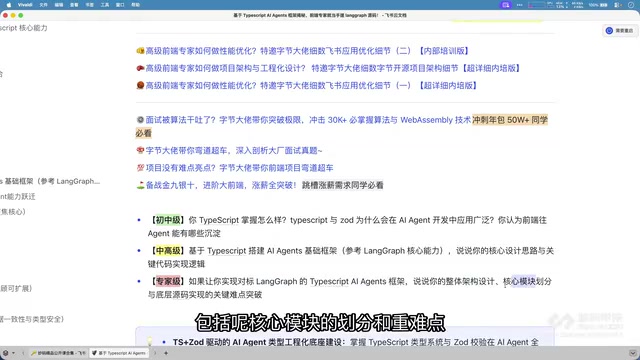
Key Challenges of Implementing an Agent Framework with TypeScript
When implementing such a framework with TypeScript, the place that best demonstrates engineering prowess lies in the passing and constraining of state types. How do you keep type safety when each node receives and returns state? How do you design a declarative graph-building API? These are all core content that can be highlighted as "key difficulties and highlights" on a resume.
For job seekers, rather than listing "I've called such-and-such API," it's better to thoroughly organize your design and implementation of the Agent's underlying scheduling logic—this is what provides more differentiation these days, and it's the engineering depth that interviewers truly want to see.
The Learning Path for Front-End Developers Transitioning to AI Agents
Migrating from front-end toward AI Agents and full-stack directions is a clear and practically valuable growth curve. This route can roughly be divided into the following stages:
Stage One: Solidify TypeScript Engineering Fundamentals
First master TypeScript's advanced capabilities (type gymnastics, generics, utility types), then dive deep into the principles and source code of mainstream frameworks, and establish a robust engineering foundation, including performance optimization strategies and monitoring system setup.
What Is TypeScript "Type Gymnastics"? "Type Gymnastics" is the TypeScript community's colloquial term for complex type programming techniques, referring to using the Turing Completeness of TypeScript's type system to implement complex type inference logic. Core techniques include: conditional types (
T extends U ? X : Y) to implement type branching; theinferkeyword to extract subtypes from a type; Recursive Types to handle nested structures; and Template Literal Types to manipulate string types. These techniques have direct engineering value in AI SDK design: advanced features like "automatically inferring parameter types from tool names" and "automatically generating TypeScript interfaces from Schemas returned by models" are essentially engineering applications of type gymnastics. Mastering type gymnastics is not only a bonus in interviews but also an essential foundation for understanding and contributing to mainstream AI framework source code—the more precise the type-level inference, the more accurate the IDE intelligent hints developers get when writing business code, and the earlier potential errors are detected.
Stage Two: Connecting Engineering Capabilities with the AI System
Building on full-stack development capabilities (server-side rendering, multi-platform development), enter the core of the AI system—AI large model application development and AI Agent development. This stage is completed entirely with TypeScript, truly integrating the engineering capabilities accumulated earlier with AI capabilities.
RAG and Vector Databases: The Long-Term Memory Infrastructure for AI Agents RAG (Retrieval-Augmented Generation) is one of the most important engineering patterns in current AI application development. Large models are limited by a fixed training data cutoff date and a limited Context Window, and cannot directly access private knowledge bases or real-time information. RAG makes up for this deficiency by dynamically retrieving relevant documents during the inference stage and injecting them into the context. Its core infrastructure is the Vector Database: text is converted into high-dimensional vectors through an Embedding Model and stored, and during queries, relevant content is quickly recalled by computing vector similarity (usually using cosine similarity or inner product). Mainstream vector databases include Pinecone, Weaviate, Qdrant, and pgvector (a PostgreSQL extension). In the TypeScript ecosystem, the Vercel AI SDK provides a unified embedding API, while LangChain.js encapsulates integration interfaces with mainstream vector databases, allowing front-end/full-stack engineers to quickly build knowledge-base-capable AI Agent applications without deeply understanding the mathematical principles of vector retrieval.
Vercel AI SDK: An Important Reference for TypeScript AI Development In the TypeScript AI development ecosystem, the Vercel AI SDK is currently one of the most influential open-source frameworks, developed primarily by Vercel, the parent company of Next.js. It provides a unified Provider interface (supporting mainstream models such as OpenAI, Anthropic, and Google), with built-in core capabilities like Streaming responses, Structured Output (deeply integrated with Zod), Tool Calling, and Agent loops, while also providing out-of-the-box Hooks (
useChat,useCompletion) for React/Next.js. Itstool()function is a typical example of TypeScript's advanced type design landing in AI scenarios: when registering a tool, the caller only needs to pass in a Zod Schema, and through a combination of mapped types and conditional types, the SDK automatically infers the parameter types of theexecutefunction, achieving "zero-boilerplate" end-to-end type safety. Studying its source code is an excellent path to understanding TypeScript's advanced usage in AI application development, and a direct window into industry best practices. For front-end engineers wishing to dive deep into AI full-stack development, the design patterns of the Vercel AI SDK are well worth studying and learning from.
Streaming Responses and Edge Computing: The User Experience Engineering of AI Applications The inference latency of large models is typically several seconds to tens of seconds. If you wait for the model to fully generate before returning the result, the user experience will be terrible. Streaming technology pushes the content generated by the model Token by Token to the client in real time via the Server-Sent Events (SSE) or WebSocket protocol, allowing users to see the "typewriter effect" of word-by-word output, reducing perceived latency from "waiting for the whole thing" to "Time to First Byte (TTFB)." In TypeScript full-stack development, the combination of Next.js's Streaming Route Handlers with the Vercel Edge Runtime allows AI applications to execute inference calls directly at Edge Nodes (i.e., CDN nodes close to users), further reducing network latency. The Vercel AI SDK's
streamText()andstreamObject()APIs deeply encapsulate streaming responses, and combined with theuseChat()Hook, a complete streaming chat interface can be implemented in React with minimal code. This front-end/back-end integrated streaming experience design is one of the TypeScript full-stack advantages that pure Python back-end solutions cannot easily replicate.
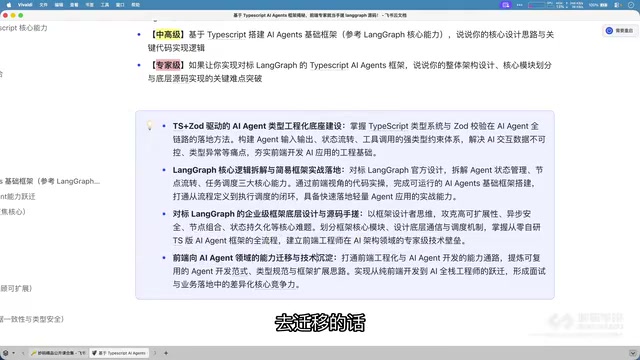
Stage Three: Filling in Business Experience Through Project Practice
Many developers' weakness lies in lacking presentable business experience and accumulated key difficulties. Supplementing real business scenario experience through intensive project practice is the most direct and effective way to make up for this weakness, and it's key to standing out in the competition. An ideal hands-on project should cover: an Agent system with multi-tool calling capabilities, RAG-based private knowledge base Q&A, an approval workflow incorporating a Human-in-the-loop mechanism, and a complete case study integrating third-party services using the MCP protocol—only the comprehensive coverage of these scenarios can truly reflect the core value of a TypeScript full-stack AI engineer.
Conclusion: Seizing the Window of Opportunity for TypeScript AI Development
For front-end and full-stack developers, AI Agent development is currently in a rare technical window of opportunity. TypeScript's irreplaceability in scenarios such as structured output, SDK design, and Agent task scheduling gives developers who master advanced TS capabilities a unique competitive advantage.
Rather than staying at the level of simple API calls, it's better to deeply understand the underlying design philosophy of frameworks like LangGraph and try to hand-implement a simplified Agent engine with TypeScript. This process can not only significantly improve your engineering capabilities but also become a truly differentiating highlight in interviews and career development. From understanding the ReAct paradigm, designing graph state machines, and engineering Human-in-the-loop implementations, to integrating the MCP protocol and applying vector retrieval—every technical node you dive deep into is an opportunity to distance yourself from developers who "only know how to call APIs."
Related articles

A Beginner's Guide to Vibe Coding: Building Your Career Moat with AI Programming
A detailed guide to Vibe Coding with AI programming tools like Claude Code, Cursor, and Codex. Learn how to leverage AI-driven development to ship products independently and build lasting career value.

OpenAI Academy's European Tour: How SMEs Can Break Through with AI
OpenAI Academy visits six European nations with its SME AI Accelerator and multilingual workshops, helping small businesses overcome AI adoption barriers through real-world training and hands-on use.

Framework 13 Pro In-Depth Review: The Modular Laptop That Finally Stops Compromising
Framework 13 Pro in-depth review covering build quality, display, performance, and Linux experience. This modular laptop achieves 85% of MacBook Pro's refinement with far superior repairability and upgradeability.