Building AI Agents with Real-Time Web Data: A Deep Dive with Bright Data

Bright Data architect breaks down how AI agents and MCP overcome traditional scraper scaling and anti-bot barriers.
This article is based on a technical session by Bright Data Solutions Architect Yohan Raju, covering the evolution from traditional web scrapers to AI-driven data collection. Traditional scrapers face a dual challenge at scale: each takes 3–5 days to build, and any selector change can break the entire pipeline. AI agents address this by autonomously discovering, building, and repairing scrapers. The session highlights how MCP (Model Context Protocol) enables AI models like Claude and GPT to bypass high-security sites like Glassdoor, using 60+ specialized APIs for compliant scraping. A live demo showed a purchase decision agent combining Amazon product data with Reddit sentiment to deliver a fully automated "should you buy it" recommendation.
Traditional web scraping is being reshaped by AI agents. In a technical session, Bright Data Solutions Architect Yohan Raju drew on six years of data collection experience to break down the shift from traditional crawler architectures to AI-driven real-time data collection — and gave a live demo of a "purchase decision agent" powered by Amazon product data and Reddit sentiment. This article distills the core insights and actionable technical paths from that session.
Where Traditional Crawler Architectures Break Down
Raju began by revisiting the logic behind traditional scrapers. Early client needs were usually straightforward: identify target sites (like Amazon and Walmart in e-commerce), start with low traffic, and pull prices, reviews, and product info. The real challenges emerged at scale — when targets expanded from two or three sites to Shopify stores, Etsy, and eventually hundreds or thousands of websites, the engineering burden grew exponentially.
He offered a key data point: building a single scraper from development through QA, testing, and end-to-end pipeline validation typically takes 3 to 5 days. Ten sites is manageable, but maintaining 1,000 sites is a completely different story. Every website has a different layout, so even if they all contain price, title, and description fields, each one requires its own scraper. Maintenance costs are even more painful: the moment Amazon or any other site changes a selector, scraping breaks, poisoning the entire data pipeline — potentially causing data gaps, SLA violations, and the need to manually backfill historical data.
The Arms Race Between Scrapers and Anti-Bot Systems
Every website wants to protect its data, so they deploy various anti-scraping and CAPTCHA mechanisms. Raju has seen the full spectrum of blocking techniques: from basic sites that datacenter IPs can bypass, to highly fortified sites protected by Cloudflare or Akamai that require residential IPs, real browsers, and convincing human-like behavior. Clicking too fast, scrolling too fast, or blocking images can all trigger anti-bot systems. This means scraping isn't just a technical problem — it requires deep, site-specific domain knowledge.
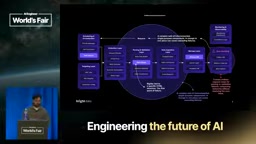
The complete traditional pipeline looks like this: trigger (scheduled job or specified URL) → proxy layer (datacenter IPs, residential IPs, or a Web Unlocker with anti-bot capabilities) → data parsing and validation → post-processing (deduplication, data enrichment, batch processing) → storage. Following the medallion architecture from bronze to silver to the database. If any link in this chain breaks, the whole process has to restart.
The Medallion Architecture is a widely adopted data lake layering model in data engineering, typically structured in three tiers: the Bronze layer (raw data stored directly as collected from the source without processing), the Silver layer (cleaned and structured data with duplicates removed and formats corrected), and the Gold layer (aggregated data ready for business analytics). In a scraping pipeline, Bronze corresponds to raw HTML or JSON results, Silver corresponds to parsed structured fields (price, title, ratings, etc.), and Gold is a deduplicated, enriched, and joined dataset ready for direct consumption by downstream models or analytics systems. The architecture's advantage is that each layer is stored independently — if a component like parsing logic fails, you can reprocess from the previous layer without re-scraping. But as Raju points out, any broken link in a traditional architecture still affects downstream data quality, which is precisely where the self-healing capabilities of AI agents add core value.
How AI Agents Are Changing Data Collection
Before AI, engineering resources were always the scaling bottleneck — managing 1,000 sites might require 2x or 4x the original engineering headcount. But now, AI agents can autonomously discover sites, build scrapers, and automatically repair them when selectors change. Work that once required team intervention, manual investigation, and data backfilling can now be automated.
Raju also distinguished between two paths an AI brain can take to retrieve information. Using "what's the best time to visit San Francisco" as an example: if the query isn't time-sensitive, the AI might take an asynchronous (async) path and answer using pre-trained data (RAG). But if the follow-up is "what's the best time to visit San Francisco this year," the AI must take a synchronous (sync) path, going online in real time to find current events and information.
Both paths have their strengths: the synchronous path suits scenarios that genuinely need real-time web data, while the asynchronous path is more efficient when pre-trained data is acceptable. He also mentioned caching strategies — for high-frequency queries like "what's the weather in New York today," caching a response once and reusing it avoids repeatedly burning tokens and cost.
RAG (Retrieval-Augmented Generation) is a technical paradigm that combines external knowledge bases with large language models. Rather than relying solely on the model's pre-trained knowledge, RAG retrieves relevant passages from a vector database or document library before generating a response, injecting them as context into the prompt. This allows models to answer questions about events after their training cutoff date or to handle private domain-specific knowledge. The "asynchronous path" Raju describes is essentially a classic RAG use case: for queries with low time-sensitivity, a pre-built knowledge index is sufficient, and there's no need to scrape the web in real time. The "synchronous path" corresponds to live web search and scraping, suited for highly time-sensitive data like stock prices, news, or event schedules. The choice between the two directly affects response speed, token consumption, and data freshness — tradeoffs that must be weighed against the specific business context when designing an agent.
MCP: Giving the AI Brain Direct Access to the Entire Web
A widely overlooked problem is that many websites' robots protocols block crawlers like ClaudeBot and GPTBot. This means that when you ask these AI engines to fetch data from the web, they may simply be unable to access blocked sites. This is precisely where Bright Data comes in — by providing the ability to "unlock the web," enabling scrapers, agents, or Claude and GPT to bypass blocks and retrieve data.
The specific tool is the Web MCP (Model Context Protocol). It integrates with tools like Claude Code, connecting the AI brain to Bright Data's MCP endpoint, which is backed by a library of 60+ controlled APIs covering search engines (Google results), page scraping to Markdown or HTML, and site-specific collection for Amazon, Reddit, LinkedIn, Instagram, and more. The tool matrix is further subdivided into categories like e-commerce, social media, financial intelligence, research, and business intelligence — and it's continuously expanding.
Raju shared a real example from two weeks prior: a user wanted to build a social media monitor with the goal of "enter my name, find all my social media profiles online, and return my follower counts." Inside Claude Code, MCP first called a search engine to find the user's Instagram, TikTok, and LinkedIn pages, then requested the data pipeline to return follower counts and provide context. MCP also supports browser automation — clicking, scrolling — like automatically placing an order on DoorDash or finding the best time to book on a travel site.
Side-by-Side Demo: The Gap With and Without MCP
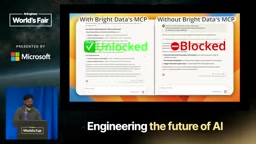
He showed a comparison video: with the same prompt — "use the browser to retrieve the content of this Glassdoor page" — Claude connected to Bright Data's MCP on the left successfully retrieved the content, while Claude without MCP on the right was outright blocked by Glassdoor. Glassdoor is notoriously well-defended, making this a compelling demonstration of MCP's practical value in real-world data collection.
MCP (Model Context Protocol) is an open standard proposed by Anthropic in late 2024, designed to solve the fragmentation problem in integrating large AI models with external tools and data sources. Before MCP, every tool provider needed to build separate adapters for different models like Claude and GPT, resulting in high maintenance costs. MCP uses a unified protocol specification so AI models can invoke external capabilities in a standardized way — whether that's database queries, API calls, or browser automation. Architecturally, the MCP server acts as a "tool proxy": the AI model declares its intent to the MCP server, which executes the specific operation and returns a structured result. This is conceptually similar to Function Calling, but MCP further standardizes how tools are discovered, described, and invoked, allowing the same tool definitions to be reused across different AI models. For data collection use cases, this means developers only need to configure Bright Data's MCP endpoint once, and models like Claude and GPT can directly call its scraping capabilities without writing separate integration code for each model.
Real-World Case Study: An E-Commerce Purchase Decision Agent
In the live demo, Raju used a Google Notebook script to build a product intelligence agent. Running it required just two things: a Bright Data API token and a Gemini API key.

The script workflow: first, call Bright Data's API to collect Amazon product data (using a Stanley Quencher tumbler as the example, pulling complete fields including price, rating, other sellers, product features, images, and URL); then call the Reddit API to do a keyword search on the product, pulling posts discussing whether it's "worth buying"; and finally run AI analysis on both datasets.
The results were compelling: the agent synthesized Amazon product information with Reddit sentiment and concluded that the product was currently at a solid discount, reviews were overwhelmingly positive, though a small number of negative voices existed (some found it "awkward," others were "obsessed"), and that demand was high on Amazon with low inventory. It then delivered a direct verdict: "you should buy it." This logic isn't limited to e-commerce — it can apply to any scenario where page data is accessible. The key is how you design the pipeline and run it at scale.
Why Bright Data Can Scrape What Ordinary Bots Can't
Someone in the audience asked: why can you collect resume-quality data when ordinary bots can't? Raju's answer identified the core advantage — Bright Data operates the world's largest proxy infrastructure. A small number of requests over a few days might slip through, but over time, sites like Glassdoor detect anomalies (such as datacenter IPs with no genuine on-page behavior) and layer on additional anti-bot defenses. What's needed isn't just a scraper or a bot, but the continuous ability to bypass CAPTCHAs, vary access strategies on every request, and avoid triggering blocks. He emphasized that the engineering time teams spend diagnosing site changes often consumes more resources than maintaining the scrapers themselves.
Closing Thoughts: Data Collection Enters the Agent Era
Raju's session traced a clear evolutionary arc: from fragile scraper pipelines dependent on manual maintenance, to AI agents that autonomously discover, build, and repair scrapers, to a world where AI brains can directly and compliantly access the entire web through MCP. For teams training models, fine-tuning, enriching RAG, or building real-time agents, the structure, consistency, reliability, and historical coverage of data matter just as much — as he illustrated with the example of hiring data: models need continuously updated job, salary, and location data to analyze trends and make precise matches.
When the underlying "unlock the web" capability is handed off to specialized infrastructure, developers can focus their energy on what truly matters: designing agent logic and scaling it to production.
Related articles

Chain of Thought Isn't Just for AI: How Humans Can Use CoT to Improve Thinking Quality
Chain of Thought isn't just a prompt trick for large models. Starting from a Hacker News discussion, this article analyzes why CoT works for human thinking too, breaks down actionable ways to transfer it, and highlights the key differences between human CoT and machine CoT.
Cloudflare Teams Up with OpenAI: Closi…
Cloudflare Teams Up with OpenAI: Closing the Loop from Vulnerability Discovery to Defense with AI
Cloudflare uses OpenAI Daybreak to investigate security vulnerabilities and generate reviewable remediation plans, while developers use Codex to boost coding efficiency and quality.

Orca Multi-Agent Orchestration in Practice: A Guide to Parallel Collaboration with Claude and Codex
Orca is Stable AI's free open-source agent workbench supporting 34 agents like Claude Code and Codex in parallel. Learn its Git worktree isolation, multi-model orchestration, and mobile management.