Building Ambient Agents with Amazon Bedrock AgentCore: From Event-Driven Automation to Human-in-the-Loop

Build event-driven ambient agents on Amazon Bedrock AgentCore with SQS, Lambda, DynamoDB, and human-in-the-loop review.
This article introduces an ambient agent architecture built on Amazon Bedrock AgentCore. Unlike traditional AI agents that passively wait for user input, ambient agents proactively listen for system events — such as S3 uploads, scheduled tasks, or monitoring alerts — and automatically trigger processing logic. The framework-agnostic design is powered by three AWS services: SQS for asynchronous event buffering, Lambda for serverless agent execution, and DynamoDB for task state persistence. For high-risk decisions, a unified `ask_human` tool suspends the workflow and routes items to a visual Jobs page for human review, forming a closed-loop workflow that combines automation efficiency with human oversight.
What Is an Ambient Agent?
Most traditional AI agents follow a passive pattern: a user sends a chat prompt, and the agent starts working. Ambient agents break this interaction paradigm — instead of waiting for input in a conversation window, they proactively respond to events happening within the system, such as an Amazon S3 file upload, a scheduled task, or a monitoring alert.
This shift transforms agents from "user assistants" into "background system guardians." They continuously listen for environmental signals and automatically trigger the appropriate processing logic at the right moment — a much more natural fit for automated workflows in real production environments. For enterprise scenarios that demand 24/7 operation and frequent event handling, ambient agents offer a more natural and efficient approach to intelligent automation.
The Architectural Design of AgentCore
Amazon Bedrock AgentCore provides a framework-agnostic approach to building agents, meaning developers aren't locked into any specific agent framework and can freely choose their underlying implementation. The entire solution is built around several core AWS service components.
Event Capture and Message Queuing
The system uses Amazon SQS as the buffer and distribution hub for event signals. When events such as S3 uploads, scheduled tasks, or alerts occur, the corresponding signals are pushed to an SQS queue, forming a reliable asynchronous messaging channel. This design decouples event production from processing — even if the processing side is temporarily busy, events won't be lost.
SQS (Simple Queue Service) is AWS's fully managed message queue service, supporting both Standard queues (at-least-once delivery) and FIFO queues (strictly ordered, exactly-once delivery). In ambient agent scenarios, it's common to pair SQS with Amazon EventBridge or S3 Event Notifications to route external events to the queue. For example, an S3 bucket can automatically send notification messages to a specified SQS queue when an object is uploaded, while scheduled tasks can periodically write trigger signals to the queue via EventBridge Scheduler. SQS's Visibility Timeout mechanism ensures that once a message is picked up by a Lambda instance for processing, other instances won't consume it again. If Lambda execution fails, the message becomes visible again and can be reprocessed. Combined with a Dead Letter Queue (DLQ), messages that fail processing multiple times are isolated for troubleshooting without blocking the main flow.
Serverless Compute Layer
AWS Lambda handles the actual computation and agent logic execution. As a serverless function, Lambda automatically scales based on the volume of events in the queue, with no need to pre-configure server resources. Events arriving in the queue trigger Lambda, which then invokes the agent to complete reasoning and decision-making — a natural fit for the "respond on demand" operational model of ambient agents.
State and Task Persistence
Amazon DynamoDB is responsible for storing the agent's state data and task records. In an event-driven asynchronous workflow, tracking the progress of each task, saving intermediate results, and recording items pending human review all require a high-performance, scalable persistence layer — and DynamoDB plays that critical role here.
Human-in-the-Loop Mechanism
Fully automated agents aren't always reliable when facing high-risk or uncertain decisions, which is why introducing a human-in-the-loop step is essential. The design of this solution is quite elegant — it implements this capability through a single unified ask_human tool.
When the agent encounters a situation requiring human judgment during execution, it can call the ask_human tool to surface the pending decision. This "single tool" design reduces complexity and makes the handoff point between the agent and humans clear and standardized.
The Jobs Review Page
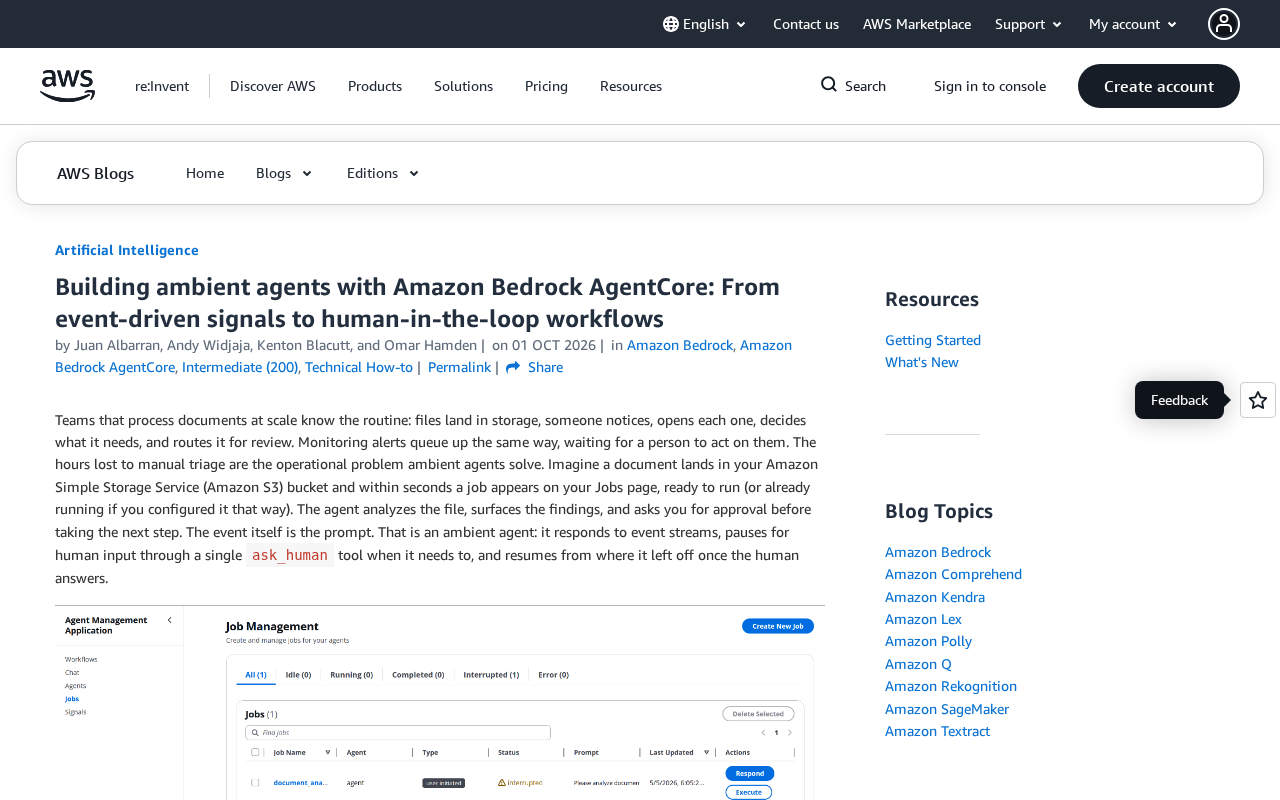
The accompanying Jobs page provides a visual interface for human review. Reviewers can examine the pending tasks submitted by the agent, review the relevant context, and provide their judgment or approval. The agent then continues the subsequent workflow based on human feedback. This combines the efficiency of automation with human judgment, forming a closed-loop workflow that operates quickly while retaining necessary oversight.
In the engineering implementation of LLM-based agents, human-in-the-loop typically faces a technical challenge: agent reasoning executes synchronously, while human review often requires minutes or even hours of waiting. Implementing the
ask_humantool usually requires serializing and persisting the agent's execution state (i.e., storing it in DynamoDB), then pausing the current execution flow and resuming it after a human provides feedback through the Jobs page. This "suspend-resume" pattern is fundamentally different from a regular synchronous function call, requiring the underlying framework or platform to support asynchronous task suspension (such as LangGraph's interrupt mechanism or AWS Step Functions' wait tokens). Amazon Bedrock AgentCore provides the necessary infrastructure support here, so developers don't need to handle state serialization and restoration logic themselves.
Value and Use Cases
Combining event-driven architecture with agent capabilities, further augmented by a human-in-the-loop mechanism, provides a practical reference paradigm for enterprise-grade AI applications. It is especially well-suited for scenarios that require real-time responses to system events while maintaining high standards for decision accuracy — such as file processing pipelines, operations alert response, and compliance review.
The framework-agnostic nature also means teams can adopt this approach incrementally on top of their existing technology stack. The proven combination of SQS, Lambda, and DynamoDB strikes a balance among reliability, scalability, and operational cost. For developers exploring how to truly bring LLM-based agents into production, this is an engineering path well worth considering.
Related articles

ChatGPT Space Launches: Team Collaboration and New Pages Features Explained
ChatGPT Space is OpenAI's new team collaboration feature with Pages, real-time collaboration, and Slack/Google Drive sync. We break down its privacy design, multi-platform integration, and the full workflow from conversation to document.

Migrating Apache Spark UDFs to GPU Acceleration with AI Agents
NVIDIA developer blog explains how AI Agents rewrite Apache Spark UDFs for GPU acceleration, covering migration criteria, agent rewriting and verification workflows, plus pitfalls like result consistency and CPU-GPU transfer overhead.

Zed Editor v0.40.4-rc2 Released: Usage Credits Now Available Without Upgrading
Zed editor releases v0.40.4-rc2, allowing users to use usage credits for AI features without upgrading to a paid plan, lowering the trial barrier.