Building an AI Assistant with Memory Using Hindsight: MemoryMate in Practice
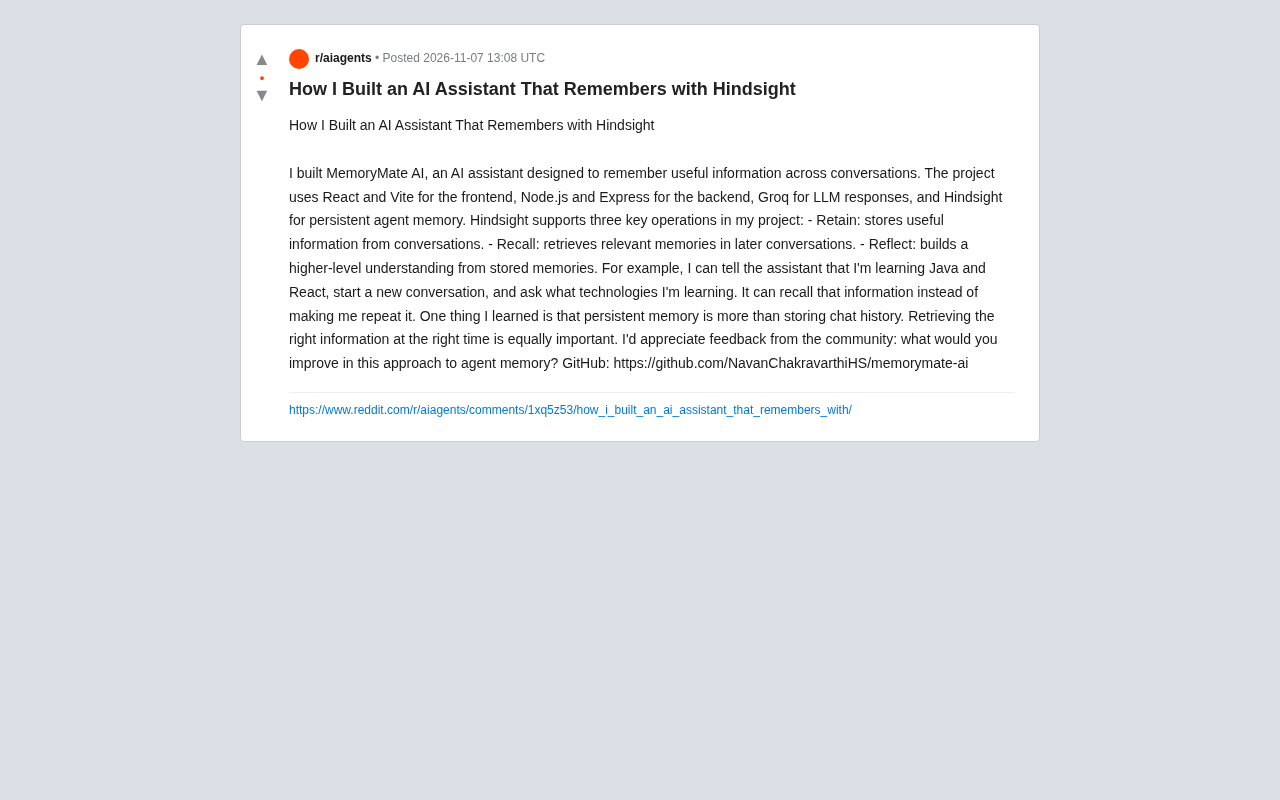
MemoryMate AI uses Hindsight to enable persistent cross-conversation memory and reveals that retrieval and reflection are the core.
MemoryMate AI is an open-source AI assistant project by developer Navan Chakravarthi HS that aims to solve the problem of conversational AI forgetting context after each session and forcing users to repeat themselves. The project uses a React + Vite frontend, a Node.js + Express backend, Groq for generating replies, and Hindsight as the persistent memory component. Hindsight provides three core operations—Retain (store), Recall (retrieve), and Reflect (reflect)—forming a complete memory management loop. The developer emphasizes that the key to memory is not saving chat history, but retrieving the right information at the right time and distilling high-level understanding from memories. The article also discusses improvement directions such as memory priority and decay, multi-user privacy, retrieval accuracy, and reflection automation.
Are you tired of repeating your preferences and tech stack every time you start a new conversation? Developer Navan Chakravarthi HS shared his solution on Reddit: MemoryMate AI, an AI assistant that achieves persistent memory through Hindsight. This project not only demonstrates technical feasibility but also reveals the core challenges of agent memory design.
Why do AI assistants need "memory"?
Most current conversational AI forgets all context after each session ends. For users who need continuous help, this means a lot of repetitive communication. The goal of MemoryMate AI is to let the assistant remember key information about the user, such as the tech stack they are learning and project preferences, so it can proactively recall this in subsequent conversations.
The developer gives an example: he told the assistant that he is learning Java and React, then started a new conversation and asked, "What technology am I learning?" The assistant accurately recalled the answer without requiring repeated input. This improvement in experience is obvious, especially for long-term project collaboration or learning scenarios.
Tech stack and architecture
MemoryMate AI uses a clear front-end/back-end separated architecture:
- Frontend: React + Vite, providing a fast development experience and a smooth interactive interface.
- Backend: Node.js + Express, handling API requests and business logic.
- LLM responses: Groq, responsible for generating conversational replies while balancing speed and quality.
- Persistent memory: Hindsight, as the core component of agent memory.
This combination balances development efficiency and feature implementation. In particular, the introduction of Hindsight makes memory management structured.
Groq is a cloud service provider focused on AI inference acceleration. Its core product, LPU (Language Processing Unit), is a chip architecture designed specifically for large language model inference. Compared with traditional solutions that rely on GPUs, Groq stands out in high-throughput, low-latency text generation scenarios and is often used in conversational applications that require real-time responses. The developer's choice of Groq as the LLM response layer means that reply quality can be maintained while significantly reducing first-token latency, which is especially critical for conversational experiences that require frequent back-and-forth.
Hindsight is memory infrastructure for AI agents. Its design goal is not simply to save chat logs, but to provide structured memory lifecycle management. It abstracts memory operations into three types of primitives: Retain (write), Recall (retrieve), and Reflect (reflect), allowing developers to compose complex memory behaviors at the application layer. This layered design decouples memory storage and indexing from high-level reasoning, making it easy to replace the underlying storage or adjust retrieval strategies.
Hindsight's three key operations: Retain, Recall, Reflect
Hindsight provides three key operations that form a complete loop for memory management:
Retain: Store useful information
During a conversation, the assistant identifies and stores valuable information, such as the user's tech stack and project goals. This is not simply saving chat logs, but selectively preserving key facts.
Recall: Retrieve relevant memories at the right time
When the user starts a new conversation or asks a related question, the system retrieves the most relevant information from stored memories. The developer emphasizes that "retrieving the right information at the right time" is just as important as storage itself. This requires an efficient retrieval mechanism, possibly involving vector similarity matching or keyword indexing.
Vector similarity matching is a common method for semantic retrieval: text is converted into high-dimensional vectors through embedding models, and then cosine similarity or dot product is used to calculate the semantic closeness between a query and memory entries. Compared with keyword indexing, it better captures synonymous expressions and contextual associations. For example, when the user asks "What frontend framework am I learning," it can still match the memory "currently learning React." In practice, systems often adopt a hybrid retrieval strategy, combining vector recall with keyword filtering to balance semantic generalization and exact matching.
Reflect: Build high-level understanding
The Reflect operation enables the assistant to distill higher-level understanding from stored memories. For example, after repeatedly mentioning learning Java and React, the assistant may infer that the user is moving toward full-stack development and thus provide more precise suggestions. This is similar to humans' ability to summarize patterns from experience.
Key insight: Memory is more than chat history
The developer's biggest takeaway is that persistent memory is far more than saving chat logs. The real challenge lies in how to organize, retrieve, and use this information. Simple history records lead to information overload and inefficient retrieval, while Hindsight's structured approach (Retain-Recall-Reflect) provides a viable paradigm.
This view is worth deep consideration by all developers building AI agents. Many projects focus only on storage while ignoring retrieval and reflection, making the memory feature largely ineffective.
Information overload in a memory system manifests as retrieval results being diluted by large amounts of low-value historical records, causing truly relevant memories to be buried. As the number of conversation turns grows, naively saving all history causes the retrieval space to expand sharply, increasing latency and reducing accuracy. Structured memory management controls memory scale through deduplication, summarization, prioritization, and forgetting mechanisms, keeping retrieval focused on high-signal content. This is also the fundamental reason why the Retain stage needs to selectively preserve key facts rather than persist everything.
Community feedback and improvement directions
The developer has made the GitHub repository public (NavanChakravarthiHS/memorymate-ai) and hopes the community will provide feedback on agent memory methods. Possible improvement directions include:
- Memory priority and decay: How should we decide which memories are more important? Should old memories fade over time?
- Multi-user and privacy: How can memories of different users be isolated and data security ensured?
- Retrieval accuracy: How can recall and precision be balanced to avoid introducing irrelevant information?
- Automation of Reflect: Can the system automatically trigger the reflection process without relying on explicit instructions?
Exploration of these questions will push AI assistants toward becoming smarter and more personalized.
Conclusion
MemoryMate AI is an open-source experiment worth following. It uses Hindsight to implement the memory loop of Retain, Recall, and Reflect, validating the feasibility of persistent memory in AI assistants. The developer candidly points out that the core of a memory system lies in retrieval and reflection, not simple storage. For developers who want to build stateful AI applications, this project offers valuable reference.
If you are interested in agent memory, you may want to visit the GitHub repository or offer your improvement suggestions to the developer.
Related articles
 Tech Frontiers
MuJoCo: An Analysis of DeepMind's Open-Source General-Purpose Physics Simulator
An in-depth analysis of Google DeepMind's open-source physics simulator MuJoCo: high-performance C++ kernel, MJCF modeling format, contact solving principles, MJX GPU acceleration, and robot reinforcement learning use cases.
 Tech Frontiers
Claude API Quick Start: The Official Quickstarts Project Collection
Anthropic's official claude-quickstarts project collection helps developers quickly build deployable apps with the Claude API. Nearly 20k stars, Python-based, great for beginners and prototyping.
 Tech Frontiers
AI Agents Connecting Directly to APIs: Which Calls Can Be Safely Allowed?
AI agents can call any API, but the real challenge is deciding which calls can be safely allowed. This article analyzes allowance decisions from three dimensions—intent matching, least privilege, and controllable impact—and argues that the control layer should sit outside the agent, combined with audit traceability to build a trustworthy API call governance mechanism.