Building an AI Digital Employee Customer Service System: Full Project Retrospective — 30-Day Delivery for $11K

Real-world AI customer service system delivered in 30 days by a 2-person team for $11K with full tech stack breakdown.
This article provides a detailed retrospective of a real commercial AI customer service project: a 2-person team delivered a fully functional AI digital employee system in 30 days for 80,000 RMB (~$11K). The breakdown covers the complete tech stack (Python/FastAPI, C#, Redis, vector DB, Qwen LLM), RAG knowledge base architecture, intelligent AI-human routing mechanisms, and layered system design — offering practical guidance for developers entering the AI application space.
Project Overview: A Real-World AI Customer Service Commercialization Case
With AI application deployment becoming increasingly popular, many developers want to know: how much is an AI customer service system that can actually be delivered to a client really worth? And how long does development take? A Chinese tech YouTuber (程序汪) shared a very specific real-world case — an "AI Digital Employee" fully automated customer service system developed for an e-commerce merchant.
The core metrics of this project are crystal clear: 30-day development cycle, 2-person team, total cost of 80,000 RMB ($11,000 USD), formal contract, with annual maintenance fees of 8,000 RMB ($1,100 USD). The system primarily runs on Windows, embeds the merchant's platform, and delivers the core functionality of AI-powered automatic replies. Compared to million-dollar custom AI projects, this case demonstrates the real cost structure of small-to-medium scale AI application deployment, offering tremendous reference value for independent developers and small teams.
Why Did the Client Need an AI Customer Service System?
Understanding the demand context is essential for evaluating an AI project's value. This client is a typical e-commerce merchant with very prominent business pain points:
- High inquiry volume across multiple platforms: Operating simultaneously on Taobao, Pinduoduo, JD.com, and other e-commerce platforms with dense inquiry traffic;
- Heavy pressure on human agents during peak periods: Human customer service simply can't keep up during promotional campaigns;
- High proportion of repetitive inquiries: A large volume of questions are repetitive common queries with low value for human response;
- High labor costs for customer service: Customer service staffing is an ongoing heavy financial burden;
- Slow response during off-hours: Inquiries outside working hours can't receive timely replies, affecting conversion rates.

These pain points are precisely the scenarios where AI customer service excels — high-frequency, repetitive, standardized Q&A. According to industry data, approximately 70%-80% of e-commerce customer inquiries are standardized questions (such as shipping times, logistics tracking, return/exchange policies, etc.), meaning that even if AI customer service only covers these scenarios, it can significantly reduce human agents' workload. By pre-organizing knowledge bases and common product Q&A answers and importing them into the system, AI can achieve the most fundamental yet most valuable automatic reply functionality, thereby freeing up human resources and improving customer service efficiency.
Technology Stack Breakdown: A Pragmatic Engineering Selection
Based on the technical approach disclosed by the creator, this AI customer service project's technology stack selection is quite pragmatic — not blindly chasing the latest trends, but centered around "rapid delivery" and "stable operation."
Frontend, Backend & Desktop Technology Selection
- Data Processing: Python
- Backend/Frontend Service: Python + FastAPI
- Frontend: Vue
- Desktop Application Development: C# (because it needs to run on Windows and interface with merchant client software)
- Development Tools: Used Codex for AI-assisted programming

FastAPI is one of the highest-performance web frameworks in the Python ecosystem, built on Starlette and Pydantic with native support for asynchronous programming (async/await), delivering excellent performance in high-concurrency scenarios. Its automatic API documentation generation, type hint validation, and dependency injection system make development extremely efficient. For AI application backends, FastAPI is particularly suitable as a front-end service layer for large model inference — it can both handle concurrent request queues and avoid blocking issues during model inference through its async mechanisms. C# was chosen for the desktop client because it needs to perform process-level interaction and message monitoring with native Windows customer service clients like Qianniu (Alibaba's merchant tool), which is difficult to achieve with cross-platform frameworks.
AI Capabilities & Data Layer Architecture
- Message Queue: Redis
- Multimodal Recognition: OCR (for recognizing image-based orders, product information)
- Vector Database: For knowledge base and business data storage and semantic retrieval
- Embedding Model & LLM: Both use Qwen (Tongyi Qianwen) as the commercial inference engine
On the Role of Redis Message Queue: Redis, as an in-memory database, has data structures like List and Stream that are naturally suited for use as lightweight message queues. In an AI customer service system, the Redis message queue plays the critical role of peak shaving and valley filling: when customer messages from multiple platforms flood in simultaneously, Redis temporarily stores messages in the queue, and the AI inference service consumes them sequentially based on processing capacity, preventing the LLM from timing out or crashing due to too many concurrent requests. Compared to heavyweight message middleware like Kafka, Redis is simpler to deploy with lower latency, making it more suitable for real-time messaging scenarios in small-to-medium scale AI applications.
On OCR Multimodal Recognition: OCR technology is far more widely used in e-commerce customer service than one might imagine. Buyers frequently send screenshots of order numbers, logistics tracking numbers, product detail pages, coupon information, etc. A pure text conversation model cannot process these image contents. By extracting text information from images into structured data through OCR, the AI customer service can understand the buyer's complete request. In recent years, with the development of multimodal large models, OCR capabilities are gradually being integrated into vision-language models, but in current engineering practice, standalone OCR modules remain the more pragmatic choice due to their fast inference speed and low cost.
On Vector Databases: Vector databases are database systems specifically designed for storing and retrieving high-dimensional vectors, such as Milvus, Pinecone, Weaviate, etc. Their core principle is transforming text into high-dimensional mathematical vectors through embedding models, where semantically similar texts are closer together in vector space. During queries, algorithms like cosine similarity or Euclidean distance quickly find knowledge fragments that are semantically closest to the user's question. Compared to traditional keyword matching, semantic retrieval can understand synonymous expressions and contextual meaning, dramatically improving knowledge base recall and accuracy.
The logic of this technology combination is clear: Python handles data and backend logic, C# solves Windows desktop integration, Redis ensures concurrent message processing capability, and OCR + vector database + LLM forms a complete RAG (Retrieval-Augmented Generation) capability loop.
RAG (Retrieval-Augmented Generation) is one of the most mainstream technical paradigms in current AI application deployment. Traditional LLMs' knowledge is limited to their training data and cannot access enterprise private data in real-time. RAG works by slicing enterprise knowledge base documents into chunks, converting them into vector embeddings, and storing them in a vector database. When a user asks a question, the system first retrieves the most relevant knowledge fragments through semantic similarity, then injects these fragments as context into the LLM's prompt, allowing the model to generate answers based on real data. This approach both avoids the LLM's "hallucination" problem (fabricating non-existent information) and eliminates the need for expensive fine-tuning training, making it the most cost-effective knowledge enhancement solution for small-to-medium scale AI projects.
The choice of Qwen's embedding model and inference engine also demonstrates that domestic Chinese LLMs have sufficient cost-effectiveness and deployment capability in commercial scenarios. Qwen (Tongyi Qianwen) is Alibaba Cloud's large language model series, providing commercial API services through the Alibaba Cloud Bailian platform, with an ecosystem covering text generation, multimodal understanding, embedding models, and full-chain capabilities. In terms of commercial pricing, Qwen's API call costs are far lower than overseas models like OpenAI, and data stays within China, meeting domestic enterprise data compliance requirements. For high-frequency calling scenarios like e-commerce customer service, domestic models have clear advantages in Chinese language understanding, cost control, and compliance.
Core Workflow: Intelligent Routing Between AI and Human Agents
The workflow design of the entire AI Digital Employee is the essence of this project, reflecting the mature understanding in real-world business deployment that "AI is not omnipotent."
The system first monitors platform messages through the message integration layer, uses multimodal input to capture images, text, orders, and product information, pulls business data such as inventory, logistics, and coupons, and simultaneously retrieves historical conversation context. Retrieving historical conversation context is crucial for AI customer service — it enables the model to understand conversational continuity, avoiding repeated requests for information the buyer has already provided, and allows for gradually understanding the buyer's true needs through multi-turn dialogue.
Next comes the critical intelligent routing decision, which splits into two paths:
Path One: Transfer to Human Agent
When encountering customers with negative emotions, or situations involving disputes, return/exchange conflicts, and other complex issues, the AI determines it as a "response failure" and triggers an alert mechanism to transfer to a human agent. After human processing is complete, it's marked as successful, and interaction data is archived.
Sentiment detection plays a critical "safety valve" role here. The system typically analyzes emotional tone by looking at mood particles, punctuation marks (such as consecutive exclamation marks), and negative keywords (such as "complaint," "bad review," "report to authorities," etc.) in user messages. The value of this mechanism lies in the fact that in e-commerce scenarios, if an angry buyer receives a mechanical AI response, it often further escalates the conflict, ultimately leading to negative reviews or platform complaints. Timely human transfer protects the merchant's interests.
Path Two: AI Automatic Response
For normal routine inquiries, the system structurally deconstructs the customer's question, retrieves from the knowledge base, has the LLM generate e-commerce-specific replies, automatically sends them to the buyer, and marks it as successful.
Structural deconstruction means the system first performs intent recognition and entity extraction on the user's natural language question — for example, determining whether the user is asking about "shipping time" or "return process," while simultaneously extracting key information such as order numbers and product names. This enables more precise retrieval of relevant content from the knowledge base, rather than using the user's raw question for fuzzy search.
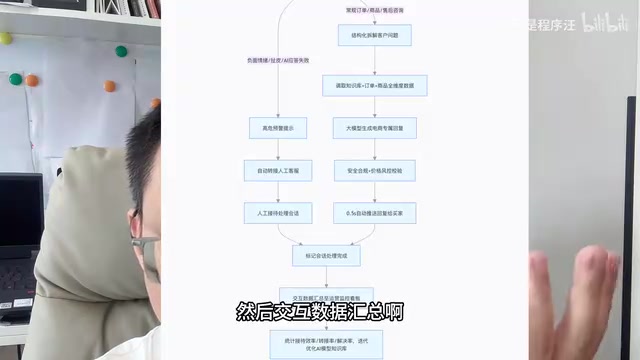
This "AI-first, human-fallback" routing design is critical. It ensures automated processing efficiency for high-frequency questions while avoiding the customer complaint risks of AI "answering incorrectly" in complex dispute scenarios through sentiment detection and failure alert mechanisms. Finally, the system also tracks service efficiency and resolution rates, forming a data feedback loop for subsequent iterative optimization and knowledge base updates. This data feedback loop means the system continuously improves over time — cases where AI answers but then get transferred to humans are marked as "unresolved," and operations staff can use this data to supplement the knowledge base or adjust routing rules, gradually increasing the AI's autonomous resolution rate.
Overall System Architecture: Layered Design Ensures Stable Operation
From the architecture diagram shown by the creator, the entire AI customer service system adopts a clear layered design:
- Access Layer: Interfaces with platform customer service clients like Qianniu, as well as the Windows engine, connected via API;
- Core Service Layer: Contains core capabilities including risk control, routing, and message queues;
- Data & External Capability Layer: Knowledge base, business data interfaces, vector database, etc.;
- Business Output Layer: Automatic sending, human takeover workspace, retrospective analysis, etc.
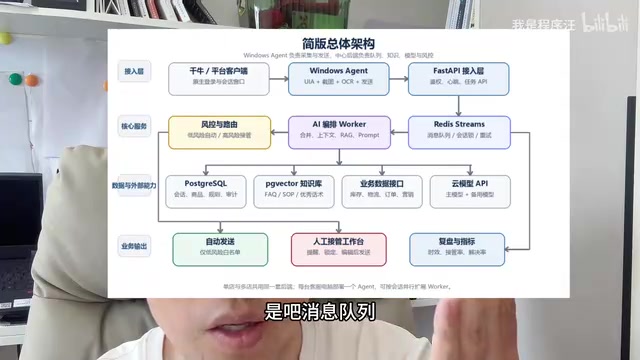
The advantage of this layered architecture is that each layer communicates through standardized interfaces. When a new e-commerce platform needs to be integrated, only a corresponding adapter needs to be added at the access layer — the core service layer and data layer require no changes. Similarly, if the LLM provider needs to be replaced in the future (e.g., switching from Qwen to another model), only the AI capability layer's API calls need modification without affecting overall business logic.
The creator specifically mentioned that the backend system could be developed quickly because the team had previously built similar enterprise customer service systems, including classification, permissions, user management, knowledge base management, and other common features. Therefore, this project was essentially "secondary development" — layering AI capabilities on top of a mature backend foundation — which is a key reason why 30-day delivery was possible. This reveals an important pattern in AI application development: AI capabilities themselves typically only account for 30%-40% of the total system engineering effort; the remaining bulk of work lies in traditional software engineering — permission management, data persistence, logging and monitoring, exception handling, deployment and operations, etc. Having a mature "base system" is a team's true competitive moat for rapid AI project delivery.
Conclusion: Practical Insights for AI Customer Service Deployment
This case offers multi-faceted insights for the industry. First, the deployment cost of AI customer service is dropping into a range affordable for small-to-medium merchants. An 80,000 RMB one-time investment plus 8,000 RMB annual maintenance, for e-commerce businesses operating across multiple platforms with high inquiry volumes, doesn't require a long payback period. Calculating based on a customer service position with a monthly salary of 5,000 RMB, plus social insurance bringing the total labor cost to about 8,000 RMB/month, if the AI system can replace the workload of 1-2 customer service positions, the investment can essentially be recovered within six months.
Second, mature engineering reuse capability is the key to rapid delivery. What truly determines project efficiency is often not the AI itself, but the team's existing accumulation in customer service systems and backend architecture. For developers wanting to enter this space, first building a reusable customer service system "foundation," then layering AI capabilities and knowledge base configurations for different industry clients, is a scalable business model.
Finally, the AI + human routing design is the mainstream paradigm for current deployments. Setting "brakes" for AI in long-tail scenarios involving emotions and disputes, with human fallback, is what a responsible, deliverable AI product should look like. This design also aligns with the current reality of AI technology — LLMs are already powerful enough in comprehension and generation capabilities, but in scenarios requiring empathy, negotiation skills, and flexible adaptation, human agents remain irreplaceable. Acknowledging AI's boundaries and establishing clear handling mechanisms for those boundaries in product design is truly mature AI product thinking. For teams looking to enter the AI application development space, this case provides a highly valuable practical roadmap.
Related articles

Workbuddy for Absolute Beginners: How a Desktop AI Agent Fits Into Real Workflows
A beginner's guide to the Workbuddy desktop AI agent: installation, claiming credits, file management, and building automated workflows—compared with CodeX for fit and cost, helping professionals shift from AI question-askers to AI managers.

OpenAI's New Agent Stack: Computer Use, Decisions API, and Ultra-Fast Workflows
OpenAI Dev Day unveiled a new agent stack: Computer Use outperforms humans, Decisions API delivers ultra-low-latency classification via Luna, Agents API opens the same Computer Use capabilities, and GPT-6.1 Sol costs only one-seventh of Astra. Core updates, benchmark data, and developer insights.

Liang Wenfeng Open-Sources DeepInfo Inference Framework, Takes On U.S. Ban
DeepSeek open-sources its DeepInfo inference framework after its models, featuring GPU/CPU cross-pipelining, small-model prediction with large-model verification, and full Huawei Ascend and NVIDIA chip support—facing the U.S. federal ban head-on. This article analyzes its significance for AI deployment and open-source strategy.