Building an AI Learning Community from Scratch: A Practical Guide to Interdisciplinary Open Collaboration

A guide to building interdisciplinary AI learning communities through open collaboration.
This article explores how to build a cross-disciplinary AI learning community integrating machine learning, deep learning, mathematics, and physics. Inspired by a Reddit user's initiative to create such a Discord community, it examines why disciplinary silos hinder AI learning, the value of research-oriented open collaboration, and practical challenges like content quality and engagement. It offers actionable advice for learners looking to join or build similar communities.
The Seeds of an Interdisciplinary AI Learning Community
In an era where AI technology is rapidly gaining mainstream adoption, a growing number of learners are realizing that Machine Learning (ML) and Deep Learning (DL) are not isolated skills — they are deeply rooted in foundational disciplines like mathematics and physics. Recently, a Reddit user launched a call to action that exemplifies this realization: they announced plans to build a Discord community integrating machine learning, deep learning, mathematics, and physics, openly inviting like-minded individuals to help build it together.
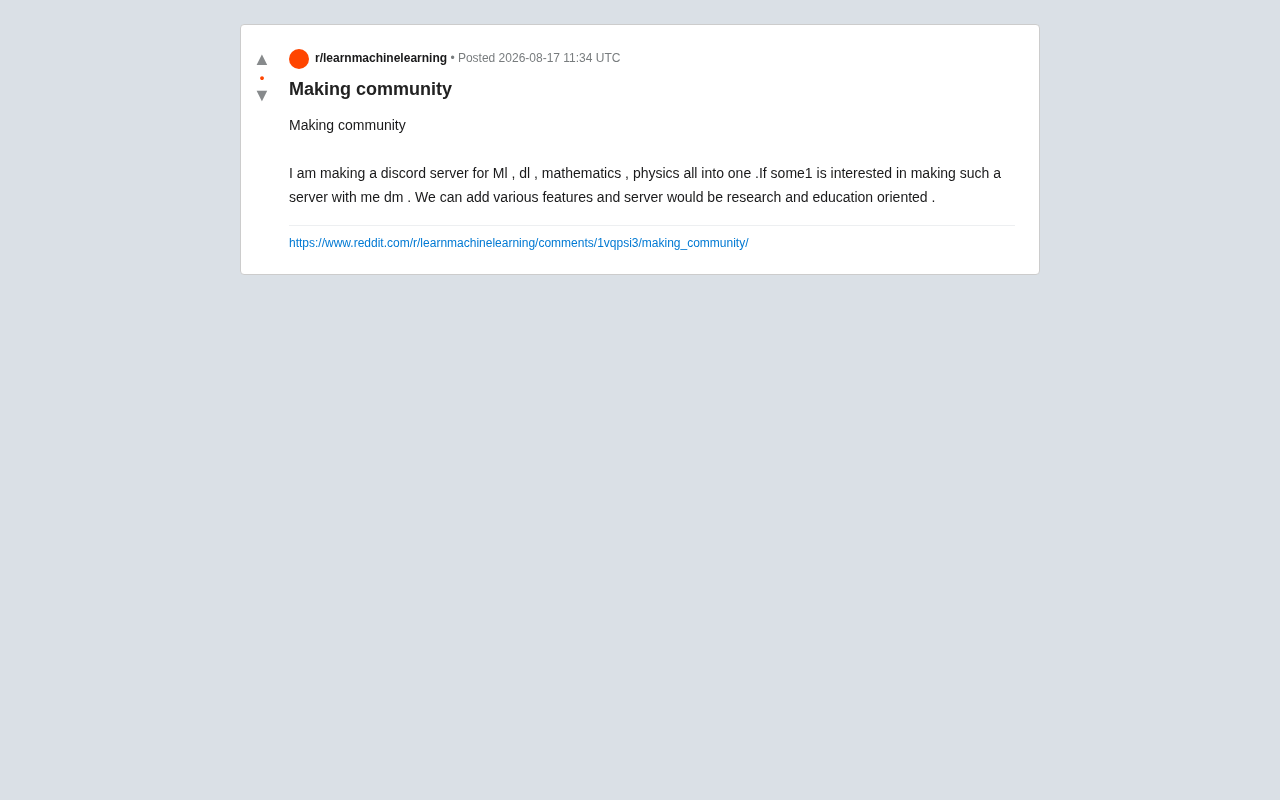
The post was brief but hit the nail on the head — "I'm creating a Discord server that brings ML, DL, Math, and Physics together. If anyone is interested in building it with me, feel free to DM me. We can add all kinds of features, and the server will be research and education oriented."
It's worth noting that Discord was originally designed as an instant messaging platform for gamers, but in recent years it has evolved into one of the world's most active online community platforms — particularly in the areas of tech learning, open-source collaboration, and academic discussion. Discord's Channel and Role systems allow community managers to organize content by topic with fine granularity. Voice channels support real-time discussions and online seminars, while the Bot ecosystem enables automated content management, Q&A retrieval, and event reminders. Today, many prominent AI projects like Hugging Face and Midjourney use Discord as their primary community hub, making it a natural choice for building technical learning communities.
This may seem like an ordinary community recruitment post, but it reflects a very real set of needs and structural gaps facing today's AI learners.
Why Do We Need an Interdisciplinary AI Learning Community?
Disciplinary Silos Are a Hidden Barrier to AI Learning
Many beginners enter the machine learning field by jumping straight into frameworks and APIs — for example, using PyTorch or TensorFlow to get a model up and running. PyTorch, developed by Meta's (formerly Facebook) AI Research lab, is known for its dynamic computation graphs and Pythonic style, making it a favorite among academic researchers. TensorFlow, developed by the Google Brain team, offers a more comprehensive production deployment toolchain. These two frameworks have dramatically lowered the barrier to practicing deep learning — developers can build complex neural networks in just a few lines of code using high-level APIs. However, this high level of abstraction comes with a side effect: learners tend to stay at the "library-calling" level, lacking genuine understanding of underlying mechanisms like automatic differentiation, tensor memory management, and computation graph optimization. When they hit performance bottlenecks or non-standard requirements, they find themselves stuck.
When these learners try to understand why gradient descent works, the mathematical essence of attention mechanisms, or the stochastic processes behind diffusion models, they run into a "knowledge gap" in their foundations.
Specifically, gradient descent is the most fundamental optimization algorithm in deep learning. At its core, it uses the gradient from multivariable calculus — a vector composed of partial derivatives in each direction — to find the minimum of a loss function. Without understanding partial derivatives, the chain rule, and basic concepts of convex optimization, learners struggle to grasp why learning rate selection is so critical or to determine whether a model has fallen into a local optimum. The Attention Mechanism, originating from the Transformer architecture, computes association weights between elements in a sequence through linear transformations of Query, Key, and Value matrices and scaled dot-product operations. This involves matrix multiplication from linear algebra, probabilistic normalization via the softmax function, and similarity measures in high-dimensional vector spaces.
Diffusion Models represent an even deeper convergence of physics and AI. Diffusion models are a generative AI technology that has achieved breakthrough progress in image generation in recent years, with notable examples including Stable Diffusion and DALL·E. Their mathematical foundation draws directly from Brownian motion in physics and Langevin Dynamics from statistical mechanics. The forward process simulates the diffusion phenomenon in thermodynamics — gradually adding Gaussian noise to data until it becomes completely random; the reverse process generates new samples by learning to denoise in reverse. Understanding this requires familiarity with stochastic differential equations (SDEs), Markov chains, and variational inference. It is precisely this deep connection to physics that gives researchers with physics backgrounds a natural advantage in understanding and improving diffusion models.
Linear algebra, probability and statistics, calculus, and even concepts of energy and optimization from physics form the underlying logic of modern deep learning. In statistical physics, systems tend to evolve toward states of minimum free energy — an idea directly incorporated into the design of classical models like Boltzmann Machines and Restricted Boltzmann Machines (RBMs). More broadly, loss functions in deep learning can be analogized to energy functions in physical systems, and the training process is essentially a search for the lowest energy point in a high-dimensional parameter space. The Simulated Annealing algorithm is directly inspired by the annealing process in metallurgy, and the Hamiltonian Monte Carlo method brings Hamiltonian mechanics from classical physics into probabilistic sampling. These cross-disciplinary knowledge transfers demonstrate that physics provides not only metaphors for understanding AI but also concrete algorithmic tools.
By placing mathematics, physics, ML, and DL within the same community framework, the initiator aims to break down these disciplinary silos, enabling learners to understand the "why" behind the technology in a unified context.
A Research and Education-Oriented Community
One important detail: the initiator explicitly positioned the community as "research and education oriented," rather than a pure tech Q&A or project outsourcing platform. This positioning suggests the community will likely emphasize:
- Paper reading and discussion
- Systematic learning of foundational theory
- Sharing and curating academic resources
- In-depth exchanges between learners
This orientation is especially refreshing in today's AI learning landscape, which is saturated with "quick-win" and "monetization" rhetoric. In fact, virtually every frontier breakthrough in AI has come from a deep understanding of foundational theory — whether it's the mathematical derivation of scaled dot-product attention in the Transformer paper or the game-theoretic analysis of Nash equilibrium in Generative Adversarial Networks (GANs). All of these demand solid interdisciplinary foundations. A community centered on research and education has the potential to provide learners with a complete growth path: from "knowing how to use tools" to "understanding principles" to "creating new knowledge."
The Value and Challenges of Open Collaboration
The Advantages of Crowdsourced Community Building
The initiator chose not to build a finished community solo before opening it to the public. Instead, they adopted a "co-building" model from the very start — inviting interested people to design features and plan the direction together. This bottom-up, crowdsourced approach has unique value.
First, multi-person collaboration brings richer perspectives. Members with math backgrounds may focus more on theoretical rigor, those with engineering backgrounds may prioritize practical implementation, and those with physics backgrounds might contribute cross-domain modeling insights. This kind of diverse knowledge exchange is precisely the core value of interdisciplinary learning — historically, many important AI breakthroughs have emerged from the intersection of ideas across fields. For example, Convolutional Neural Networks (CNNs) were inspired by neuroscientists' research on receptive fields in the visual cortex, and Temporal Difference Learning (TD Learning) in reinforcement learning drew from behaviorist learning theory in psychology.
Second, early co-builders typically develop a stronger sense of ownership and responsibility, which is crucial for long-term community engagement. A community shaped by its core members tends to have more vitality than one dominated by a single operator. This model mirrors the success logic of open-source software communities — projects like Linux and Python have thrived for decades precisely because a group of core contributors were deeply involved in shaping the community's DNA from the very beginning.
Real-World Challenges That Can't Be Ignored
However, the road from a Reddit post to a truly thriving learning community is fraught with practical challenges:
Maintaining content quality. A research and education orientation demands depth, which raises the question: how do you prevent the community from devolving into a low-quality spam or advertising dump? This requires clear rules and sustained management effort. Successful technical communities typically establish explicit content tiering systems and peer review mechanisms — for example, Stack Overflow's reputation system and Arxiv's preprint review process. These are experiences worth learning from.
Sustaining engagement. A large number of Discord learning communities go quiet shortly after an enthusiastic launch. Without regular activities — such as reading groups, paper sharing sessions, or Q&A hours — communities struggle to retain members. Research shows that online learning community retention rates typically plummet to below 10% after 30 days. Only communities that consistently provide value and social connection to their members manage to break through this bottleneck.
The difficulty of interdisciplinary integration. Merging ML, DL, mathematics, and physics into a cohesive whole is a beautiful ideal, but in practice, content can easily become too scattered and lose focus. Striking the right balance between "integration" and "focus" is a challenge that requires ongoing experimentation. One viable strategy is to organize interdisciplinary discussions around specific anchor questions — for example, exploring "Why can Transformers effectively handle long-range dependencies?" through simultaneous analysis from linear algebra (matrix attention computation), probability theory (probabilistic interpretation of softmax), and information theory (information bottleneck theory).
Practical Takeaways for AI Learners
Although this community recruitment effort is small in scale, it offers a meaningful observation window. It suggests that as AI technology deepens, learners' needs are evolving from "how to use it" to "why it works this way," with significantly greater emphasis on foundational disciplines. This trend aligns closely with developments in AI research: as architectural innovation increasingly depends on deep insight into underlying mathematical structures, learners who "understand the principles" will have far greater room for growth than practitioners who simply "know how to tune hyperparameters."
For learners interested in joining or building a similar community, here are some recommendations worth considering:
- Define a core direction: Rather than trying to cover everything, start by building a reputation in a specific niche (such as deep learning theory).
- Create high-quality onboarding content: A carefully curated learning roadmap is often more effective at attracting and retaining members than flashy features. A good learning path should clearly label the mathematical prerequisites for each stage — for example, the linear algebra and attention mechanism fundamentals needed before studying Transformers, or the probabilistic graphical models and KL divergence concepts required before diving into Variational Autoencoders (VAEs).
- Encourage deep discussion: Regularly organize activities like paper deep-dives and formula derivation sessions to cultivate an academic atmosphere.
- Prepare for the long haul: Community building is a marathon, not a sprint. An initial period of quiet is perfectly normal.
Conclusion
The birth of an interdisciplinary AI learning community may be just one ripple among countless instances of online self-organization, but it reflects the organic vitality of the AI education ecosystem. As more and more learners come to realize that mathematics and physics are the true cornerstones of understanding AI, community experiments like this one take on lasting significance. Regardless of the ultimate outcome, this kind of initiative — launched by an individual, built through open collaboration, and centered on research and education — deserves our attention and encouragement.
Related articles

Chain of Thought Isn't Just for AI: How Humans Can Use CoT to Improve Thinking Quality
Chain of Thought isn't just a prompt trick for large models. Starting from a Hacker News discussion, this article analyzes why CoT works for human thinking too, breaks down actionable ways to transfer it, and highlights the key differences between human CoT and machine CoT.
Cloudflare Teams Up with OpenAI: Closi…
Cloudflare Teams Up with OpenAI: Closing the Loop from Vulnerability Discovery to Defense with AI
Cloudflare uses OpenAI Daybreak to investigate security vulnerabilities and generate reviewable remediation plans, while developers use Codex to boost coding efficiency and quality.

Orca Multi-Agent Orchestration in Practice: A Guide to Parallel Collaboration with Claude and Codex
Orca is Stable AI's free open-source agent workbench supporting 34 agents like Claude Code and Codex in parallel. Learn its Git worktree isolation, multi-model orchestration, and mobile management.