Building an AI Quiz in a Day and a Half with Claude Code: A Real-World Vibe Coding Sample

A developer built an AI-themed quiz game in a day and a half using Claude Code — a real Vibe Coding case study.
A developer shared on Reddit a fun quiz game built with Claude Code, designed to test how much AI has influenced the user, completed in roughly a day and a half using Opus 5.5 and Fable 5.1 in combination. Beyond the tech, the project demonstrates thoughtful design: a PS1 retro visual style, full keyboard accessibility, multiple endings, and hidden Easter eggs. The case highlights three signals about AI-assisted development — dramatically lower barriers to shipping creative projects, a self-referential theme reflecting society's complex feelings about AI's growing role, and hobby projects emerging as the most authentic window into how mature and usable AI tools have actually become.
The AI Development Practice Behind a Weekend Project
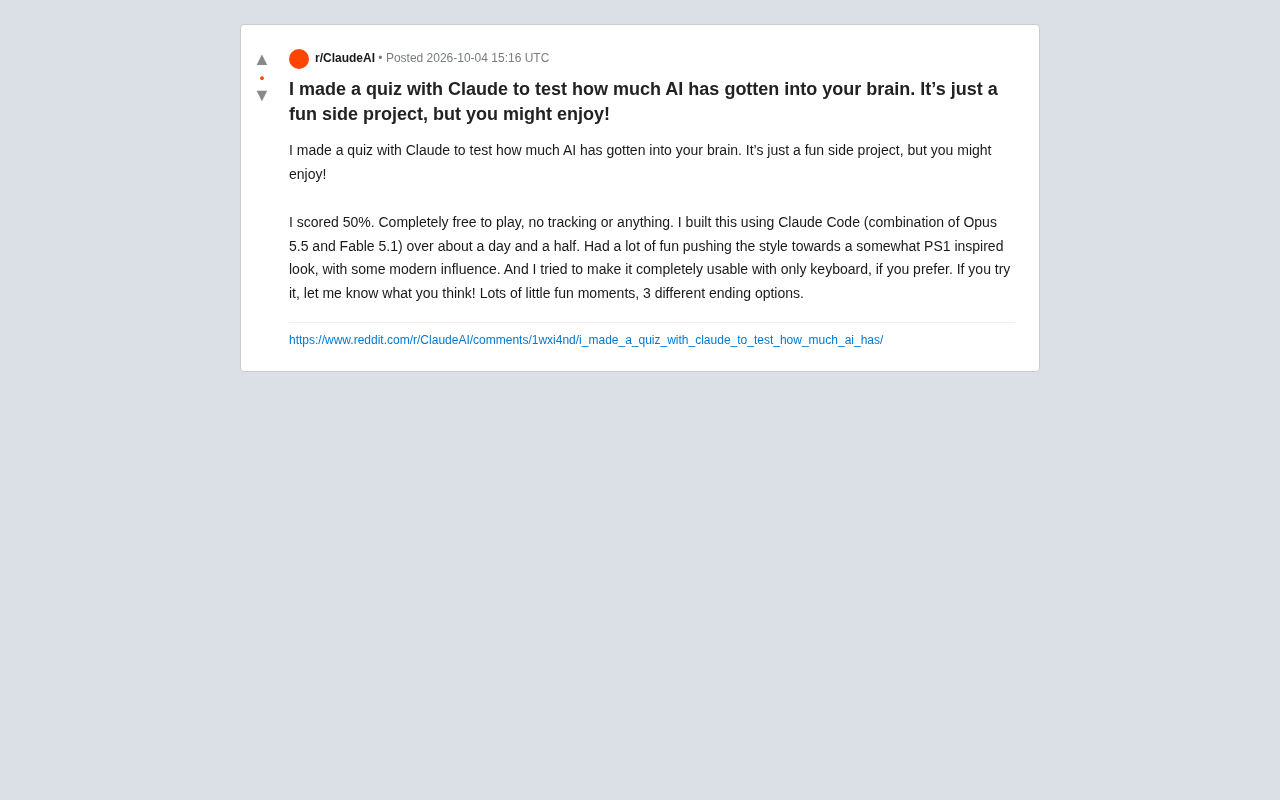
A developer shared on Reddit a small quiz game they built with Claude — the theme being a self-deprecating test of "how deep AI has actually penetrated your brain." The author admitted to scoring only 50 points themselves, and emphasized that this was purely a hobby project: completely free, no tracking, no ads.
Beneath this casual share lies a genuine observation window into the current state of AI-assisted programming. The entire project went from concept to launch in roughly a day and a half, built entirely with Claude Code. That kind of development pace would have been nearly unimaginable a few years ago, yet it's increasingly becoming the norm for indie developers and hobbyists.
The Toolchain: Claude Code and Multi-Model Collaboration
The tech stack the author mentioned is worth examining. They used Claude Code as the primary development environment, combining two models — Opus 5.5 and Fable 5.1. This multi-model approach reflects a broader trend: developers no longer rely on a single model for everything, but instead assign tasks to models best suited for reasoning, code generation, or creative expression.
As a command-line-driven coding assistant, Claude Code's strength lies in its ability to understand a project holistically and execute multi-step tasks autonomously, rather than simply completing individual lines of code. For a small game with multiple ending branches, interactive logic, and a distinct visual style, this kind of end-to-end assistance was the key to finishing in a day and a half.
Claude Code is a command-line interface (CLI) tool from Anthropic that lets developers invoke Claude models directly in the terminal for writing code, debugging, and project management. Unlike common code completion plugins (such as GitHub Copilot), Claude Code can read the context of an entire code repository, understand dependencies between files, and autonomously plan and execute multi-step tasks — such as creating file structures, modifying code across multiple locations, running tests, and iterating based on results. This "agentic" mode of working means developers take on more of the role of requirements provider and reviewer rather than line-by-line code author. The Opus 5.5 and Fable 5.1 models mentioned in the article are different versions within the Claude model family. Opus models generally emphasize strong reasoning capabilities suited for complex logic design, while using different models in combination aims to strike a balance between quality and cost.
Design Details: PS1 Retro Aesthetics and Keyboard Accessibility
What makes this project genuinely interesting isn't the technology itself, but the thoughtful design choices the author made. They deliberately pushed the visual style toward the retro aesthetic of the PS1 era, blended with modern design elements, creating a nostalgic yet contemporary feel.
Also worth highlighting is the accessibility consideration. The author specifically ensured the entire quiz could be completed using only keyboard navigation, accommodating users who can't or prefer not to use a mouse. These kinds of details are often overlooked in hobby projects, but they represent an extra dividend of AI-assisted development — when the time cost of the underlying coding drops dramatically, developers can invest more energy into refining the experience.
The game also includes multiple fun Easter eggs and three different ending branches, giving this "weekend project" a level of polish that exceeds expectations.
PS1 retro aesthetics refers to the deliberate imitation of the visual style from the Sony PlayStation 1 era (1994–2006), characterized by low-resolution pixel fonts, limited color palettes, scanline filter effects, and rough geometric borders. This style has long been popular in the indie developer community because it resonates emotionally with users of a certain generation while being relatively straightforward to implement technically — requiring no complex graphical assets. Keyboard accessibility is one of the core requirements of Web Accessibility (a11y), mandating that all interactive functions in an interface can be navigated via the Tab key and triggered with Enter/Space, serving users with motor disabilities, visually impaired users (in conjunction with screen readers), and power users who prefer keyboard-only operation. The WCAG (Web Content Accessibility Guidelines) lists keyboard operability as a foundational criterion for compliance evaluation.
What This Case Reveals
From an industry observation standpoint, this small project reflects several signals worth paying attention to.
AI has lowered the barrier to bringing creative ideas to life. One person, in their spare time, independently completed the full pipeline — from coding and interaction to visual design. Projects that once required team collaboration or weeks of effort are now being compressed into a day or two.
The theme itself carries a reflective quality. Using AI to build a quiz that tests "how much AI has influenced you" is a self-referential kind of humor that perfectly captures the complex attitude people hold toward AI's growing presence in everyday life — enjoying the capability boost it provides while remaining alert to its influence. The author's own score of 50 points is, in a way, a form of self-mockery.
The value of hobby projects is being reassessed. When development costs are low enough, "just for fun" projects can be created at a remarkably high frequency. These small projects form the most active and authentic layer of the AI application ecosystem — far more reflective of a technology's real-world usability than any big company launch event.
The concept of "Vibe Coding" implicit in this article deserves a standalone explanation. The term was coined by AI researcher Andrej Karpathy in early 2025 to describe a mode of programming that relies heavily on AI-generated code, where developers primarily express their intent through natural language rather than writing code line by line. In Vibe Coding, the developer acts more like a product manager or creative director — responsible for defining requirements, reviewing output, and steering iteration — while leaving the specific implementation details to AI. This approach dramatically lowers the technical barrier to programming, enabling non-professional developers to build fully functional applications, though it also introduces potential risks such as opaque code quality, hard-to-detect security vulnerabilities, and over-reliance on AI output. The case described in this article is a textbook example of Vibe Coding.
Closing Thoughts
This Claude quiz game may not change anyone's life, but it's a vivid footnote: AI-assisted programming has moved from "can it even work" into the phase of "just reach out and use it." For developers curious about trying Vibe Coding, rather than watching from the sidelines, take a page from this author's book — spend a weekend building something you actually want to make. Real learning almost always happens in the doing.
Related articles

Cursor Practical Guide: Core Features of the AI Programming Tool and Development Efficiency Comparison
A deep dive into the Cursor AI programming tool from a Bilibili tutorial: AI-native design, intelligent code generation, context awareness, and efficiency comparisons with VS Code across completion, debugging, and refactoring, plus target user analysis.

Trump's Request to Rename the Atlantic Rejected by Google; 1Password Lets AI Agents Log In Securely
The Vergecast roundup: Trump's request to rename the Atlantic the 'Trump Ocean' was politely declined by Google's CEO; 1Password's new feature lets AI agents log into accounts without touching passwords; OPPO launches the world's first 200-megapixel phone, the Find X10 Pro Max. All three point to the boundaries of tech authorization and trust.

The Truth About American College Party Culture: The Risks Schools Won't Admit
Behind American college party culture, the administration's "don't ask, don't tell" attitude is amplifying freshman risks. This article analyzes how the pandemic strengthened Greek dominance, freshmen's difficulty accessing safety information, and the chain reactions caused by a culture of denial.