Building an AI Robot Dog for Kids: Multi-Model Routing, Content Filtering, and Latency Optimization
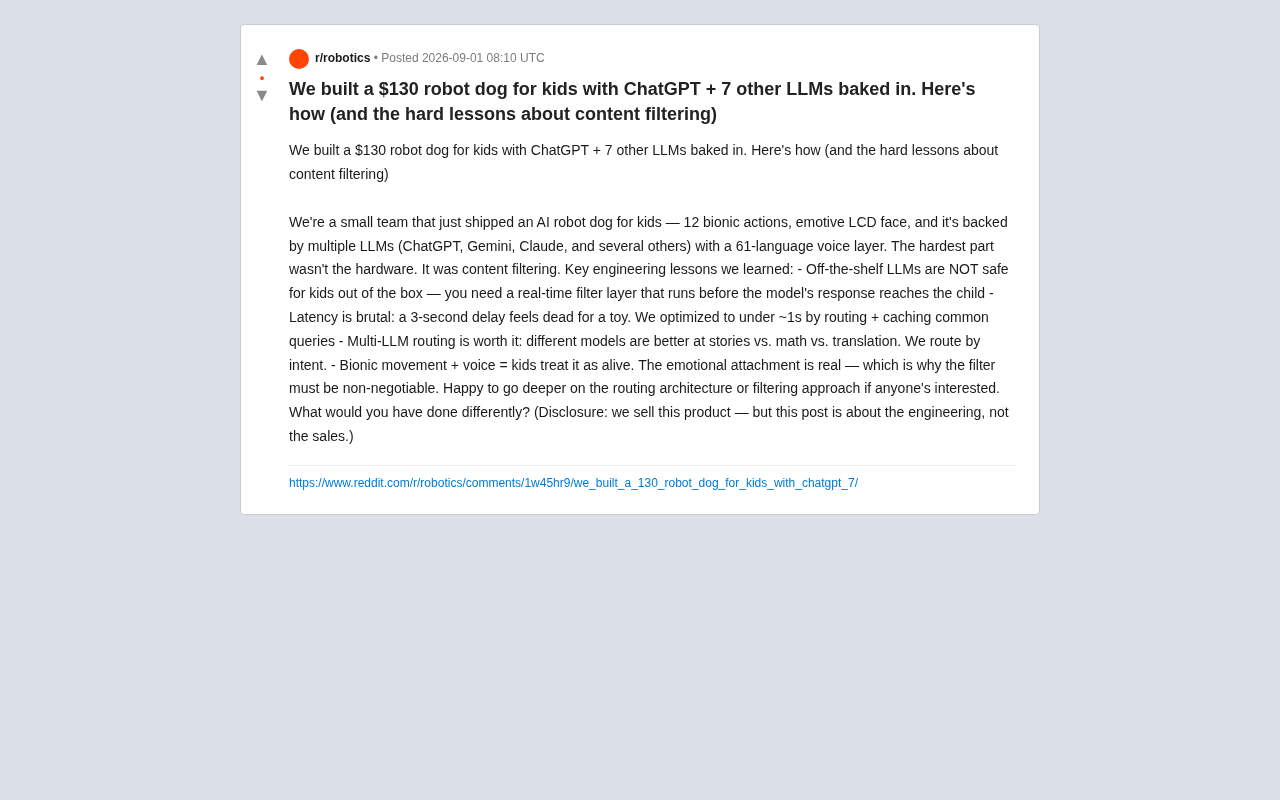
Engineering lessons from a $130 kids' AI robot dog: content filtering, multi-LLM routing, and latency optimization.
A small dev team built a $130 AI robot dog for children, integrating 8 LLMs and 61-language voice interaction. They share hard-won engineering lessons: off-the-shelf LLMs aren't safe for kids and require custom real-time content filtering, 3-second latency kills toy engagement so they optimized to under 1 second via smart routing and semantic caching, and multi-model orchestration by intent balances quality, speed, and cost. They also highlight how emotional attachment amplifies safety risks and why compliance costs like COPPA shouldn't be underestimated.
The Birth of a $130 AI Robot Dog
Recently, a small development team shared their children's AI robot dog product on Reddit, sparking widespread discussion in the engineering community. Priced at just $130, the product features 12 biomimetic movements, an LCD "face" capable of expressing emotions, and under the hood integrates 8 large language models including ChatGPT, Gemini, and Claude, paired with a voice interaction layer supporting 61 languages.
It sounds like a hardware triumph, but the team was candid: "The hardest part was never the hardware — it was content filtering." This statement hits on the core pain point of AI consumer products designed for children — when AI speaks directly to kids, safety is no longer optional; it's a prerequisite for the product's very existence.
Off-the-Shelf LLMs Are Not "Safe Out of the Box" for Children
The most important engineering lesson the team shared: off-the-shelf LLMs are not safe for children. Whether it's ChatGPT or Claude, their native content moderation mechanisms are designed for general-purpose scenarios and cannot directly meet the stringent requirements of children's products.
To understand this, you need to know how current LLM safety mechanisms work. Mainstream LLMs typically use techniques like RLHF (Reinforcement Learning from Human Feedback) and Constitutional AI for "alignment," making model outputs conform to human values. But these alignment strategies are primarily designed for adult users — they'll refuse to generate obviously harmful content (such as violence or pornography), yet lack specialized optimization for the gray-area content that needs filtering in children's contexts. For example, overly complex emotional topics, age-inappropriate scientific explanations, or information that might trigger anxiety — content that's perfectly normal in adult conversations but may be unsuitable for children. Additionally, LLMs carry "jailbreak" risks — safety restrictions can be bypassed through specific prompts, and children driven by curiosity might inadvertently trigger such behavior.
To address this, the team built a real-time content filter layer between the model output and the child. This filter operates independently of the underlying models, intercepting and validating every sentence the model returns to ensure inappropriate content is caught before reaching the child.
From a technical implementation perspective, this kind of real-time filter layer typically comprises multiple components: rule-based filtering using keywords and regular expressions (fastest but most crude), semantic filtering based on classifiers (using specially trained small models to classify output content for toxicity/age-appropriateness), and secondary review by another LLM. In children's products, where latency requirements are extremely tight, this filter layer typically combines lightweight classification models with rule engines rather than making another full LLM call. While off-the-shelf tools like OpenAI's Moderation API and Google's Perspective API exist, they are similarly general-purpose and cannot fully replace custom filtering tailored for children's scenarios.
This design philosophy is worth noting for all AI application developers. Relying on model providers' built-in safety mechanisms is often insufficient — their alignment strategies target the broadest adult user base, while vertical scenarios (especially children's contexts) require developers to take responsibility for the "last mile" of safety. The team specifically emphasized that this filter layer is "non-negotiable."
Emotional Attachment Makes Content Safety Even More Critical
The team observed a fascinating phenomenon: when biomimetic movements are combined with voice interaction, children treat the robot dog as "alive." This emotional attachment is real, and precisely because of it, any inappropriate AI output could have an impact on children far exceeding that of a typical text chatbot. The stronger the emotional connection, the more unyielding the safety baseline must be.
This phenomenon is well-supported by extensive research in Human-Computer Interaction (HCI) and developmental psychology. MIT Media Lab professor Sherry Turkle documented in her book Alone Together how children perceive machines with anthropomorphic features as "living" beings. Research shows that when a machine simultaneously possesses autonomous movement, environmental responsiveness, and human-like emotional expression (such as facial expressions), children's emotional projection is significantly enhanced. This robot dog, with both biomimetic movements and an LCD emotional face, meets all of these conditions. This means that what the robot dog says may carry an "authority" in a child's mind equivalent to or even exceeding that of a friend or pet, amplifying the psychological impact of any inappropriate content manyfold.
Latency Optimization: The Silent Killer of Children's AI Toy Experiences
The second hardcore lesson concerns latency. The team pointed out: "A 3-second delay is death for a toy."
For AI applications used by adults, a few seconds of thinking time is tolerable, but for children expecting instant feedback, any noticeable delay instantly shatters the immersive feeling that "it's alive." The team optimized response latency to approximately under 1 second through two approaches:
- Smart routing: Dispatching requests to the most suitable model based on request type, avoiding all requests going through the slowest path
- Common query caching: Pre-caching results for high-frequency questions to avoid redundant model calls
Smart routing is an increasingly mature pattern in AI application architecture. Its core idea is to use a lightweight intent classifier (typically a small model or rule-based system) to determine the type and complexity of a request before it reaches the LLM, then dispatch it to the most appropriate processing path. For example, a simple "hello" greeting can be handled directly by local rules with no API call needed, while complex story creation requests are routed to models that excel at creative writing. Regarding caching strategy, children's conversations have a notable characteristic — high repetitiveness. Kids ask the same or extremely similar questions over and over. Using semantic caching technology, the system can map semantically similar queries to cached responses rather than relying on simple exact string matching, dramatically improving cache hit rates and significantly reducing API call costs.
This latency optimization approach has reference value for any real-time interactive AI product. Latency isn't just a technical metric — it directly determines the user's emotional experience, especially in scenarios requiring anthropomorphization.
Multi-Model Routing Architecture: Let Specialized Models Handle Specialized Tasks
The most interesting architectural decision in this product was the adoption of multi-LLM routing. The team found that different large language models excel at different tasks:
- Some models are better at storytelling
- Some perform better on math problems
- Others excel at translation tasks
Therefore, they dispatched requests to the most suitable model based on user intent, rather than using a single model for everything.
The Practical Significance of Intent Routing
This "route by intent" approach reflects a maturing industry consensus: no single model is the optimal solution for all tasks. Multi-Model Orchestration is becoming the mainstream architectural paradigm for AI application development, driven by several factors. First, different model providers' products genuinely have differentiated strengths — for example, Claude excels at long-text comprehension and following complex instructions, GPT-4o leads in multimodal tasks, and Gemini has unique advantages in multilingual support. Second, cost differences are enormous — GPT-4-level models can cost dozens of times more per million tokens than lightweight models. The industry has already seen multiple open-source frameworks supporting multi-model routing, such as LiteLLM and OpenRouter, which provide unified API interfaces to connect with different model providers, significantly reducing the engineering cost of implementing multi-model routing.
Through intent recognition combined with model orchestration, products can achieve a better balance among cost, speed, and quality. For a $130 consumer product, this architecture also means stronger models can be called for scenarios requiring high-quality output, while cheaper, faster models handle simple tasks — effectively controlling overall API call costs. For consumer products that primarily profit from hardware margins and need to bear long-term operational costs, this is a matter of survival.
Compliance Challenges: The Hidden Cost You Can't Ignore
Beyond technical-level safety filtering, AI products targeting children face strict legal compliance requirements. In the United States, the Children's Online Privacy Protection Act (COPPA) imposes strict limitations on collecting data from children under 13, including requirements for verifiable parental consent, limits on the scope of data collection, and ensuring data security. In the EU, GDPR has similar or even stricter provisions for children's data protection.
For a children's product integrating multiple LLMs, every API call potentially involves transmitting children's voice data to third-party servers, adding extra complexity at the compliance level. The team needs to ensure that conversation data is not used by model providers for training, that sensitive information is anonymized before transmission, and that data retention policies comply with regional regulations. These compliance costs are often a hidden but non-negligible development burden for children's AI products, and a part that many teams tend to underestimate early in product development.
Practical Takeaways for AI Product Developers
Although this case comes from a single team's self-reported experience (the author also candidly disclosed they are selling this product), the engineering lessons have broad reference value:
- Safety filtering is the core competency of vertical scenarios: Don't expect model providers to solve all safety problems for you. In sensitive domains like children's products and healthcare, building your own filter layer is a necessity.
- Latency equals experience: In anthropomorphized, real-time interactive products, response speed directly determines the product's sense of "being alive."
- Multi-model orchestration beats single-model approaches: Routing requests based on task characteristics is an effective means of improving quality and controlling costs.
- Emotional connection is a double-edged sword: It can generate extremely strong user engagement, but it also amplifies content safety risks.
- Compliance costs must not be underestimated: Children's data protection regulations impose additional constraints on product architecture and data flow design, and these need to be factored in from the earliest stages of product design.
Conclusion
From a $130 robot dog, we can see where the real challenges lie when bringing AI hardware products to market — it's not about how many large models you integrate, but how you make those models serve the most vulnerable user group safely, quickly, and appropriately. As AI enters children's lives in the form of "living things," the weight of responsibility on engineers' shoulders grows accordingly. This is perhaps a question the entire AI consumer product industry needs to take seriously.
Related articles

Enterprise AI Memory Systems: The Real Cost of Bad Retrieval and Incorrect Ingestion
Analyzing the real costs of bad retrieval and incorrect ingestion in enterprise AI memory systems—from token waste to manual correction and user trust loss—with governance advice.

DIY iToF+RGB Rig: First Metric Room Map and Gaussian Splatting
A maker shares progress on a DIY iToF+RGB rig: a 320×240 iToF engineering sample paired with a Raspberry Pi camera yields the first metric room map and Gaussian splatting training. Multi-view voxel voting removes 27,675 floating points, and median edge alignment drops from 2.2px to 1.0px, though issues like dark wall loss remain.

Oura Sues Ultrahuman Again: Smart Ring Patent War Escalates
Oura sues Ultrahuman again, alleging Ring Pro infringes two patents, threatening Ultrahuman's US market return. Analysis of the lawsuit, market impact, and smart ring competition.