Oura Sues Ultrahuman Again: Smart Ring Patent War Escalates

Oura sues Ultrahuman's Ring Pro for patent infringement, threatening its US market return.
Oura has filed another lawsuit against competitor Ultrahuman, alleging its latest product, Ring Pro, infringes two patents. This escalation directly threatens Ultrahuman's planned US market comeback. Competition in the smart ring segment is intensifying, with Oura defending its position through first-mover advantage and patent barriers, while Ultrahuman challenges with differentiated features and pricing. The lawsuit's outcome will shape the US market: if Oura wins, Ultrahuman could face a sales ban or licensing fees; if settled, it must pay a price for market access. The case highlights the importance of IP strategy in technology-intensive categories. Consumers may face fewer choices and higher prices, but in the long run, legal battles could drive original R&D.
Patent Lawsuit Resurfaces: Oura Alleges Ring Pro Infringement
The patent dispute between Oura, the leader in the smart ring market, and its competitor Ultrahuman has escalated once again. According to the latest news, Oura has filed another lawsuit against Ultrahuman, alleging that its latest product, the Ring Pro, infringes two Oura patents. This marks yet another round of legal confrontation between the two companies and directly threatens Ultrahuman's plans to return to the US market.
Oura did not disclose specific patent details in the lawsuit but made clear that the Ring Pro's technical approach falls within the scope of its patent protection. The two parties have a history of multiple patent lawsuits, and this new suit undoubtedly further intensifies their conflict. For Ultrahuman, which is preparing for a US market comeback, this lawsuit poses a substantial obstacle.
In patent infringement litigation, the plaintiff typically must assert that the defendant's product infringes specific claims, which are the core part of a patent document that defines the scope of protection. Oura's decision not to disclose specific patent details may be a strategic choice to avoid revealing the focus of its claims early in the litigation. Smart rings involve multiple categories of technology, including biosensing, optical heart rate monitoring, and battery life management, and patent portfolios often cover hardware structure, algorithms, and interaction design. If Ultrahuman wants to avoid infringement, it would need to conduct a freedom-to-operate (FTO) analysis, but this is costly and the results are uncertain. Such lawsuits often end in settlement or cross-licensing, but the process can last months or even years, significantly disrupting the defendant's market timeline.
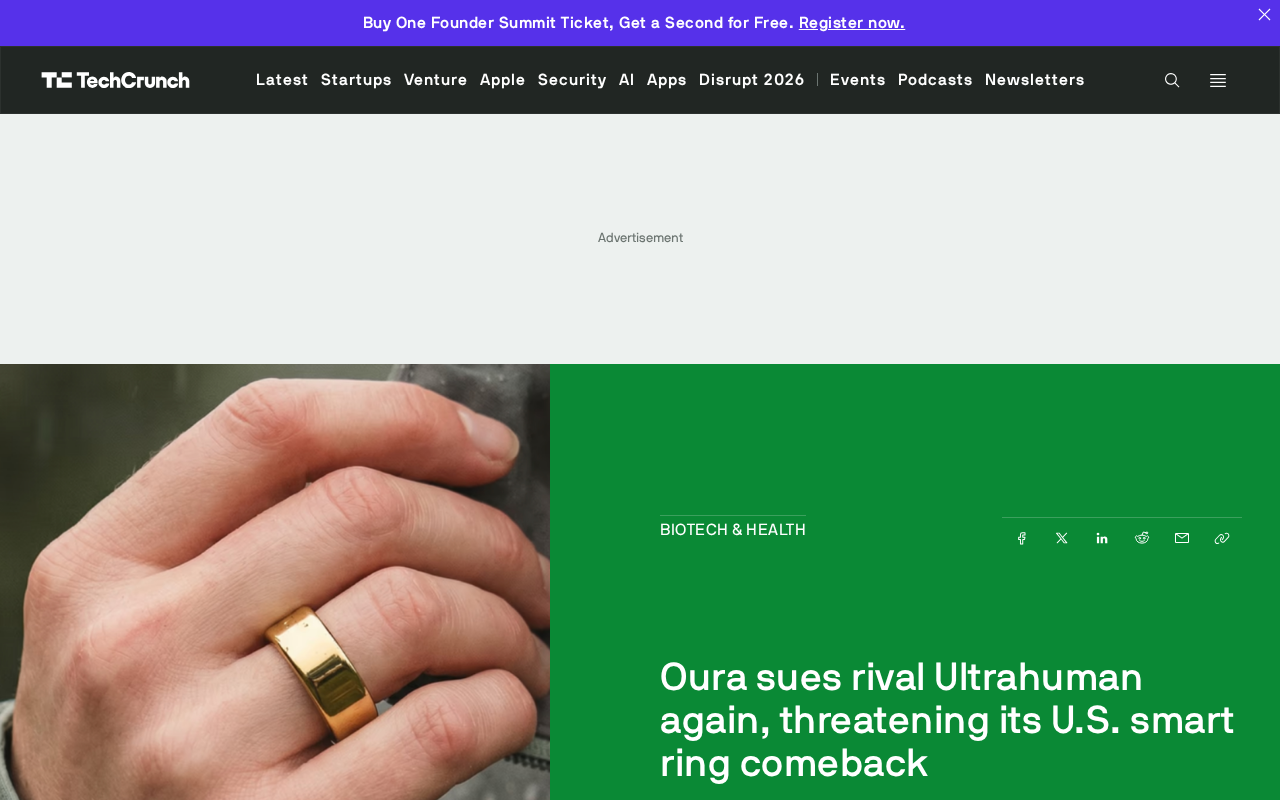
Market Background: Competition in the Smart Ring Segment Intensifies
As a subcategory of wearable devices, smart rings have been gaining popularity in recent years. Oura has secured a major market share thanks to its first-mover advantage, while Ultrahuman has entered the market with richer features and more competitive pricing. Ultrahuman's Ring Pro offers upgrades in health monitoring, battery life, and material design, and is seen as a strong challenger to the Oura Ring.
However, patent barriers have become a threshold that latecomers find hard to circumvent. Oura maintains its technological moat through continuous litigation, and this lawsuit against the Ring Pro is a continuation of that strategy. If Ultrahuman cannot win the lawsuit or reach a settlement, its US market plans may be forced to delay or even stall.
The core technical barriers in smart rings include miniaturized biosensors (such as PPG optical heart rate monitoring), low-power Bluetooth chips, battery life optimization, and health data analysis algorithms. Oura has years of patent accumulation in this field, covering sensor placement in ring form factor, charging solutions, and sleep tracking methods. As a latecomer, Ultrahuman has differentiated itself through feature integration and pricing, but it needs to design around existing patents or seek licensing. The US market has relatively strict regulation of wearable health devices, and products must pass FCC certification and FDA-related compliance requirements. Patent litigation combined with compliance costs further raises the barrier for new entrants. This also explains why patent wars have become an effective means for Oura to curb competition.
Impact and Outlook: Legal Battle May Reshape Market Landscape
The outcome of this lawsuit will directly affect the competitive landscape of the US smart ring market. If Oura wins, Ultrahuman may face a product sales ban or patent licensing fees, which would weaken its price advantage; if the two sides settle, Ultrahuman will need to pay a corresponding price in exchange for market access. Regardless of the outcome, the patent war serves as a reminder to latecomers: in technology-intensive categories, intellectual property strategy is just as important as product innovation.
For consumers, weakened competition could mean fewer choices and higher prices. But from a positive perspective, legal battles will also prompt companies to focus more on original R&D, promoting the long-term healthy development of the industry. Currently, Ultrahuman has not made a public response to the latest lawsuit, and further developments warrant continued attention.
Related articles

Build an AI Super Employee System at Zero Cost: A Full Breakdown of Automated Agent Workflows
A deep breakdown of the AI super employee system demoed on Bilibili: agent orchestration, digital human voiceovers, map and enterprise lead generation, 24/7 customer service, and legal modules. We analyze the business logic and compliance risks behind zero-cost signup to help entrepreneurs judge the real ROI of this AI digital employee system.

The Essential Difference Between Chatbots and AI Agents: Crossing from Conversation to Execution
What's the difference between a chatbot and an AI agent? Based on the MCP series on the Learn Tech channel, this article uses examples like booking flights and summarizing notes to explain: a chatbot only gives answers, while an agent actually completes tasks through a think-act-observe loop. It breaks down the four core components—model, tools, memory, and goal—as well as MCP's role as a bridge, and discusses agents' applicable boundaries and permission risks.

Free GitHub Repo: 342 Hours of AI Courses, from Math to MCP Servers
A free GitHub repo offers 342 hours of AI courses: 523 lessons across 20 phases, from math fundamentals to agent building and MCP servers. Nearly 100,000 learners have started.