Building an AI Sci-Fi Short with LTX + MiniMax H3: Restrained Cinematography in ComfyUI
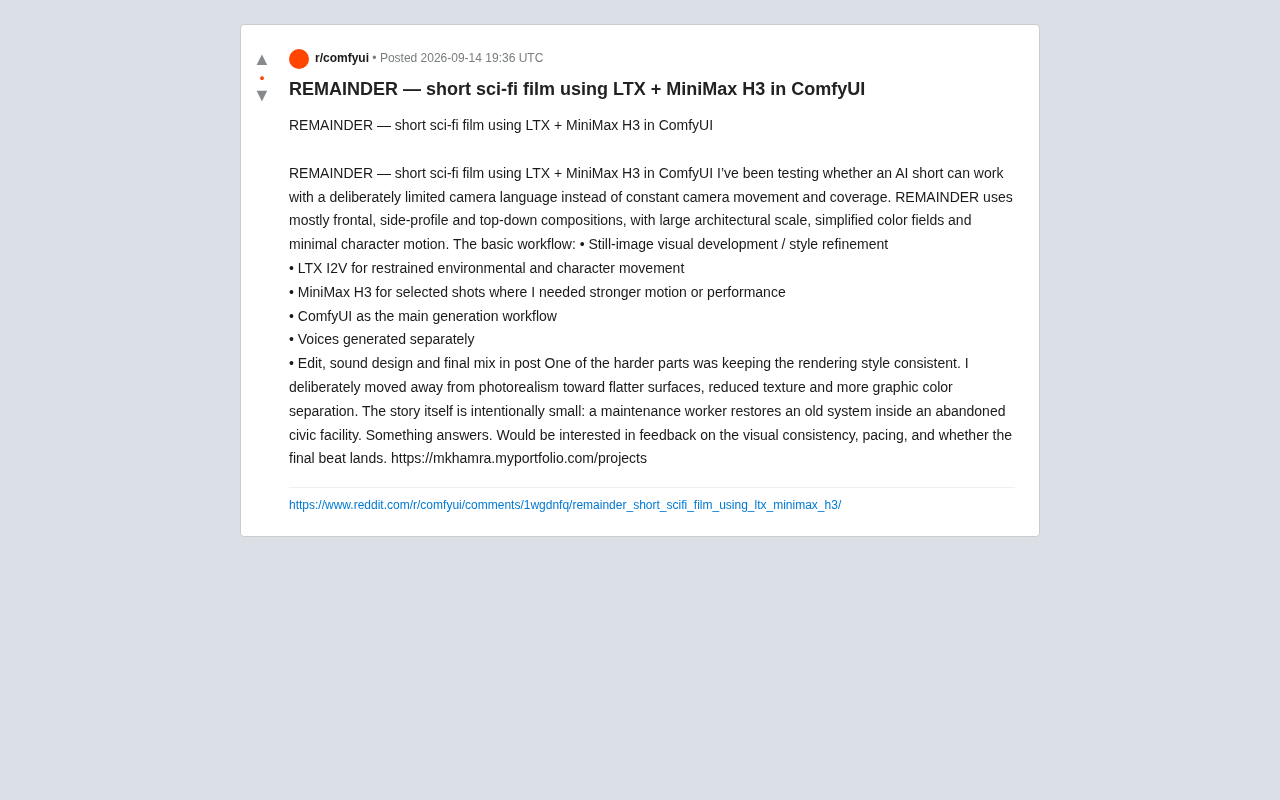
REMAINDER shows how fixed compositions, flat aesthetics, and a multi-model pipeline can drive narrative-first AI filmmaking.
Creator mkhamra's AI sci-fi short REMAINDER takes a counter-intuitive approach, using only frontal, side-profile, and top-down compositions to sidestep temporal inconsistency in AI motion generation. The ComfyUI-based pipeline assigns LTX I2V to low-motion environment shots and MiniMax H3 to high-intensity performance shots, with audio and post handled separately. A flat, graphic aesthetic replaces photorealism to improve cross-shot consistency. The film's real value lies in demonstrating a methodology where creative constraints become a stylistic strength.
A Counter-Intuitive AI Short Film Experiment
Most AI-generated videos chase flashy camera moves and rapid cuts, using constant motion to hide the seams in generative models. Creator mkhamra took the opposite approach with the sci-fi short REMAINDER — deliberately adopting a limited camera language, letting static compositions carry the story.
The film relies almost entirely on three fixed framings: frontal, side-profile, and top-down. These are paired with grand architectural scale, simplified color blocking, and minimal character movement. This kind of restraint is rare in AI video, because continuous motion is the standard workaround for temporal inconsistency, flickering, and morphing artifacts. Giving up camera movement means putting generation quality directly in front of the audience with nowhere to hide.
The story itself is kept deliberately small: a maintenance worker repairs an aging system inside an abandoned municipal facility — and then something responds to him. This understated narrative approach echoes the film's visual minimalism.
Workflow Breakdown: A Multi-Model Generation Pipeline
REMAINDER doesn't rely on a single tool. Instead, it orchestrates multiple models into a clear production pipeline, with ComfyUI as the core generation environment. The overall process breaks down into several key stages:
- Still-frame visual development and style refinement: The art direction and visual tone are locked in at the static image stage, establishing a consistent visual language before any motion generation begins.
- LTX I2V: Used to generate restrained environmental motion and character movement — handling the majority of low-motion shots.
- MiniMax H3: Applied to selected shots requiring stronger motion or character performance, compensating for LTX's limitations in dynamic intensity.
- ComfyUI: Serves as the primary generation workflow, connecting the models above.
- Voice generation handled separately: Audio is produced independently and kept apart from the visual pipeline.
- Post-production integration: Editing, sound design, and final mixing are completed in post.
The thinking behind this combination is instructive — rather than betting on a single "do-everything" model, the pipeline assigns LTX's stable environmental animation and MiniMax H3's stronger motion capabilities to different shots based on what each scene demands. This reflects the current reality of AI video production: no single model can handle every scenario on its own, and the ability to orchestrate tools is itself a form of creative skill.
Visual Consistency: The Hardest Problem to Solve
The creator openly admits that maintaining rendering style consistency was the most difficult part of the entire project. He deliberately moved away from photorealism, opting instead for flatter surface textures, reduced detail, and stronger graphic color separation.
This choice is both an aesthetic decision and an engineering workaround. Photorealistic styles place extreme demands on model consistency — any wavering in skin, materials, or lighting is immediately noticeable. A flat, graphic style is naturally more forgiving of fine detail variation, and the clean separation between color areas makes it easier to maintain visual coherence across shots. In other words, he adopted an aesthetic that plays to AI's strengths, sidestepping the pitfalls that most commonly derail the photorealistic approach.
This strategy of using style design to offset technical limitations offers a useful lesson for AI creators trying to deliver finished work: rather than fighting uphill for photographic realism, choose a visual language that turns your tools' weaknesses into non-issues.
What This Means for AI Filmmaking
The value of REMAINDER isn't in technical showmanship — it's in demonstrating a creative methodology where narrative and aesthetics drive technical choices.
First, there's the discipline of restrained cinematography. When the entire industry is piling on motion for visual impact, deliberately choosing static compositions can forge a distinctive authorial voice while sidestepping AI's weaknesses in motion generation. Second, there's the clear division of labor in the pipeline — stills set the tone, LTX handles environments, MiniMax H3 handles performance, and post-production handles integration, with each stage doing its specific job. Third, style as strategy: proactively choosing a flat aesthetic to buy consistency across shots.
The creator is also actively soliciting feedback, particularly around visual consistency, pacing, and whether the final beat lands. These three points happen to be exactly where AI short films most commonly fall apart: consistency tests the workflow, pacing tests the edit, and emotional payoff tests the creator's overall command of the story — all things a model cannot do for you.
The full film is available on the creator's portfolio page at mkhamra.myportfolio.com/projects. For anyone exploring AI-driven visual storytelling, this is a valuable case study in how to trade limitation for texture.
Related articles
Building a Privacy-First TV Box: Escape Smart TV Data Surveillance
Smart TVs are a hidden privacy risk. Compare Apple TV, Raspberry Pi LineageOS, LibreELEC, and flashed Android boxes to build a privacy-first TV setup for Jellyfin and YouTube.
Volvo XC60 and XC90 PHEV Upgrades Push Electric Range Close to Full EV Levels
Volvo unveils upgraded PHEV versions of the XC60 and XC90, targeting electric-only range well beyond the industry average of 30–50 miles to redefine what plug-in hybrids can offer.

LangChain Deep Agents vs. MDA: Clearing Up the Confusion for Developers
What's the difference between LangChain's Deep Agents and MDA (Managed Deep Agents)? We break down create_deep_agent vs. define_deep_agent and help developers choose.