Building an App from Scratch with AI: 3 Billion Tokens to Launch a Voice-Prompted Teleprompter on the App Store

Zyta used AI to build and ship a voice-following teleprompter app on the App Store — burning 3 billion tokens along the way.
Bilibili creator Zyta, with no prior coding experience, used AI-assisted programming tools to independently develop Properto1 — a voice-following teleprompter that scrolls text at your speaking pace — and successfully launched it on the App Store. The development consumed roughly 3 billion tokens, ran the AI for over 20 hours, and required more than 100 iterations, revealing the real debugging costs behind AI development's so-called "low barrier." Zyta plans to publicly share download numbers, retention, and user feedback, offering a rare first-hand case study for the indie AI development community.
From Zero to First App
Just a few months ago, he couldn't write a single line of code. Now his first app has passed Apple's review and officially launched on the App Store. Bilibili creator Zyta used his own journey to demonstrate how AI-assisted programming (Vibe Coding) is lowering the barrier to independent app development.
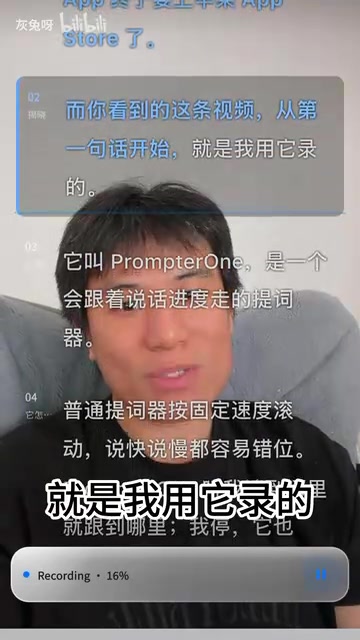
The app is called Properto1 — a teleprompter that "follows along as you speak." Zyta noted in his video that the entire introduction was recorded using Properto1 itself, from the very first word. It's both a demo and a statement of confidence.
What Pain Point Does It Solve?
Traditional teleprompters scroll at a fixed speed — once set, the user has to keep pace with the machine. Read too fast and the text falls behind; read too slow and you get left in the dust. Any slight slip breaks your rhythm and disrupts the recording.
Properto1's core differentiator is voice-following: the text tracks wherever you are in your speech. Pause, and it pauses with you. This "you speak, it follows" interaction gives control back to the user — a genuinely practical improvement for anyone who regularly records voiceovers, tutorials, or presentations. From a product positioning standpoint, it targets a clear, high-frequency real-world need.
The AI Development Cost: 3 Billion Tokens and 100+ Versions
The making of this app tells us a lot about the real state of AI-assisted development today. According to data Zyta shared publicly in his video, the entire app consumed roughly 3 billion tokens, with the AI running continuously for over 20 hours, across more than 100 iterated versions.

Those numbers carry two meanings. On one hand, they confirm that AI can genuinely help a complete beginner turn an idea into a shippable product. On the other hand, 3 billion tokens and 100+ versions make it clear that "no-code" doesn't mean "zero cost" or "one-click generation." The real work was in relentless debugging — especially the gap between simulator and physical device. Zyta openly admitted to hitting countless "real-device pitfalls," requiring round after round of fixes, testing, and resubmission. This grinding process is exactly what tends to be most underestimated in AI-assisted development.
Tokens are the basic unit of measurement for how large language models process text — roughly 1–2 tokens per English word, and similarly 1–2 tokens per Chinese character. 3 billion tokens is a staggering amount. Based on typical AI coding tool pricing, the API costs for this volume could run anywhere from hundreds to thousands of dollars, depending on the model and provider. This illustrates that the "low barrier" of AI-assisted development primarily refers to technical knowledge requirements — not financial cost. For developers looking to replicate this approach, planning your token budget in advance and choosing the right pricing plan (e.g., a subscription rather than pay-per-use) is a critical step in keeping costs manageable.
The Moment It Went Live: Approved
For independent developers, waiting for an App Store review decision is often the most nerve-wracking moment. Zyta mentioned that only after seeing Approved in the email did it feel real. He then went into App Store Connect and clicked "Release This Version" to officially push the app to market.

From "knowing nothing" to "shipping a first app" — the journey took several months. For anyone looking to get started, this milestone is itself instructive: AI tools have lowered the bar, but App Store guidelines, device compatibility, and submission workflows remain mandatory hurdles you can't skip.
Apple's App Store review process is a significant challenge for independent developers. After submission, you typically wait 1–3 business days for a result. Reviewers assess whether the app's description accurately reflects its functionality, whether privacy permissions are properly declared, whether the UI conforms to Apple's Human Interface Guidelines (HIG), and whether there are crashes or obvious bugs. A rejection means you must address the specific issues and resubmit — a back-and-forth that can eat up weeks. For first-time submitters, App Store Connect's interface, certificate configuration (Provisioning Profiles), and the TestFlight real-device testing workflow are all things you need to get familiar with beforehand — none of which any AI tool can fully handle for you yet.
Committing to Transparency with Real Data
More than just "I built it," Zyta intends to make the journey going forward fully transparent. He's committed to publicly sharing real download numbers, usage data, and user feedback to see just how far this product can go.

This "open data" approach is especially valuable for anyone following AI development and indie app publishing. Most content about AI-built apps stops at the "look, I made it" demo stage. Cases that actually track downloads, retention, and user feedback over time are rare. If Zyta follows through, this will be an unusually valuable first-hand reference.
What This Means for AI Coding Enthusiasts
The signal from this case is clear: with AI assistance, the path from idea to App Store launch is getting significantly shorter. But it also comes with a few important reminders:
- Whether a product succeeds still depends on whether it solves a real problem — not how cutting-edge the technology is.
- AI-generated code is just the starting point; debugging, device compatibility, and compliance review still demand real effort.
- Publishing real data is the only true test of a product's staying power.
If you're interested in AI or Vibe Coding, it's worth following real "zero to launch" journeys like this one. They're far more grounded than any tutorial, capturing both the creative process and the pitfalls along the way.
Related articles

Workbuddy for Absolute Beginners: How a Desktop AI Agent Fits Into Real Workflows
A beginner's guide to the Workbuddy desktop AI agent: installation, claiming credits, file management, and building automated workflows—compared with CodeX for fit and cost, helping professionals shift from AI question-askers to AI managers.

OpenAI's New Agent Stack: Computer Use, Decisions API, and Ultra-Fast Workflows
OpenAI Dev Day unveiled a new agent stack: Computer Use outperforms humans, Decisions API delivers ultra-low-latency classification via Luna, Agents API opens the same Computer Use capabilities, and GPT-6.1 Sol costs only one-seventh of Astra. Core updates, benchmark data, and developer insights.

Liang Wenfeng Open-Sources DeepInfo Inference Framework, Takes On U.S. Ban
DeepSeek open-sources its DeepInfo inference framework after its models, featuring GPU/CPU cross-pipelining, small-model prediction with large-model verification, and full Huawei Ascend and NVIDIA chip support—facing the U.S. federal ban head-on. This article analyzes its significance for AI deployment and open-source strategy.