Building an Unattended YouTube Automation Workflow with n8n

n8n chains AI scripting, voiceover, video rendering, and publishing into a fully automated YouTube channel.
This article details a creator's fully automated YouTube content pipeline built with n8n: a scheduled trigger fires at 6 AM daily, calling OpenAI to generate structured scripts, a TTS node to synthesize voiceover, a video node to assemble footage and subtitles, and a YouTube upload node to publish — all logged to Google Sheets. The author claims per-video costs drop from $75 (manual) to roughly $38, saving over $2,200/month. The article validates the technical demo while flagging real limitations: the $38 figure may exclude setup and maintenance costs, bulk AI content risks homogeneity and platform compliance issues, and topic strategy and quality control still require human judgment.
One Workflow, Running an Entire Channel
No one on camera, no one sitting at an editing desk — yet a YouTube channel can consistently publish videos every single day. That's exactly what one creator achieved by building an automated workflow in n8n. The core logic is straightforward: use automation tools to chain together script writing, voiceover, video rendering, and publishing — tasks that normally require human effort — into a single pipeline that runs without any manual intervention.
This approach, often called "faceless YouTube automation," isn't a new concept, but tools like n8n have dramatically lowered the barrier to entry. It reflects a notable trend: content production is shifting from "labor-intensive" to "process-orchestrated."
n8n is an open-source workflow automation tool that lets users connect different services and APIs through a visual, node-based drag-and-drop interface — no heavy coding required. It's comparable to Zapier or Make (formerly Integromat), but its self-hosting capability gives it an edge in data privacy and cost control. Each "node" represents a single operation unit — calling an API, transforming data, sending a request, or evaluating a condition — and nodes are linked by data flows to form a complete automation pipeline. For developers or technically-inclined creators, n8n offers deeper customization than purely no-code tools, while sparing you the infrastructure work of building everything from scratch.
Workflow Breakdown: From Scheduled Trigger to Auto-Publish
The entire process kicks off with a Scheduled Trigger. As configured by the author, the workflow automatically wakes up at 6:00 AM every day, and production of a new video begins immediately.
Next comes the script generation step. An OpenAI node writes the complete script, structured into three sections: a Hook, a Story, and a Call to Action. This kind of structured script framework is a standard formula for short-form video content — hand it off to a large language model to fill in, and you get both efficiency and a solid narrative flow.
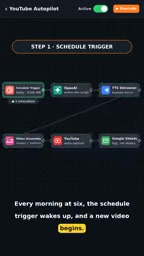
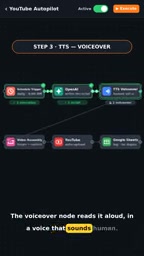
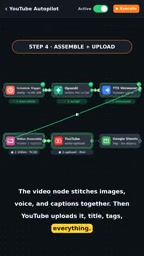
Once the script is ready, a Voiceover Node converts the text into human-sounding speech. A Video Node then assembles the images, audio, and subtitles into a finished video.
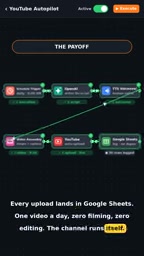
Finally, a YouTube upload node handles publishing automatically — filling in metadata like the title and tags. Every upload is logged to Google Sheets for tracking and review.
TTS (Text-to-Speech) services are a critical piece of workflows like this. In recent years, services like ElevenLabs, OpenAI TTS, and Microsoft Azure Neural Voice have used deep learning to dramatically improve the naturalness of synthesized speech — matching human podcast delivery in tone, pacing, and emotional expression. A voiceover node typically calls these services via API, converting the script text in segments into audio files that are passed along to the video rendering node. Different TTS services vary considerably in voice selection, multilingual support, and per-character pricing, so the choice of service directly affects both audio quality and overall cost.
The Cost Math: $38 vs. $2,250
The headline selling point the author makes is a cost comparison. At manual production rates, one video costs approximately $75 — meaning 30 videos a month runs $2,250. This workflow produces the same output for around $38, saving roughly $2,212 per month.
This comparison is striking, but deserves a more measured read. The $38 figure likely covers only direct variable costs — API calls for OpenAI, voice synthesis, and video rendering — and doesn't account for n8n hosting fees, the time invested in building and debugging the workflow, or ongoing maintenance. For anyone building this from scratch, the hidden time cost of getting from "it runs" to "it runs reliably" is often significant.
The Value and Limits of This Approach
From a technical standpoint, the value of this case study is that it clearly demonstrates how to use n8n to orchestrate multiple AI services into an end-to-end content pipeline. Each node has a single, well-defined responsibility and is interchangeable — you can swap in a different TTS service, switch the script model, or plug in a different video rendering tool. That modularity is exactly what makes workflow automation so compelling.
That said, the claim that "the channel runs itself" deserves some qualification. Automation solves the "production" problem, but it doesn't solve "quality" or "compliance." Scripts generated at scale tend to be homogeneous and lack distinctive perspective. Platforms also have moderation and throttling mechanisms for low-quality, bulk-uploaded AI content. What actually drives sustainable value — topic strategy, audience positioning, and content differentiation — still requires human judgment.
In other words, this kind of workflow is better thought of as an "accelerator" for content production rather than a fully hands-off "money printer." It frees creators from repetitive, mechanical work, but redirecting that energy toward topic selection, quality control, and distribution strategy is what makes automation like this actually work in the long run.
YouTube's stance on large-scale AI-generated content continues to evolve. Since 2023, YouTube has required creators to disclose when videos contain AI-generated realistic content, particularly in sensitive areas like news and politics. Beyond disclosure, the platform's algorithm uses signals like watch time, click-through rate, and engagement to assess content quality — videos produced in bulk without differentiation often struggle to earn recommendation traffic and may face distribution restrictions. So even when the automation pipeline runs flawlessly on a technical level, whether content can survive and grow within the platform's ecosystem still comes down to whether topics resonate with audiences and whether the content offers genuine unique value — the core judgment calls that algorithms and automation tools cannot yet replace.
Summary
This n8n unattended YouTube workflow is an inspiring example of automation: scheduled trigger, AI-written scripts, AI voiceover, automated rendering, auto-publishing, and data logging — all in one seamless flow. It demonstrates the productivity potential that emerges when low-code orchestration tools meet generative AI. For anyone interested in content automation, it offers a clear and reusable blueprint. But while embracing the efficiency gains, it's equally important to stay clear-eyed about cost accounting and the real limits of content quality.
Related articles

No Code Required: Using AI to Plan Production-Grade Application Architecture
No code, no problem: how to use AI to plan production-grade application architecture — database modeling, agent endpoint design, chat storage, and layered memory.

AI Writes Code, Will Programmers Lose Their Jobs? The Truth About Devin's Autonomous Programming
Devin and other autonomous AI coding agents are changing software development: from Copilot-assisted coding to fully automated engineering agents, the programmer's role shifts from writing code to system design and oversight. This article analyzes the impact of AI programming on employment, code security, and junior developer training, as well as the real direction of programmer demand under the efficiency paradox.

Citigroup's 14,000 Engineers Use Devin, Slashing Tech Outsourcing Bill by 30%
Citigroup's 14,000 engineers used AI coding agent Devin to cut its tech vendor bill by 30% and speed releases 30-40%, while JPMorgan says AI gains aren't in earnings yet.