Building Automotive Crash AI Surrogate Models with NVIDIA PhysicsNeMo
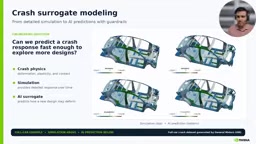
PhysicsNeMo uses four notebooks to train crash simulation data into a Transolver surrogate model and deploy it as an inference service via NIM.
The article introduces the practical path of the NVIDIA PhysicsNeMo framework in automotive crash analysis: using existing high-fidelity finite element simulation data to train a surrogate model, approximating a physics solve that originally takes hours with second-level AI inference. The workflow is split into four Jupyter Notebooks: data preparation and physical-domain parameterization of geometry, surrogate model training based on Transolver (a GNN architecture), model export and packaging into an inference microservice via NVIDIA NIM, and comparative validation of inference results against simulation ground truth. The article emphasizes that geometry must be partitioned by physical meaning rather than simply cut into grid blocks, and that datasets should be split by operating condition groups to ensure valid generalization evaluation. It also notes that the demo is based on simplified parameterized components, and cross-condition generalization capability still needs to be validated by implementers themselves.
From Crash Simulation to AI Surrogate Models: A Practical PhysicsNeMo Path
Automotive crash analysis has long relied on high-fidelity finite element simulation, with a single solve often taking hours. In an official video, NVIDIA demonstrates an alternative path: using the PhysicsNeMo framework to train existing crash simulation data into a surrogate model, letting AI approximate the otherwise expensive physics solve in seconds. The video's author is an AI Physics Solution Architect, and the content is built around a complete four-notebook workflow.
The core logic of this path is not complicated—first use traditional simulation to generate a dataset, then use a neural network to learn the mapping from "geometry input to physical response," and finally package the trained model into an interactive inference service. What is really worth paying attention to is the engineering detail: how geometry is parameterized, how the dataset is split, how the model is exported, and how NVIDIA NIM turns the model into an API.
Geometry Parameterization: Turning Crash Structures into Learnable Inputs
The video first addresses the "model representation" problem. The object of crash analysis is a specific body structural component, and for a neural network to understand it, the geometry must first be converted into tensors. The demo uses a parameterized crash component—from the screenshot, you can see that the workflow partitions the geometry and divides it into physical domains, mapping different regions into input features the network can process.
The difficulty in this step is maintaining physical consistency. Once the geometry is split, the relationships between regions must not be lost; otherwise, the surrogate model only learns surface shape rather than structural mechanical behavior. The video emphasizes that the geometry must be divided "in a physical sense," rather than simply cut into grid blocks—which also explains why the entire process must define physical domains before discussing training.
Dataset Splitting and Training Configuration
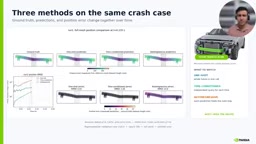
Moving into the training stage, the video shows the dataset splitting strategy. The original simulation data is divided into a training set and a validation set, and the screenshot shows the role assignment corresponding to different data blocks—some data blocks are used for training, while others are reserved for evaluating the model's generalization ability.

Here there is an engineering judgment that is easy to overlook: dataset splitting is not random division, but grouping by physical scenario, ensuring that the validation set covers operating conditions unseen during training. The video mentions the need to split data "deliberately" so that the model can still give reasonable predictions outside the training distribution. The training objective is to compare the error between the surrogate model output and the simulation ground truth, using an error plot to intuitively judge under which geometries or operating conditions the model has larger deviations.
Multi-Notebook Workflow: Breaking Down Four Steps from Data to Inference Service
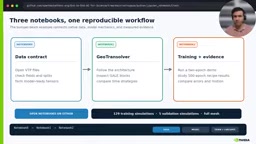
The video splits the entire process into multiple Jupyter Notebooks, each with a clear responsibility, forming a reproducible pipeline.
Notebook 0: Data Preparation and Geometry Sampling
The first notebook is responsible for loading the crash simulation dataset, completing geometry parameterization, and configuring the PhysicsNeMo crash analysis recipe. The video mentions that this step needs to introduce the necessary physical components (such as boundary condition definitions related to crash), preparing uniformly formatted data for subsequent training.
Notebook 1: Surrogate Model Training
The second notebook performs training. The model architecture chosen is a Transolver-type architecture based on graph neural networks (GNN)—the video repeatedly mentions "Transolver" and "transolver strategy," indicating that this type of geometry-oriented operator learning method is the default choice for this recipe. The training process periodically outputs error metrics for judging convergence.
Transolver is a geometry-oriented operator learning architecture whose core idea is to introduce a physics-aware tokenization strategy on top of the Transformer attention mechanism: the input geometry is discretized into several spatial regions (slices), the points within each slice are aggregated into one token, and then the global interactions between slices are learned through attention. Compared with traditional graph neural networks with point-by-point message passing, Transolver can more efficiently capture long-range dependencies on large-scale geometries while remaining robust to mesh resolution. In crash simulation scenarios, this means the model can learn the propagation paths of stress waves through the body structure, rather than being limited to local neighborhood feature aggregation. PhysicsNeMo uses it as the default backbone for the crash analysis recipe precisely because of its balance between expressiveness on complex geometries and computational efficiency.
Notebook 2: Model Export and NIM Packaging
The third notebook exports the trained weights and packages them into an inference microservice through NVIDIA NIM. This step is the value exit of the entire chain: the model is no longer an object in an experimental script, but a service callable through an API, allowing engineering teams to embed crash prediction capabilities into their own design workflows.
NVIDIA NIM (NVIDIA Inference Microservice) is a toolchain for quickly packaging trained models into standardized inference services. It is based on a containerized runtime, has built-in optimized inference engines for different model architectures (such as TensorRT and Triton Inference Server), and exposes a unified REST/gRPC API interface. For physical surrogate models, the value of NIM lies in shielding deployment details: developers do not need to manually write server-side code or tune batching strategies; they only need to provide model weights and input/output specifications to obtain a horizontally scalable inference endpoint. This allows crash prediction capabilities to be integrated into design toolchains like ordinary web services, lowering the barrier for AI models to enter engineering workflows.
Notebook 3: Inference and Result Comparison
The final notebook demonstrates calling the packaged model and comparing AI prediction results side by side with simulation ground truth. The video shows the spatial distribution of prediction error, used to evaluate the credibility of the surrogate model on specific components.
Who This Path Is For, and Where Its Boundaries Lie
From the demo, the PhysicsNeMo crash analysis recipe compresses what originally required a large amount of handwritten code—training a surrogate model—into configuration plus a small amount of customization. For automakers or component suppliers that already have accumulated simulation data, this means they can quickly validate the feasibility of surrogate models on specific components.
But the boundaries of the demo need to be noted: the geometry in the video is a simplified parameterized component, not a complete body-in-white; the error comparison is also concentrated on a single operating condition. Real crash analysis involves complex factors such as material nonlinearity, contact, and large deformation, and whether the surrogate model can cover these scenarios depends on the coverage of the training data. The video itself does not provide quantitative conclusions about cross-condition generalization, so implementers need to validate it themselves.
Another signal worth noting is the introduction of NIM. Turning physical surrogate models into standard inference services means AI crash prediction may enter the daily design iteration process, rather than remaining a one-off experiment in the research stage. This has direct significance for shortening development cycles, but only on the premise that model accuracy has been fully validated.
Overall, this video provides an actionable engineering blueprint: simulation data → geometry parameterization → Transolver training → NIM deployment → comparative validation. Its value lies not in some astonishing metric, but in pulling physical AI from concept down to the level of a concrete workflow.
Related articles
Cerebras CS-4 Stuns with Launch: The 4-Trillion-Transistor Wafer Monster That Crushes GPUs in Inference Speed
Cerebras CS-4 wafer-scale engine launched: 4 trillion transistors, 900,000 AI cores, inference an order of magnitude faster than GPUs. Modular power rack plus compute backpack design, 3D vertical stacking, and half-millimeter power delivery—online in minutes.

Apple's M6 Chip Lands in iMac: A Week in Review of Performance Upgrades and AI Controversy
Apple launches new iMac and MacBook Pro with M6 chip, N1 wireless chip brings speed gains; OpenAI claims three major discoveries but faces academic skepticism; data centers become a U.S. midterm election issue; Anduril teams up with Qualcomm for all-American laptops.

AI Cracks the Quasi-Riemann Hypothesis? A Mathematician's Account of a Stunning Moment
Number theorist Alex recounts on Lex Fridman's podcast the shocking experience of AI proving the quasi-Riemann hypothesis, plus Fermat's Last Theorem formalization and Navier-Stokes within a month, explaining the signal-processing intuition behind the Riemann hypothesis and the boundaries of AI breakthroughs in mathematics.