Building Autonomous Data Agents: Real-Time Data Integrity Repair at Scale
A guide to designing autonomous data agents that detect and repair data integrity issues in real-time at scale.
As data throughput scales up, traditional manual review and batch validation can no longer keep pace with real-time data integrity demands. Autonomous data agents address this through layered detection (schema validation, business rules, statistical/ML methods) and tiered remediation — directly correcting deterministic errors while isolating uncertain cases to a Dead Letter Queue. Production deployment also requires horizontal scalability, idempotent processing, canary release management for rule updates, and robust observability to build team trust.
Introduction: Why Data Integrity Becomes a Scalability Challenge
In data-driven business systems, real-time data integrity has long been one of the most difficult challenges for engineering teams. As data streams grow from thousands of records per second to millions, traditional batch validation and manual review mechanisms often fall short. A developer shared their experience on Reddit about building a large-scale Autonomous Data Agent to repair real-time data integrity issues at scale, sparking a lively community discussion.
Unfortunately, the original post only provided high-level information without specific technical implementation details. Based on this topic, this article attempts to outline the core questions and design considerations worth exploring when building such systems, as a reference for engineering teams with similar needs.
What Is an Autonomous Data Agent
An Autonomous Data Agent is a software system capable of automatically monitoring, diagnosing, and repairing data quality issues with minimal human intervention. Unlike traditional data validation scripts, it typically has the following characteristics:
- Always-on: Runs as a persistent service that listens to data streams in real time, rather than processing data on a scheduled batch basis
- Autonomous decision-making: Determines whether data is anomalous based on predefined rules or learned patterns
- Automatic remediation: Upon detecting an issue, attempts to complete, correct, or isolate the anomalous data
These agents typically combine rule engines with machine learning models, enabling them to handle both known deterministic errors and suspicious data that deviates from historical distributions.
Typical Challenges in Real-Time Data Integrity
In large-scale real-time scenarios, data integrity issues usually stem from several sources. Format changes or missing fields from upstream data sources can trigger cascading errors downstream. Network jitter or duplicate message delivery from message queues leads to duplicated or lost data. Timing inconsistencies between multiple systems can break referential integrity.
As system throughput climbs, the absolute number of these problems grows proportionally. Even if the error rate remains at a very low percentage, the cumulative number of anomalous records per day can reach a significant volume. This is precisely where automated agents outperform manual intervention — they can respond at the same speed as the data stream itself.
Design Approaches and Key Considerations
Layered Detection Mechanisms
A robust data agent typically employs a multi-layered detection strategy. The bottom layer is Schema Validation, ensuring field types and structure conform to the agreed-upon contract. The middle layer handles business rule validation, checking value ranges, enum values, and cross-field constraints. The top layer can introduce statistical or machine learning methods to identify anomalies that deviate from normal distributions.
Trade-offs in Remediation Strategy
Automatic remediation must be designed with care. For deterministic errors (such as format normalization), direct automated correction is appropriate. For uncertain situations, the safer approach is to isolate suspicious data into a Dead Letter Queue and await further processing, rather than making hasty modifications. Incorrect automatic remediation can sometimes be more harmful than taking no action at all.
A Dead Letter Queue (DLQ) is a special queue in a message queuing system designed to store messages that cannot be processed normally. When a message fails due to formatting errors, business rule violations, or exceeding the retry limit, the system routes it to the DLQ rather than discarding it or blocking the main pipeline. In the context of a data agent, the DLQ serves as a "staging area for suspicious data," keeping the main data pipeline flowing while preserving a complete record of problematic data for manual review or subsequent automated strategies. Common DLQ implementations include dedicated Topics in Apache Kafka, Dead Letter Queue configurations in AWS SQS, and Dead Letter Exchanges in RabbitMQ. When designing a DLQ, pay attention to message retention duration, alert thresholds, and replay mechanisms to ensure that data entering the DLQ is eventually addressed rather than accumulating indefinitely.
Observability and Auditing
Any autonomous system requires comprehensive logging and auditing capabilities. Every detection decision and remediation action should be recorded for post-hoc tracing and continuous rule optimization. This is also the foundation for evaluating agent effectiveness and building team trust.
Considerations for Production Deployment at Scale
To keep a data agent running reliably in high-throughput environments, performance and fault tolerance are unavoidable concerns. The agent itself should be horizontally scalable to avoid becoming a bottleneck in the data pipeline. It also needs idempotent processing logic to ensure that retries or failure recovery don't introduce new data issues.
Additionally, the agent's rules and models need to evolve alongside the business, which requires teams to establish a configuration management and canary release process to prevent rule changes from triggering widespread false positives.
Idempotency refers to the property whereby executing the same operation once or multiple times produces the same result. In distributed data pipelines, network failures or consumer crashes often lead to duplicate message delivery. If the processing logic is not idempotent, duplicate consumption will introduce duplicate records or compounding errors. Common techniques for achieving idempotency include: assigning a globally unique ID to each message and deduplicating before processing, leveraging database
INSERT OR IGNORE/UPSERTsemantics, and using distributed locks or idempotency keys to prevent concurrent write conflicts. Horizontal scaling and idempotency design often need to be considered together — when multiple agent instances consume the same data stream in parallel, the deduplication logic itself must be thread-safe and consistent across instances, typically maintained using external state storage like Redis to track already-processed messages.
Conclusion
Autonomous data agents represent one direction in the evolution of data engineering toward automation and intelligence. They are not meant to fully replace human involvement, but rather to free engineers from repetitive data cleaning work so they can focus on higher-value rule design and system optimization.
It's worth noting that the original source material for this article was limited, providing only a topical direction without specific technical implementation details. If the original author could supplement with architecture diagrams, technology stack choices, and real-world performance data, it would greatly help the community explore the replicability of this practice in greater depth.
Related articles
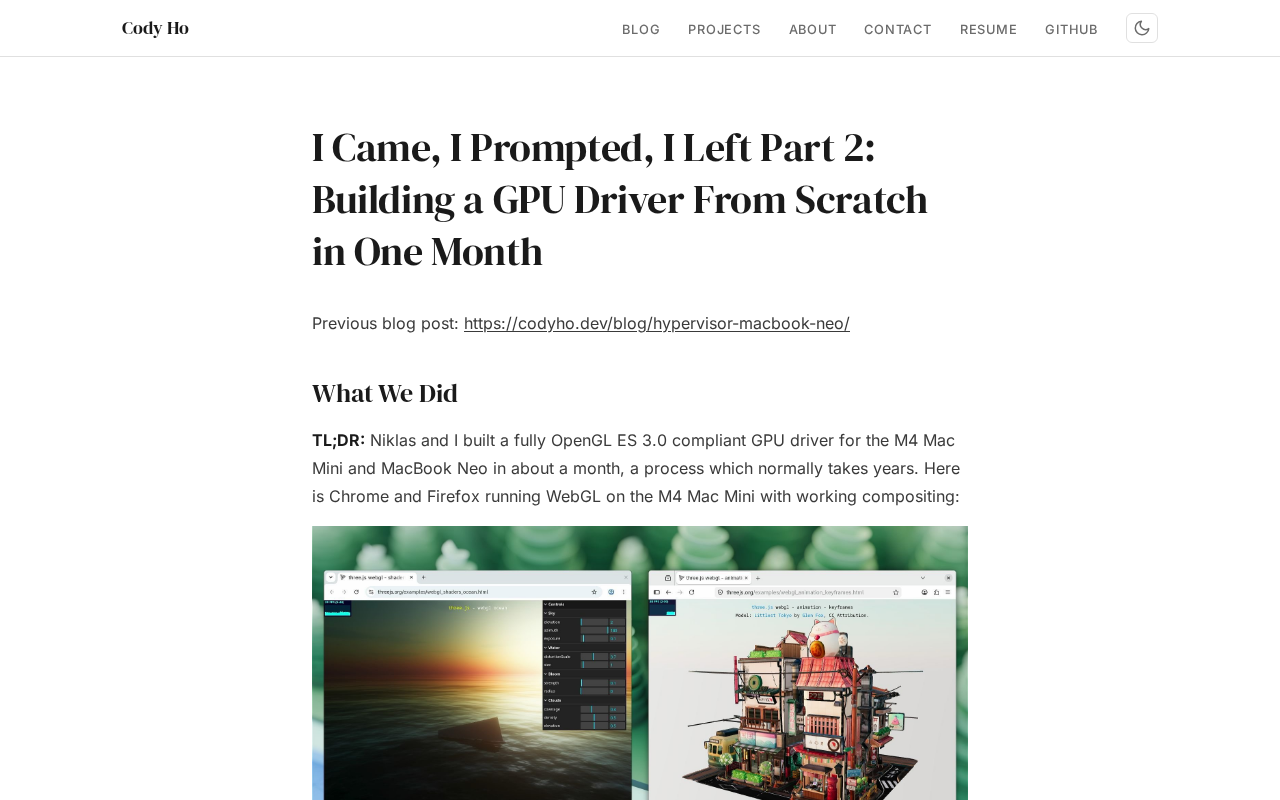
The Technical Challenges of Developing a Linux GPU Driver for the M4 Mac Mini in One Month
Developer Cody Ho built a Linux GPU driver for the M4 Mac Mini in one month. We break down the core challenges of reverse engineering Apple Silicon's closed GPU architecture.
SEO Page Builder Enhanced: Breaking Free from Generic AI-Generated SEO Content
An open-source enhanced SEO content tool that adds editorial review, firsthand experience, fact-checking, and writing-style guardrails to combat generic AI content.

Hierarchical RAG Architecture Research: How Independent Developers Can Break Into Academic Research
An indie developer on Reddit seeks IR professor guidance for hierarchical RAG research. This article explores the technical background and practical advice for independent AI researchers facing academic barriers.