Building Enterprise-Grade AI Agents from Scratch: A Structured Learning Path Breakdown

A four-stage structured course breaking down AI Agent development from principles to job readiness.
This article reviews a structured AI Agent course designed to address the fragmented nature of most Agent tutorials. The course spans four modules: Fundamentals (Agent principles, prompt engineering, workflow design), Advanced (CRAG, multi-agent collaboration, tool calling), Hands-On Projects (knowledge base assistant, customer service agent, office automation), and Career Prep (job market landscape, resume tips, interview questions). The article also cautions learners to look past marketing language — real capability comes from hands-on practice, with a focus on principles and engineering thinking over framework-specific API details.
AI Agents are rapidly becoming the dominant form of large language model applications in the real world. But for developers looking to get started, online tutorials tend to be scattered and unsystematic — leaving learners still unable to independently build a working agent after finishing them. A course published by a Bilibili creator attempts to address this pain point through a structured four-stage learning path. This article breaks down the course's content to outline a relatively complete Agent learning and hands-on roadmap for developers.
Why Most Agent Tutorials Leave You Still Stuck
Before creating this course, the author reviewed a large number of Bilibili Agent tutorials from the past month — ranging from viral videos with millions of views to obscure niche content. The conclusion: most content is fragmented and unsystematic, leaving viewers unable to independently build an agent after watching.

This observation hits on a widespread problem in AI education. Agent development spans a broad range of knowledge — from foundational LLM calls and prompt engineering, to workflow orchestration, knowledge base retrieval, multi-agent collaboration, and production deployment. Explaining any single piece in isolation makes it hard for learners to develop a complete skillset. Quick-tip videos can answer "how do I write this feature," but they can't answer "how do I build a complete agent system from the ground up."
An effective learning path needs to connect these scattered pieces in a logical progression from beginner to advanced, and translate that knowledge into transferable hands-on experience through real projects. This is why structured courses offer more value than one-off tutorials.
Four Modules: A Complete Loop from Fundamentals to Employment
This course is divided into four modules — Fundamentals, Advanced, Hands-On Projects, and Career Prep — forming a clear progressive learning chain.
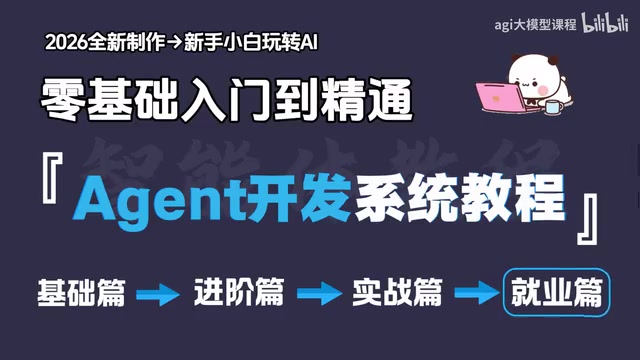
The Fundamentals module focuses on Agent principles, prompt engineering, and workflow design to help beginners get up to speed quickly. The core of this stage is understanding what an Agent actually is — not just a simple wrapper around an LLM, but a closed-loop system capable of perceiving, planning, calling tools, and executing tasks. Prompt engineering is the foundational capability that drives system behavior, while workflow design determines how tasks get decomposed and orchestrated.
The Advanced module moves into the architecture layer, covering CRAG (Corrective Retrieval-Augmented Generation), knowledge bases, agent architectures, multi-agent collaboration, and tool calling — with hands-on development using mainstream frameworks. This stage marks the dividing line between "getting a demo to run" and "knowing how to design a scalable system." Multi-agent collaboration and tool calling are core capabilities of enterprise-grade agents, determining whether an agent can handle complex, real-world business scenarios.
What is CRAG? CRAG (Corrective Retrieval-Augmented Generation) is an improved version of the standard RAG pipeline. Traditional RAG vectorizes a user's question, retrieves relevant chunks from a knowledge base, and feeds those chunks into the prompt for the model to answer. But when retrieval quality is poor or results aren't relevant enough, the model often produces incorrect or hallucinated responses. CRAG adds an "evaluate and correct" step: the system scores retrieved documents for relevance, and if quality falls below a threshold, it triggers a fallback strategy — such as rewriting the query, expanding the search scope, or even turning to web search — before feeding the corrected context to the model. This self-correction mechanism significantly improves accuracy on knowledge-intensive QA tasks and is a key step toward building reliable enterprise-grade RAG systems.
Hands-On Projects: Turning Knowledge into Capability
The Hands-On Projects module is the most valuable part of the course. The author walks learners step by step through building projects including a personal knowledge base assistant, an intelligent customer service agent, and an automated office assistant.
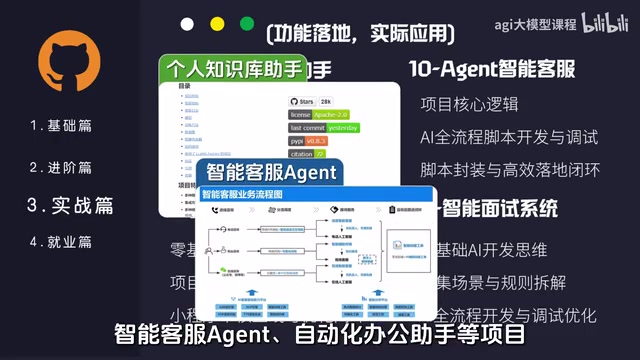
The choice of projects is deliberate. The personal knowledge base assistant applies RAG and retrieval skills in an integrated way; the intelligent customer service agent tests multi-turn conversation management and tool calling; the automated office assistant aligns closely with real enterprise needs around cost reduction and efficiency. Together, these three projects cover the most typical real-world Agent deployment scenarios, allowing learners to progressively convert theoretical knowledge from earlier stages into genuine engineering experience.
For developers trying to break into this field, having a few complete, demonstrable projects in a portfolio is often more compelling than being able to name a long list of concepts.
What is RAG? RAG (Retrieval-Augmented Generation) is the most common knowledge integration approach in AI Agents today. The basic idea: external documents (such as PDFs, web pages, or database records) are split into small chunks, converted into vectors using an embedding model, and stored in a vector database. When a user asks a question, the system simultaneously vectorizes the query, retrieves the most semantically similar text chunks from the vector database, and injects those chunks as context into the prompt — allowing the LLM to generate answers grounded in real source material. RAG's core value lies in breaking through the LLM's knowledge cutoff date, enabling the model to reference real-time or private data while significantly reducing hallucination risk. A personal knowledge base assistant is the classic entry-level RAG project, covering the full engineering pipeline: document parsing, chunking strategies, vector retrieval, and result ranking.
Career Focus: From Learning to Landing an Offer
The fourth module is aimed directly at employment — mapping out the Agent development job landscape and hiring standards, guiding learners on how to polish their resume and portfolio, and diving deep into frequently asked interview questions.
This "learn → build → job-ready" loop reflects how AI Agent development is gradually shifting from a research buzzword into a real employment direction. Companies have genuine demand for engineers who can independently build intelligent agent systems, and this type of talent remains relatively scarce.
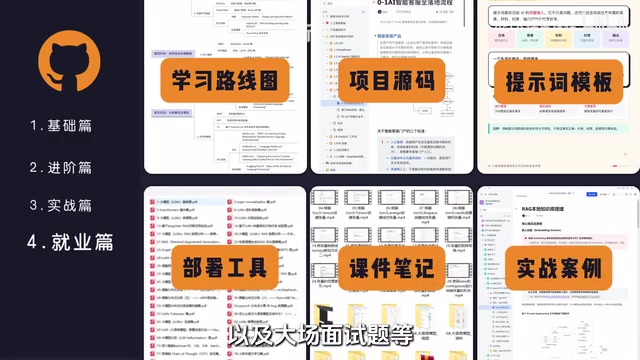
The author has also compiled supplementary resources including a complete learning roadmap, project source code, prompt templates, deployment tools, lecture notes, practical case studies, and interview questions. The completeness of supplementary materials is often a good indicator of whether a course is truly "systematic."
A Few Suggestions for Learners
A well-structured course is just the starting point. Agent development is a fast-moving field — mainstream frameworks, model capabilities, and best practices are all constantly evolving. When studying, it's worth keeping your focus on understanding principles and developing an engineering mindset rather than memorizing the API details of specific frameworks. Frameworks iterate, but a solid understanding of Agent system design can be reused long-term.
Also, marketing phrases like "skip 99% of the wrong turns" or "every second is packed with value" are standard content promotion language — actual learning outcomes still depend on how much hands-on practice you put in. No course, however good, can replace the experience of building, debugging, and hitting roadblocks yourself. For developers who genuinely want to go deep in the Agent space, finishing a structured course is just the beginning — staying engaged with open-source communities and frontier research papers is equally important.
Related articles

JobRunner MCP Server: AI Agents Can Now Fix Failed Java Jobs
JobRunner launches an open-source MCP server enabling AI agents to view cluster status, diagnose failures, and recover Java jobs—incident response from any cloud coding environment or existing agent.

MLAI Digital Launches 9 Security Agents: MCP Server Safeguards the Full Lifecycle of Agentic AI
MLAI Digital launches Security MCP Server with nine built-in specialized security agents covering vulnerability discovery, attack simulation, prompt injection detection, API and infrastructure assessment, and accelerated remediation—embedding security validation across the full Agentic AI lifecycle from development to production.

Running Isaac Lab on H100 GPUs: Exploring Better Approaches
Exploring optimization methods for running Isaac Lab on NVIDIA H100 GPUs, including MIG configuration, mixed precision, TensorRT acceleration, and community experience to improve robotics simulation and reinforcement learning efficiency.