Building Internal Tools with Replit Saves Finance Team 150 Hours a Year

A finance employee built a tool with Replit, saving 150 hours a year and showing how citizen developers reshape business efficiency.
The article tells the story of Clarisse, a finance team employee who used the online programming environment Replit to independently build a customized tool, saving her team 150 hours a year. This case shows that low-code/no-code platforms are lowering the barrier to software development, enabling business people to move from software users to creators. By building her own tool, Clarisse not only improved efficiency but also changed how she collaborates with her team and stakeholders, achieving a self-driving work model. The article further analyzes the advantages of low-code tools in business understanding, iteration speed, and cost, while noting that professional developers remain irreplaceable in complex systems. Finally, it suggests that enterprises cultivate a citizen developer culture by choosing low-barrier platforms, establishing security boundaries, and sharing success stories, thereby unleashing frontline employee creativity and driving overall organizational efficiency.
Starting from Business Pain Points: Non-Technical Employees Can Build Their Own Tools
Clarisse is a member of a finance team who noticed that her team repeatedly got stuck in inefficient manual processes in their daily work. Rather than waiting for IT scheduling, she chose to build a customized tool herself using Replit. That decision ultimately saved the finance team 150 hours in a single year—equivalent to nearly 20 full working days.
Replit is a browser-based online programming environment that supports multiple programming languages and integrates AI-assisted coding capabilities. Its low barrier to entry allows business people without deep programming backgrounds to get started quickly and turn ideas into runnable tools. Clarisse's case is a microcosm of this trend: business people are no longer just users of software—they are beginning to become creators as well.
A Citizen Developer refers to business personnel who use low-code/no-code platforms or easy-to-adopt development tools to independently build applications or automation tools outside the formal support of the IT department. They typically do not have professional programming backgrounds, but they deeply understand business processes and pain points. Gartner once predicted that by 2023, the number of applications created by citizen developers would be more than four times that of professional developers. The core value of the citizen developer movement lies in unleashing the creativity of frontline employees, shortening the cycle from requirement to delivery, and at the same time allowing IT teams to focus on more complex, higher-value system building.


The Value Behind 150 Hours: More Than Just Time Savings
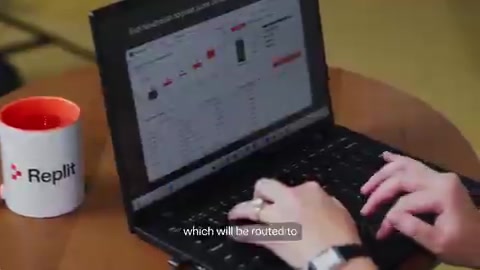
150 hours is impressive in itself, but Clarisse's gains go far beyond that. By building her own tool, she redefined how she collaborates with her team and stakeholders. Processes that originally required cross-department coordination and waiting for development resources became a closed loop she could control independently.
This "self-driving" work model allows business people to quickly validate ideas and iterate on tools without being constrained by external resources. The shift from operational challenge to opportunity hinges on a mindset: when encountering repetitive, inefficient problems, first ask "Can I solve this myself?"
How Low-Code/No-Code Tools Are Reshaping Business Teams
Platforms like Replit are lowering the barrier to software development. In the past, after business teams raised requirements, they had to go through lengthy requirement reviews, development scheduling, and testing before launch; now, frontline staff familiar with the business can directly build prototypes and put them into use quickly.
The advantages of this model are:
- Deeper business understanding: Tools are built by the people who best understand the pain points, resulting in a higher degree of requirement fit.
- Faster iteration: No cross-team communication is needed, and modifications can be made instantly.
- Lower cost: Formal development resource investment is avoided, making it suitable for solving long-tail, fragmented needs.
Of course, this does not mean the role of professional developers is replaced. For complex systems and scenarios with high security and compliance requirements, professional engineering teams are still needed. But a large number of internal small tools and automation script needs can be fully handled by business people themselves.
Low-code/no-code platforms greatly lower the technical barrier to application development through visual drag-and-drop interfaces, prebuilt components, and templates. Low-code platforms usually allow developers to extend functionality with a small amount of code, making them suitable for users with some technical foundation; no-code platforms rely entirely on graphical configuration and are aimed at purely business users. These platforms are particularly suitable for building internal tools, automated workflows, data collection forms, and simple reports and other long-tail needs. Their limitation is insufficient capability when handling complex business logic, high-performance scenarios, or high security and compliance requirements, so enterprises need to clearly define the boundaries of applicability.
Implications for Enterprises: Cultivating "Citizen Developers"
The lesson of Clarisse's story for enterprises is that they should encourage and empower frontline employees to become "citizen developers." Providing the right tools and a certain level of training support can unleash tremendous creativity in business teams.
Enterprises can start from the following aspects:
- Choose low-barrier platforms: Such as Replit and other online development environments that support AI assistance, reducing the difficulty of getting started.
- Establish security boundaries: Clarify which types of tools can be built independently and which require IT review, avoiding data and security risks.
- Share success stories: Cases like Clarisse's can be spread internally to inspire more employees to try.
When business people shift from "waiting for tools" to "creating tools," organizational efficiency gains will no longer depend solely on the IT department's capacity, but will come from every person who discovers a problem.
Related articles
 Tech Frontiers
Gemini Omni 1.2 Flash: AI Video Moves Toward Draft-Style Editing
Google's Gemini Omni 1.2 Flash update enables conversational, draft-style editing of the same video—swap scenes while keeping products, adjust lighting while keeping characters. Clips up to 15s, 720p costs 30% less than the previous Flash—ideal for e-commerce ads, previs, and short-asset production.

Codex Tutorial: One-Command Install and Run Your First Task
Codex tutorial: one-command install and run your first task. Covers the four Codex forms, sandbox and approval guardrails, AGENTS.md and MCP configs, cloud network policy, and the iron rule of human review—everything you need to get started with this autonomous coding agent.
 Tech Frontiers
Localix: An Open-Source Agentic Development Environment with Multi-Model and Local AI Integration
Localix is an MIT open-source Agentic Development Environment (ADE) supporting seamless Claude Code plugin loading, multi-model cloud and local execution, Mini Apps extensions, and agent context management—an open AI collaboration workbench for developers.