Building Magic: The Gathering in C# and WinForms: A Counterintuitive Technology Choice Explained

Exploring why C# and WinForms is a surprisingly pragmatic choice for building a Magic: The Gathering rules engine.
This article examines the counterintuitive decision to build Magic: The Gathering using C# and WinForms. It explores how WinForms' low development barrier enables rapid prototyping, how the .NET ecosystem supports complex rules engine development, and why the event-driven model naturally fits card game mechanics like the stack and triggered abilities. The piece highlights the architectural value of separating game logic from UI for future portability.
A Seemingly Outdated Technology Choice
In an era overflowing with web frontend frameworks and cross-platform solutions, choosing C# paired with WinForms to build a card game seems like a highly counterintuitive decision at first glance. This is exactly the core question explored in the first installment of the open-source project series Coding Magic the Gathering in C# — why recreate Magic: The Gathering on WinForms?
Magic: The Gathering was designed by mathematician Richard Garfield in 1993 and published by Wizards of the Coast. It is the world's first trading card game (TCG). To date, Magic has released over 27,000 unique cards covering hundreds of mechanical keywords. In 2019, an academic paper by Alex Churchill et al. even proved from a computational complexity theory perspective that Magic: The Gathering is Turing complete — meaning its rule system is capable of simulating any computational process. This makes it one of the most complex non-electronic games ever created, with a rule system of unparalleled intricacy in gaming history.
Fully implementing such a system in code is, in itself, an enormous test of a developer's architectural capabilities. Choosing WinForms — a desktop UI framework that many consider "outdated" — adds even more value to the technical discussion surrounding this challenge.
Why Choose WinForms for a Card Game?
Rapid Prototyping and Low Development Barrier
WinForms (Windows Forms) is a desktop application development framework that Microsoft released in 2002 alongside .NET Framework 1.0. Built on Windows' GDI+ graphics subsystem, it uses an event-driven programming model and provides a rich library of visual controls. Although Microsoft subsequently released more modern UI frameworks such as WPF (2006), UWP (2015), and MAUI (2022), WinForms remains widely used due to its simplicity and stability. Notably, Microsoft open-sourced WinForms in 2018 and ported it to .NET Core (now .NET 5+), giving it cross-generational longevity.
WinForms' greatest advantage lies in its extremely low development barrier and extremely high iteration speed. For a project whose core goal is "implementing game logic," the UI layer should not become a bottleneck that slows down progress. WinForms provides a mature visual designer that allows developers to quickly build interfaces through drag-and-drop, freeing them to focus their energy on the truly complex rules engine.
For a card game, the interface doesn't need flashy 3D effects or complex animation systems. Cards are essentially rectangular controls with text, images, and state — WinForms' basic controls like PictureBox and Panel are more than adequate. This pragmatic "good enough" attitude is precisely what enables many solo developer projects to sustain momentum.
Backed by the Mature .NET Ecosystem
Choosing WinForms doesn't mean giving up a modern development experience. It runs on the .NET platform and can fully leverage C#'s powerful features. LINQ (Language Integrated Query) allows developers to query and filter collections of game objects with declarative syntax — for example, "find all green creatures on the battlefield with power greater than 3" can be accomplished in a single chained expression. The async/await asynchronous programming model can elegantly handle scenarios where the game waits for player input without blocking the UI thread. Generics and interfaces provide a type-safe abstraction layer for building an extensible card ability system. Additionally, C#'s delegate and event system is naturally suited for implementing the observer pattern — exactly the core design pattern needed for card trigger effects (such as "whenever X happens").
This layered approach actually reflects solid architectural thinking: encapsulating complex game rules in a core engine independent of the UI, with WinForms serving merely as a replaceable presentation layer. Specifically, this follows classic MVC or the more modern Clean Architecture principles — the game engine exists as an independent Class Library project that doesn't reference any UI-related namespaces, communicating through clearly defined interfaces. The WinForms project is solely responsible for rendering the engine's exposed state into a visual interface and translating user actions into commands the engine can understand. This Dependency Inversion design means that even if the frontend were to migrate to WPF, Avalonia UI, MAUI, or even Unity in the future, the core logic could be fully reused without modifying any game logic code.
Technical Challenges of the Magic: The Gathering Rules Engine
Complexity of the Rules System
The real difficulty of Magic: The Gathering lies not in the visuals, but in the rules. The game has tens of thousands of different cards, each potentially possessing unique abilities, trigger conditions, and interactions. Chain reactions between cards, the priority system, and the stack mechanism — these are all "deep waters" when it comes to programming implementation.
The stack is one of the most core rule mechanisms in Magic: The Gathering. It is essentially a last-in, first-out (LIFO) data structure, completely isomorphic to the stack structure in computer science. When a player casts a spell or activates an ability, the effect doesn't resolve immediately — instead, it's placed on the stack. Opponents then have the opportunity to respond (also placed on the stack). When all players choose not to respond further, effects on the stack resolve one by one from the top — the last effect added resolves first. In a programming implementation, this requires a recursive resolution system that supports pause-and-resume, while also handling edge cases where an effect on the stack fizzles because its target has become invalid.
For example, when a card's effect says "whenever another creature dies," the system needs a comprehensive event listening and triggering mechanism. When multiple triggered effects meet their conditions simultaneously, their order of entry onto the stack must be handled correctly. This kind of rule-driven system design is a core problem that any developer attempting to recreate Magic: The Gathering cannot avoid.
State Management and Game Loop Design
Another technical challenge of card games is state management. Every object in the game — players, libraries, hands, the battlefield, graveyards — has constantly changing state. The "game loop" of a turn-based game needs to clearly delineate each phase (draw, main, combat, end) and correctly respond to player actions and rule triggers during each phase.
When implemented with WinForms, the event-driven programming model naturally aligns with the interaction logic of a card game. Event-Driven Programming is a programming paradigm where program execution flow is determined by external events. In WinForms, virtually all user interactions are handled through Events and Event Handlers. This model is highly consistent with how Magic: The Gathering works — trigger conditions like "when a creature enters the battlefield" and "when a player gains life" are essentially event subscriptions. Developers can use C#'s event keyword and delegate mechanism to map triggered effects in game rules to event listeners at the code level, achieving a nearly one-to-one correspondence between rule descriptions and code implementation. A player clicks a card, an event fires, the system updates the game state and refreshes the interface — this pattern is clear and intuitive for turn-based games.
The Learning Value of This Open-Source Project
For developers looking to learn game development or C#, the value of this tutorial series doesn't lie in whether it can ultimately produce a commercially shippable product. Rather, it demonstrates how to build a complex system from scratch. From architectural design and rules engines to state management and UI interaction, it covers many core concepts in software engineering.
There are no absolutely right or wrong technology choices — only whether they're appropriate for the current goal. This project uses an "unfashionable" tech stack to tackle an "extremely complex" domain problem, serving as a reminder that tools exist to serve objectives. Rather than agonizing over whether a technology is new enough, it's better to focus your attention on what truly creates value — actually bringing your ideas to life.
As the first part of the series, this article primarily answers the question of "why." Subsequent installments will dive deeper into specific architectural design and code implementation, making this practice-oriented open-source tutorial well worth following.
Related articles

The Complete Codex Guide: A Hands-On Manual from Basics to Advanced
A complete guide to the new Codex: project folders, office file processing, multi-agent collaboration, image annotation, agents.md, Skills, automation workflows, and advanced AI programming features.
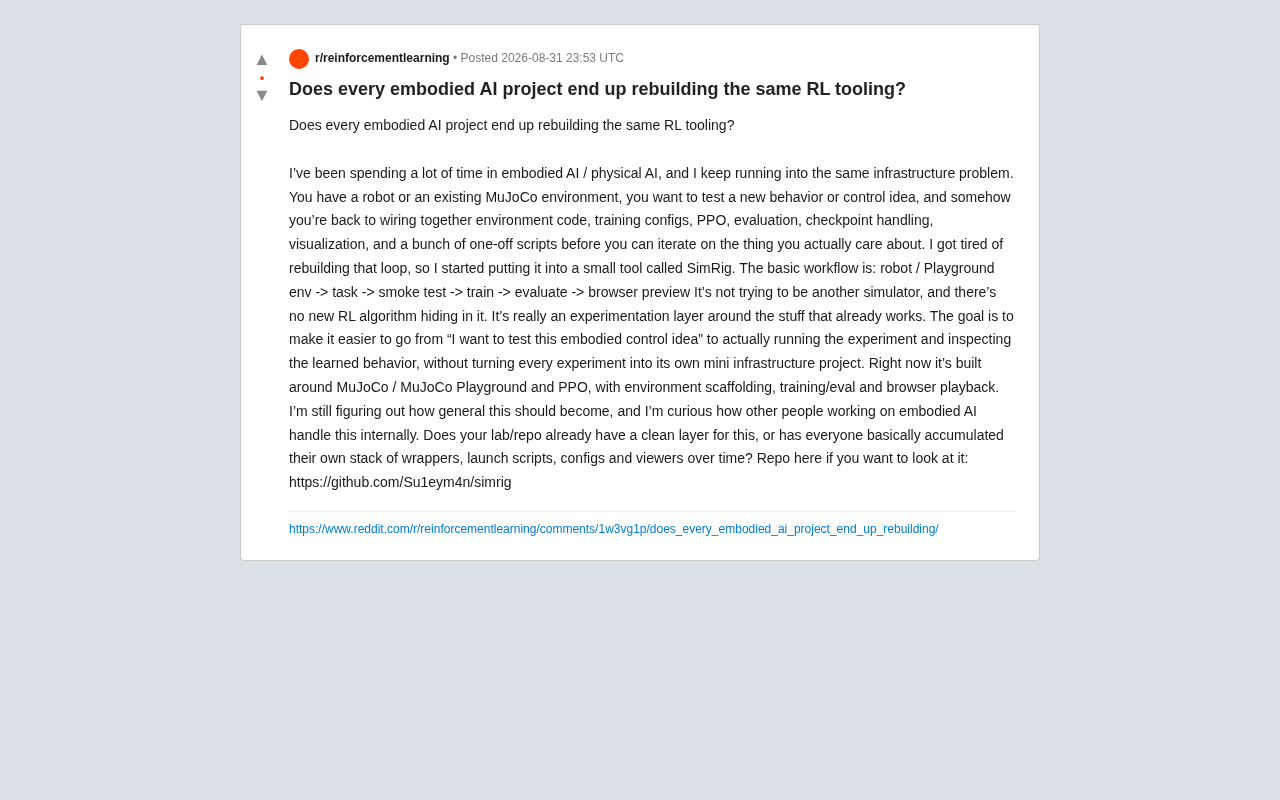
SimRig: Building a Unified Experimentation Layer for Embodied AI — Stop Reinventing the Wheel
SimRig builds a lightweight experimentation layer on MuJoCo and PPO, offering standardized workflows from environment setup to browser preview, cutting engineering friction for Embodied AI research.

AI Security 101: A Complete Guide from Prompt Injection to Agent-Based Attack and Defense
A systematic guide to AI security fundamentals covering LLM principles, prompt injection attacks, AI code auditing, CTF applications, and Agent attack-defense evolution.