Building Production-Grade Projects with AI from Scratch: A Deep Dive into One Practical Course

An AI-driven full-stack course bridging the gap from demo to production-grade, deployable projects.
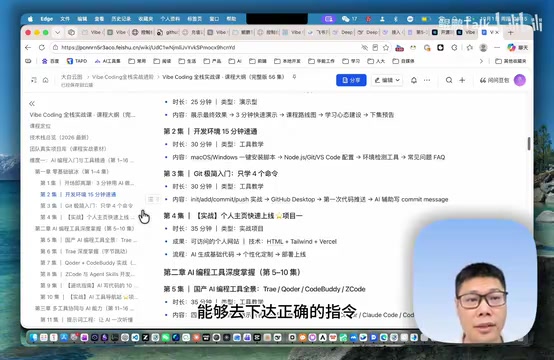
This course positions itself as bridging the gap between AI-generated demos and truly deployable, commercial products. Spanning 56 episodes, it covers frontend/backend (React/Vue/Node/Java), multi-platform apps (Flutter/HarmonyOS/Mini Programs), AI integrations (iFlytek Spark, MCP enterprise connectivity), and full deployment. Its methodology emphasizes human-led requirements with AI execution — not blind delegation. Open-source projects like Omnilabs and Kinning Work serve as capability proof, and a commercial scaffold with four-platform source code and payment integration is included (299 RMB with course, or one platform free). Best for non-technical users targeting rapid productization; depth is limited for those seeking strong programming fundamentals.
From Demo to Production: The Real Gap in AI-Assisted Programming
Most users who try AI coding tools can only produce a runnable demo — there's still a significant gap between that and a product that's truly deployable and commercially viable. This course, promoted by a Bilibili content creator, is built around one core promise: helping learners use AI to build complete, production-grade projects from scratch, rather than stopping at the demo stage.
One source of credibility the creator cites is real-world outcomes: a collaboration with Beijing No. 4 High School where first-year students built their own satisfying products within a week, along with non-technical participants from HR and product roles who completed genuinely usable projects. The key takeaway here is that the capability threshold for AI-assisted programming can be lowered through structured curriculum and process — but only if learners understand what they're actually doing.
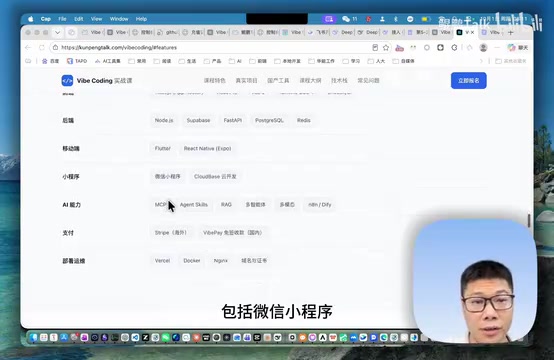
Tech Stack and Product Types Covered
The course is substantial — 56 episodes total — and is designed with a "skip around" structure to accommodate learners at different levels. In terms of content, it aims to cover a complete full-stack development path:
Frontend and Backend
The frontend covers mainstream frameworks like React and Vue; the backend includes Node and Java; and the database layer touches on tools like Redis. The creator emphasizes that learners won't be expected to dig into low-level internals — the goal is "can use it, can understand it, can debug it when something breaks." This positioning is beginner-friendly, though it does mean limited depth.
Multi-Platform and AI Capabilities
On the application side, the course covers Flutter, React, and WeChat Mini Programs, and integrates AI capabilities including iFlytek Spark (CPU Spark), intelligent agents, and multimodal features. Crucially, the course also covers the "last mile": domain setup, server configuration, deployment — addressing the common pain point of "I built it but can't get it online."
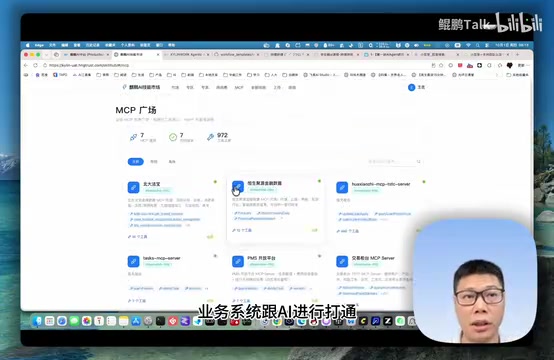
MCP (Model Context Protocol) is an open protocol proposed by Anthropic to standardize how large models connect with external tools and data sources. Think of MCP as the "USB port" of the AI world — once a business system is connected via the protocol, a large model can directly access enterprise systems like CRM, ERP, and OA without needing custom integration code for each one. When the course mentions an "MCP registry" and "using MCP to connect enterprise internal systems with AI," it's referring to an enterprise-grade AI integration layer built on this protocol. For learners looking to deploy AI capabilities in enterprise environments, understanding MCP's role helps evaluate the practical value of the enterprise modules in the course.
A Point Repeated Throughout: AI Is Not a Magic Wand
The course takes a noteworthy methodological stance: AI cannot replace your own understanding of what you need to build. The creator explicitly points out that many people assume "you can just let AI handle everything" — but if you don't know what you want, AI can't deliver it.
This leads to two practical principles:
- Controllability: Production-level work requires predictable outputs. Letting AI run wild produces uncontrollable results. The course therefore focuses on teaching learners how to give AI the right instructions — for example, explicitly telling AI to install environments like Node.js or Python.
- Debugging ability: Understanding development environment setup isn't about reinventing the wheel — it's so that when things break, you can diagnose the problem and know what to ask AI to fix.
This "human leads, AI executes" framework is far closer to engineering reality than simply hyping AI as fully autonomous.
Open-Source Projects as Proof of Capability
To demonstrate this isn't purely a "demo course," the creator points to a set of open-source projects — this is arguably the most substantive part of the content:
- Omnilabs (local AI toolkit): Integrates local LLM inference, local image generation, local video generation, local text-to-speech, and ASR meeting transcription — all in one tool.
- Kinning Work: A fully open-source alternative to WorkbuddyAd, featuring a complete backend, Skills management, and a Skills marketplace.
- Enterprise capabilities: The skills marketplace targets internal enterprise use, including expert management, MCP (for connecting internal business systems with AI), workflow orchestration, knowledge bases, MCP registry, and a large model gateway. The gateway provides content safety filtering, data desensitization to prevent leaks, and a unified key for accessing all internal enterprise systems.
- WebPureCode: A coding tool; plus an earlier open-sourced prompt engineering tool.
The value of open source here is verifiability — the code is public, and readers can check for themselves whether the capabilities are real. That's more convincing than verbal promises alone.
ASR (Automatic Speech Recognition) is the technology that converts human speech in audio into text, widely used for meeting transcription, subtitle generation, voice assistants, and more. The "ASR meeting transcription" in Omnilabs uses a locally running speech recognition model to automatically transcribe meeting recordings into text — avoiding the privacy risks of uploading audio to the cloud. "Local LLM inference" corresponds to the growing trend of on-device inference: using frameworks like Ollama or llama.cpp, users can run open-source models (such as LLaMA or Qwen) on their own computers or private servers, keeping data entirely local while still benefiting from AI capabilities — particularly valuable for enterprises or individuals with strict data security requirements.
Business Model and the Included Scaffold
The course's monetization structure is laid out fairly transparently. The core selling point is a "I will pay / webbase" scaffold project that includes a user-facing client, an operations dashboard, a mobile app, H5, and full payment integration — with native four-platform APP support (iOS, Android, HarmonyOS) and Mini Programs all included.
Pricing works as follows:
- The scaffold is sold separately for 599 RMB, or 299 RMB when purchased alongside the course.
- Even without purchasing, one platform's source code is given away for free — learners can choose from the user client, operations dashboard, mobile app, H5, or Mini Program.
- Purchasing the course unlocks the source code for all platforms.
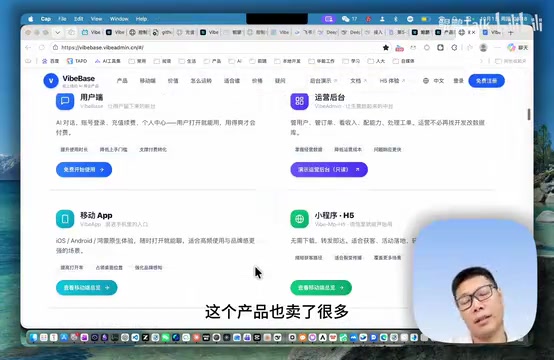
This scaffold has reportedly been used by many learners to build mature commercial products. The course will be released and refined incrementally, with a complete syllabus available on the official site (the webcoding section under the Kunpeng-related domain).
In software development, a "scaffold" refers to a pre-built project foundation that includes base configuration, common modules (such as user authentication, payment APIs, and permission management), and directory conventions — allowing developers to focus on business logic without rebuilding repetitive boilerplate. The value of a commercial scaffold is twofold: it saves significant repetitive labor, and it reduces the risk of shipping something with poor architecture. The reason the webbase scaffold is priced at 599 RMB as a standalone product is precisely because it includes high-effort modules like payment integration and multi-platform support (iOS/Android/HarmonyOS/Mini Program). For non-technical users, a scaffold essentially clears the "how do I set this up" hurdle for you, freeing your energy for "what do I want to build."
A Realistic Assessment of "Guaranteed Results" Courses
Courses that promise "100% guaranteed production-grade projects" have a genuine appeal: end-to-end coverage, ready-made scaffolds, and open-source projects as proof points make them genuinely attractive to non-technical users who want to quickly build commercial prototypes.
But two caveats are worth keeping in mind: first, the "guaranteed project" outcome relies heavily on the provided scaffold templates — true independent development ability still takes time to build; second, the course covers a broad tech stack but not in great depth, making it better suited for getting started and rapid prototyping than for learners pursuing a deep understanding of underlying principles. For people with a clear goal of using AI to accelerate product development, this is a pragmatic shortcut worth considering. For those looking to systematically build strong programming fundamentals, it should be supplemented with additional learning resources.
Related articles

Chain of Thought Isn't Just for AI: How Humans Can Use CoT to Improve Thinking Quality
Chain of Thought isn't just a prompt trick for large models. Starting from a Hacker News discussion, this article analyzes why CoT works for human thinking too, breaks down actionable ways to transfer it, and highlights the key differences between human CoT and machine CoT.
Cloudflare Teams Up with OpenAI: Closi…
Cloudflare Teams Up with OpenAI: Closing the Loop from Vulnerability Discovery to Defense with AI
Cloudflare uses OpenAI Daybreak to investigate security vulnerabilities and generate reviewable remediation plans, while developers use Codex to boost coding efficiency and quality.

Orca Multi-Agent Orchestration in Practice: A Guide to Parallel Collaboration with Claude and Codex
Orca is Stable AI's free open-source agent workbench supporting 34 agents like Claude Code and Codex in parallel. Learn its Git worktree isolation, multi-model orchestration, and mobile management.