Building Proxy Rotation Custom Tools for LangChain and CrewAI Agents

Agent failures at scale stem from IP blocking, not reasoning—proxy rotation must be built as a tool-layer capability.
This article argues that the primary cause of LangChain and CrewAI agent failures in production is often not insufficient LLM reasoning but proxy IPs blocked by target sites, causing 403/429 errors and self-correction death loops. The solution is encapsulating proxy rotation logic into agent tools, letting the transport layer handle identity negotiation. It presents a ProxyManager wrapper and @tool decorator implementation, emphasizes retry, exponential backoff, and hard-fail logic; in CrewAI, specialist tools can inherit BaseTool, with a three-tier proxy strategy matching task difficulty. Header rotation and jitter delays are essential for evading WAF detection. The conclusion: agent resilience comes from infrastructure-level visibility management, not prompt tuning.
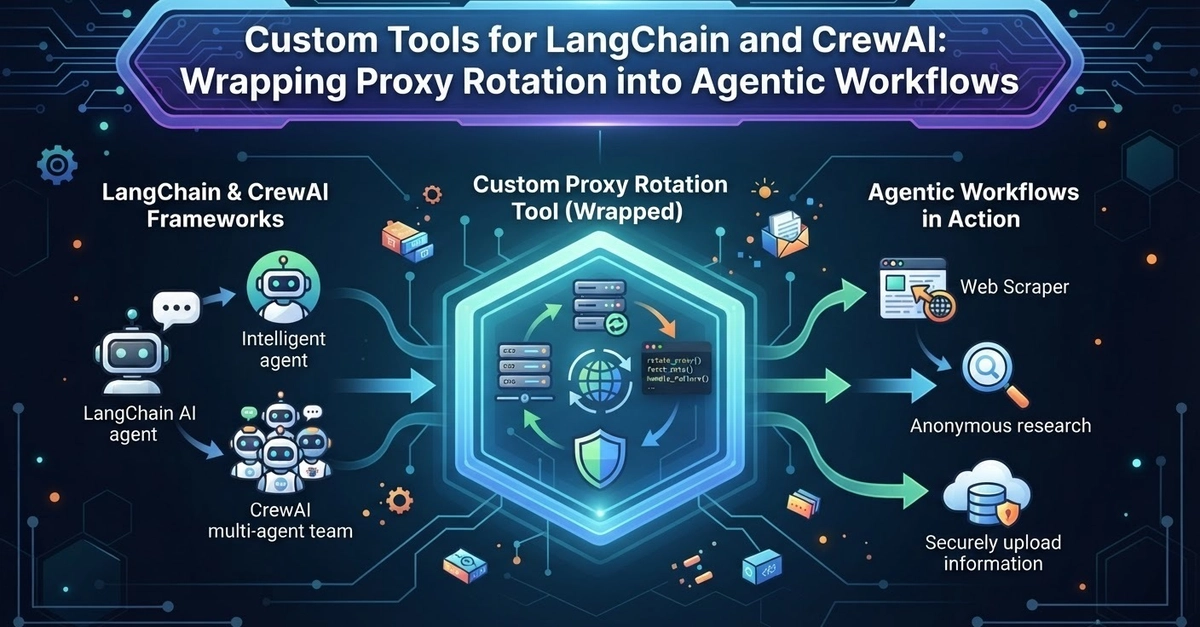
When building LangChain or CrewAI agents, the most overlooked failure cause isn't insufficient model reasoning—it's the agent's IP being blocked by target websites. When agents repeatedly hit 403 or 429 errors, the entire multi-agent system gets stuck in a self-correction death loop. Based on a technical analysis, this article explores how to encapsulate proxy rotation logic as a core tool for agents, giving them sustained access at the infrastructure level.
Why Do Agent Deployments Fail at Scale?
Rate Limiting and Anti-Scraping Mechanisms Form an Invisible Wall
According to the original analysis, many developers deploying CrewAI teams for deep market research encounter the "self-correction loop of death" phenomenon: the agent visits a URL and gets blocked, assumes it's a formatting error and retries, and eventually gets blacklisted. The root cause isn't the LLM's reasoning ability—it's the lack of infrastructure-aware tools.
Standard tools like DuckDuckGoSearchRun or Selenium wrappers are too naive for production environments. They treat the internet as a friendly library rather than a heavily fortified fortress. To make agents resilient, proxy rotation logic must be encapsulated directly into the functions agents call, letting the tool handle identity negotiation at the transport layer so the agent itself doesn't have to "worry" about being blocked.
The Essential Difference Between HTTP 429 and 403: 429 (Too Many Requests) is the server explicitly telling you "you're sending too fast," usually accompanied by a Retry-After header—it's a rate-limiting signal. 403 (Forbidden) means access is directly denied, possibly because the IP is blacklisted, the User-Agent is flagged as a crawler, or the request lacks necessary authentication. For agents, both responses mean "retrying the same request" cannot succeed—but standard tools often throw them as recoverable exceptions, causing the LLM to retry repeatedly and ultimately trigger stricter blocking. Intercepting both at the tool layer and converting them into structured states (like blocked, rate_limited) is the prerequisite for agents to make correct decisions.
The Difference Between Residential and Datacenter Proxies: Datacenter proxies come from cloud provider IP ranges (like AWS, DigitalOcean). They're fast and cheap, but their IP ranges are publicly traceable, and mainstream anti-scraping services flag them immediately. Residential proxies are assigned by real ISPs to home users, with traffic passing through real devices, making them harder to identify as bots. Mobile proxies come from cellular networks, where IPs are shared among many real users, making blocking extremely costly. These three aren't a matter of "better or worse"—they correspond to different detection intensities of target sites.
Limitations of Standard Scraping Tools
The original article points out that HTTP 429 (Too Many Requests) and 403 (Forbidden) shouldn't be handled by the agent's reasoning module but should be absorbed at the tool layer. The value of custom tools lies in abstracting these complexities, letting agents focus on decision-making rather than network troubleshooting.
Core Architecture of Proxy-Aware Tools
Structure of the ProxyRotator Wrapper
A mature proxy management tool shouldn't just cycle through an IP list. According to the original, it needs to manage state, handle retries with exponential backoff, and select the appropriate proxy type (residential or datacenter) based on the target domain. The original provides an example of a ProxyManager class, whose core logic includes: maintaining a proxy list and returning http and https proxy configurations by index rotation.
The corresponding LangChain tool uses the @tool decorator to define a resilient_web_scraper function, which internally contains a three-attempt loop: each time, get a new proxy from the manager, make a request, continue to the next attempt if it hits a 403, and continue if an exception occurs. If all attempts fail, it returns a clear error message: "All proxy nodes are currently rate-limited by the target host."
Why Retry and Backoff Strategies Are Needed
The original emphasizes that the tool shouldn't trap the agent in infinite retries. By limiting attempts and returning clear states, the agent can pivot to other strategies rather than spinning its wheels in failure.
Exponential Backoff is a retry interval strategy: double the wait time after each failure (e.g., 1s, 2s, 4s, 8s), with optional random jitter to avoid synchronized retries from multiple clients causing a "thundering herd." In proxy rotation scenarios, backoff must also coordinate with IP switching—waiting without changing IP is meaningless against a target site that has already banned that IP; switching IP without waiting may still be identified because the request frequency pattern still matches crawler characteristics. The ideal approach: switch to a new proxy on each retry while elongating intervals along an exponential curve, and set a maximum attempt count (typically 3-5) before hard-failing. This gives the target site breathing room and prevents the agent from entering an infinite loop. Returning a clear error message (like "all proxy nodes are currently rate-limited by the target host") is more valuable than throwing raw exceptions, because it lets the LLM treat the failure as an unrecoverable state, switching strategies rather than retrying.
How Does Proxy Rotation Affect Agent Reasoning Behavior?
Tool Tiering Changes Task Delegation Patterns
In CrewAI, if a manager agent knows which tools are "heavy," it can delegate tasks more effectively. According to the original analysis, when a researcher agent fails with standard tools, the manager can reassign the task to a "stealth agent" equipped with residential proxy tools. This creates access tiers within the agent cluster.
The "Stealth Scale" Matrix: Three-Tier Proxy Strategy
The original proposes a framework for classifying tools by target difficulty:
- Tier 1: Datacenter proxies. Fast and cheap, but easily detected. Suitable for open APIs and non-commercial blogs.
- Tier 2: Rotating residential proxies. Slower and more expensive, but appearing as real home users. Suitable for LinkedIn, Amazon, or Google search results.
- Tier 3: Mobile proxies. The gold standard. Nearly impossible to block unless thousands of real users are blocked. The agent's "last resort" tool.
This tiering strategy helps developers balance cost and success rate.
The "Endpoint" Model of Proxy Providers: The traditional approach is to maintain your own proxy IP list and rotate calls, but IP pools require continuous validation, cleaning, and replenishment—extremely high operational overhead. Modern proxy providers (like Bright Data, Oxylabs, Smartproxy) offer an "endpoint" model—developers only connect to a fixed host:port, and the provider handles IP rotation, geolocation, and session persistence internally. Some endpoints also support "sticky sessions," maintaining the same exit IP for a period, useful for scenarios requiring login state or shopping cart continuity. For agent tools, the endpoint model dramatically reduces implementation complexity: the tool just reads a proxy URL from environment variables, no need to understand the underlying IP pool. When choosing, focus on three metrics: rotation granularity (per-request or per-session), geographic coverage (whether city-level exits can be specified), and concurrency limits.
Integration with CrewAI: The Specialist Tool Approach
Creating a Switchable-Identity ProxyTool
In CrewAI, tools are the agent's "hands." The original shows how to create an AdvancedResearchTool class by inheriting BaseTool, named "Deep Web Research," described as "exhaustive search tool that bypasses regional blocks." In the _run method, the internal logic rotates geo-specific proxies, letting the agent view the web from a London, Tokyo, or New York perspective.
The Importance of Context Injection
The original suggests telling the agent in the tool's docstring why it should use this tool, e.g., "use this tool for sites with strict anti-scraping policies." This helps the agent make the right choice during the planning phase.
Step-by-Step Checklist for Implementing Proxy Rotation
According to the original, when migrating agents from local experiments to production-grade automation, follow these steps:
- Identify friction points: Monitor agent logs for
ConnectionResetErroror empty strings returned by search tools—these are usually signals of invisible blocking. - Choose a provider: Prioritize providers offering "endpoints" (single IP/port with internal rotation) over managing tens of thousands of IPs yourself.
- Encapsulate tools: Use the
@tooldecorator in LangChain to create custom functions. - Implement hard-fail logic: Ensure tools return clear messages when blocked, letting the agent try different strategies rather than looping infinitely.
- Context injection: Explain usage scenarios in the docstring.
The Subtle Art of Making Agent Behavior "Human-like"
Header Rotation and Request Intervals
The original points out that proxy rotation is only half the battle. If the agent switches to a new IP every 2 seconds but uses the exact same User-Agent string or lacks a Referer header, it will still be caught. Custom tools should also rotate request headers. The original summarizes with a formula: Header_{Rotation} + Proxy_{Rotation} = Agent_{Persistence}.
Detection Dimensions of WAFs (Web Application Firewalls): Modern WAFs (like Cloudflare, Akamai, AWS WAF) don't just look at IP—they comprehensively evaluate TLS fingerprints (JA3/JA4), HTTP/2 frame ordering, the order and consistency of header fields, cookie behavior, and frontend signals like mouse/scroll. Rotating only IPs while keeping the same User-Agent and header set creates a stable "fingerprint" on the WAF side; once that fingerprint is flagged, all IPs using it are implicated. Therefore, proxy rotation must be synchronized with header rotation: randomly select from a set of real browser User-Agents on each request, and pair them with consistent Accept, Accept-Language, Referer, Sec-Fetch-* headers (e.g., a mobile UA should pair with mobile Accept-Language and viewport-related Sec-CH-UA values). The "identity consistency" of headers and IP matters more than sheer quantity.
Jitter Delays to Simulate Human Browsing
Injecting random delays (jitter) between tool calls can simulate human browsing patterns, reducing the "agent signature" that WAFs (Web Application Firewalls) look for.
Future Outlook: The Evolution of Agent Infrastructure
We're moving from a world where agents are just prompts to one where agents are complex stacks of logic, identity management, and network navigation. Encapsulating proxy rotation as custom tools for LangChain and CrewAI isn't a technical "hack"—it's a fundamental requirement for building autonomous systems that can interact with the real internet. Without it, agents are confined to sandboxes; with it, agents hold the keys to the kingdom.
Next time an agent task fails, don't just tweak the prompt. Check the IP. The problem may not be in the agent's brain but in its visibility.
One-line Summary
Agent failures at scale are usually due to IP blocking rather than reasoning ability—proxy rotation must be encapsulated as a tool-layer capability.
Paragraph Summary
This article points out that the primary cause of LangChain and CrewAI agent failures in production is often not insufficient LLM reasoning but proxy IPs being blocked by target websites, triggering 403/429 errors and self-correction death loops. The solution is to encapsulate proxy rotation logic into the tools agents call, letting the tool handle identity negotiation at the transport layer. The article provides implementation ideas for a ProxyManager wrapper and @tool decorator, emphasizing the importance of retries, exponential backoff, and hard-fail logic; in CrewAI, specialist tools can be created by inheriting BaseTool, with a three-tier proxy strategy (datacenter, residential, mobile) matching task difficulty. Additionally, header rotation and jitter delays are necessary supplements for evading WAF detection. The ultimate conclusion: agent resilience comes from infrastructure-level visibility management, not prompt tuning.
Related articles

How Big Can Stars Really Get? The Physical Limits of the Largest Stars
Red supergiants are the largest stars by volume, with radii up to 2,000 times the Sun, engulfing the inner solar system. But there is no precise upper limit on stellar size—models predict up to 15,000 solar radii. The most massive blue stars are far smaller than red supergiants—biggest and heaviest are two different things.

Apple HomeView Smart Display Full Feature Breakdown: Wall-Mount or Desktop, $299
Apple launches HomeView, a $299 smart display with wall-mount and desktop options, 12MP camera for facial recognition, smart home control, music playback, and recipe step-by-step cooking. Full breakdown of watch faces, apps, privacy, and cooking integration.

Where Did the Promised New Studio Go? Craft Computing Answers After Five Years
Craft Computing's host responds to viewer questions: the new studio promised five years ago was shelved as construction costs soared from $30,000 to $75,000, and was replaced by a 168-square-foot garage conversion.